The World of Panem
Interpreting Society, Geography, and Characters of the Hunger Games
The Goose and the Common: An Unexpected nod to (New) England in Sunrise on the Reaping
Warning: Spoilers Ahead for Sunrise on the Reaping
As early as page 5 in Sunrise, we learn that Collins seems to maintain some kind of fascination with geese. Haymitch’s “girl,” Lenore Dove, treats about a dozen of them (lots of “dozens” show up in this novel) as pets, leading them around the famed Meadow and thereabouts. They only trust Lenore Dove, as they tend to hiss at Haymitch much like Prim’s cat, Buttercup, who hissed at Katniss — that is, until she fed him. In this case the parallel continues as Haymitch regularly brings some cracked corn from Hattie to appease Lenore Dove’s waddling friends. Of course, this new novel finally explains the bizarre reference to Haymitch raising geese in the Epilogue of Mockingjay. He is remembering his one true love who was stolen from his life much too soon.
Chapter one has barely opened when Collins offers her first song of the novel, which goes unnamed within the narrative. Haymitch arrives at the Meadow to find Lenore Dove “serenading a dozen geese grazing on the grass, her voice as soft and haunting as moonlight” (8). The first verse of the poem-turned-ballad reads:
- They hang the man and flog the woman / Who steals the goose from off the common, / Yet let the greater villain loose / That steals the common from the Goose
With this first verse alone we can see clearly where Collins is headed. As Lenore Dove sings additional verses in between Haymitch’s reflections on family relationships, he tells us that this is “not a song her uncles let her play at the mayor’s house,” or even when the three of them perform around District 12 (9). “Too rebellious,” he explains bluntly, and we can see why. Perhaps the clearest reference with this first verse is its symbolism with the oppressive Capitol which continues to punish the districts for a war ended long ago. The verse implies — quite accurately — that the Capitol maintains the authority to strip all rights and humanity away from its district subjects, while they are the ones who are punished for breaking the Capitol’s draconian rules. What we have here, it turns out, is another protest song, the likes of which we saw with “The Hanging Tree,” featured in both the original series and more recently in Ballad. In one sense, Lenore Dove’s protest song is even more direct than that of Lucy Gray. The last two lines of this one say prophetically, “And geese will still a common lack / Till they go and steal it back.”
It turns out this is not one of Collins’ original poems or songs, but a well-placed throwback to teach us some relevant history once again. She explains in the book’s Acknowledgements that “The Goose and the Common was written by an unknown author in the 17th or 18th century.” This is all she says about it, though this single sentence provides plenty of clues to further chase down its backstory.
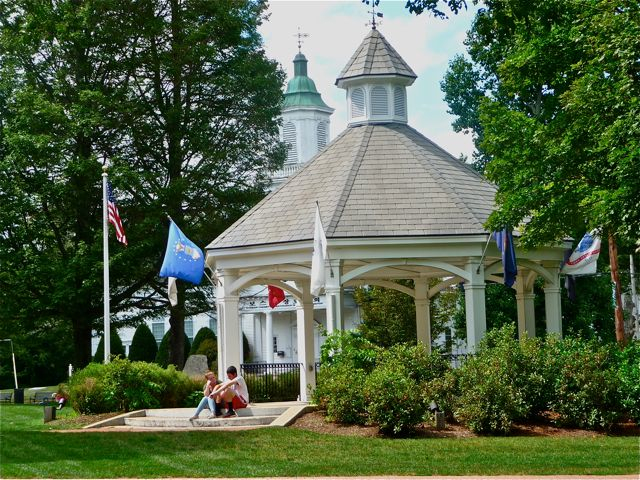
Funny thing, those not from New England (or old England for that matter) may be puzzled over the strange use of the word “common” in both the poem and its title. Is “common” an adjective or a noun? Those with some knowledge of colonial town settlement in New England, from Maine to Connecticut and Rhode Island, will likely pick up this reference right away. Town settlements that followed the lead of the Massachusetts Bay Colony often included a shared public space at or near the center of the village. Known simply as a “common,” this local quirk of regional geography was designed into their otherwise medieval-era town plans as a place on which all farmers could share for the grazing of their cattle or for related uses. The most famous of these, of course, is Boston Common, now one of the city’s cherished public parks. Lenore Dove is nice enough to explain this to our protagonist, once telling him that “the common was land anyone could use.” It is more than fitting that she grazes her geese in the Meadow which, for purposes of this novel, is now re-interpreted as a District 12 public space in the form of an English-style common. And true to the poem, the local Peacekeepers occasionally chase off her geese for no apparent reason other than that they could do so.
By the end of the colonial era, most commons in New England towns were gradually transitioned to public parks, sometimes now referred to bucolically as the “town green” with picturesque gazebos and bandstands and all. Their original agricultural intent was rendered obsolete when New Englanders rebelled en masse — not from an oppressive imperialist nation, but rather from the unforgiving rocky soil that prevented decent farming. Many farm families picked up and moved westward into today’s upper Midwest during the 19th century, not long after that region’s indigenous peoples had been driven off. But I digress…
Despite the excitement some readers like myself enjoyed when finding this New England tidbit in Collins’ novel (I myself am from a colonial-era town in CT), the story behind this opening poem can be traced even further back to England itself. “The Goose and the Common” is largely associated with the English enclosure movement, which involved the intentional closing off of public spaces to convert them into private property. As Oleg Komlik (2018, citing Boyle 2003) writes in the article linked above, “Like most of the criticisms of the enclosure movement, the poem depicts a world of rapacious, state-aided privatization, a conversion into private property of something that had formerly been common property or, perhaps, had been outside of the property system altogether.”
Collins therefore creatively appropriates the poem for her own use as a blatant metaphor for the Capitol’s treatment of the districts, at the same time cleverly tying in this historical protest movement to her novel’s theme of Lenore Dove’s geese. We further learn that even Haymitch is concerned about his girlfriend’s rebellious ways. When mentioning how the Peacekeepers chase her and the geese out of the Meadow for no apparent reason, Lenore Dove tells Haymitch “that’s just a teaspoon of trouble in a river of wrong” (10). He adds, “She worries me, and I’m an Abernathy.” He explains elsewhere that the Abernathys were notorious for their rebellious ways. This foreshadowing sets up Lenore Dove’s character as an outward protester herself against the “river of wrong” that the Capitol imposes on the districts. The rest of this latest prequel continues to feature Haymitch’s own character’s journey from “implicit submission” to “rascally rebel” (my words). He is encouraged in no small part by the courageous Lenore Dove, determined as she is to see that one day the sun will no longer rise on the reaping.

Image Sources: Conspiracy-of-kindness.com (poem graphic above), visitingnewengland.com (feature image of Hopkinton town common, starting place of the Boston Marathon)
Meet the Author
 Tom Paradis

This site inspired by a first-year seminar on the Hunger Games at Butler University.

 The World of Panem