The World of Panem
Interpreting Society, Geography, and Characters of the Hunger Games
Announcing a New Book on All Things “Ballad!”

I’m thrilled to announce my second book interpreting the Hunger Games saga, this one focused especially on the “Ballad” film and its connections to the prequel and original series! Titled Behind the Ballads: A Tribute to the People, Places, and Music of Songbirds and Snakes, this book takes readers on a tour of the numerous layers of meaning and backstories that underlie both the film and prequel. Now available on Amazon (with a sample) and numerous global retailers. Thank you for your consideration, and enjoy the show!
From the Back Cover: The 2023 premier of Hunger Games: The Ballad of Songbirds and Snakes introduced global audiences to the songster Lucy Gray Baird and her breathtaking performances. Based on Suzanne Collins’ prequel, the dystopian saga’s fifth film merges two unlikely worlds—namely Appalachia’s distinctive musical traditions with Germany’s postwar reconstruction era. These worlds collide in the Capitol’s Tenth Hunger Games and the dubious relationship between Lucy Gray and villain-to-be, Coriolanus Snow. This book explores the film as a period piece, including real-world geography, history, and meanings behind Appalachia’s District 12 and an emerging fascist Panem. We further delve into the principal filming locations, music production, casting decisions, character philosophies, comparisons with the novel, and of course the intricate backstories to those unforgettable ballads.
Year of Ballad! A Guide to Media Articles and News
Production, Filming, and Casting for Hunger Games: The Ballad of Songbirds and Snakes (Release Date: Nov. 17, 2023)
The following select collection of online sources provides a go-to place for “all things Ballad,” including production, filming locations, casting, and related information from a variety of news, media, and fan sites. This collection was screened and recommended by students within our First-Year Seminar Class, titled Unpacking the Hunger Games at Butler University, Indianapolis. We hope you find these sources enlightening about the highly anticipated feature film! (More will be added as available.)
Official Trailers and Reveals
- Official Trailer! (YouTube), released April 27, 2023
- Official Teaser Trailer (YouTube)
- Lionsgate Prequel Reveal (YouTube)
- Lionsgate Publicity Page, Including Reveal (Lionsgate)
Overviews and Collections
- IMDb Movie Information Page. Scroll down for primary cast members, links to additional cast information and backgrounds, production information, and much more.
- The Hunger Games Wiki: The Ballad of Songbirds and Snakes (film). Includes a wide range of information, organized through its Table of Contents, including synopsis, plot, development, cast, gallery, and more.
- Dynatic Films: Video Overview of the Prequel Story and Film (YouTube, 9 min). A concise and informed introduction to the Ballad film storyline, cast members, and what to expect. Includes an overview of the original Hunger Games trilogy at the beginning.
- Panem Propaganda: The Ballad Prequel. An impressive collection of articles, photo galleries, and discussions focused on the filming and production of the Ballad in Europe. See the “Latest News” articles on the left for numerous specialized topics.
ON SET: Filming Locations and Images
- A Behind-The-Scenes Tour of The Ballad of Songbirds and Snakes Set (YouTube, Rachel Zegler TikTok video)
- Behind-The-Scenes Set Photos of the Hunger Games Prequel (Panem Propaganda, Oct 10, 2022)
- Propaganda Posters, The Hanging Tree, Peacekeeper Vehicles, Extras, and More! Inside The Hunger Games [Prequel] Set in Germany and Poland (Panem Propaganda, Sept 2, 2022)
- The Hunger Games [Prequel] First-look Photos Show Child Actors Running Past Dead Bodies on a Battlefield in Berlin (Daily Mail, Oct 25, 2022)
- Hunger Games: Extras Wanted for the Prequel Shoot (News in Germany, May 2022)
News Releases and Articles
(Most recent at the top)
- Rachel Zegler Wraps Filming on Hunger Games Prequel, The Ballad of Songbirds and Snakes (Collider, Nov 5, 2022)
- Everything We Know So Far about Hunger Games Prequel, The Ballad of Songbirds and Snakes (Entertainment, Oct 23, 2022)
- The Hunger Games Prequel Cast: Every Character Cast, So Far (Nerdist, Sept 16, 2022)
- Hunger Games: The Ballad of Songbirds & Snakes Rounds Out Cast with Fionnula Flanagan, 10 Others (Deadline, Sept 16, 2022)
- Who’s Who in The Hunger Games: The Ballad of Songbirds and Snakes’ Movie Cast (The Hollywood Reporter, Sept 3, 2022)
- The Hunger Games:The Ballad of Songbirds and Snakes: Exclusive First Look (Vanity Fair, Aug 16, 2022)
- What We Know about the Upcoming Hunger Games Prequel Movie (Insider, Aug 16, 2022)
- West Side Story breakout Rachel Zegler to star in Hunger Games prequel. (Entertainment, May 31, 2022)
Film Analysis and Speculation
- Ballad of Songbirds & Snakes Movie Will Have to Change the Book (Sorry) (ScreenRant, Aug 7, 2022)
- Oh, The Hunger Games Prequel’s First Look is Not A Good Start (ScreenRant, Aug 17, 2022)
Recent Published Books Interpreting The Ballad:
A Place Called District 12: Appalachian Geography and Music in the Hunger Games (by Thomas Paradis, McFarland & Co., 2022)
Songbirds, Snakes & Sacrifice: Collins’ Prequel References and Philosophies Explained (by Valerie E. Frankel, LitCrit Press, 2020)

Announcing a New Book on the Hunger Games Saga (Including the Prequel)
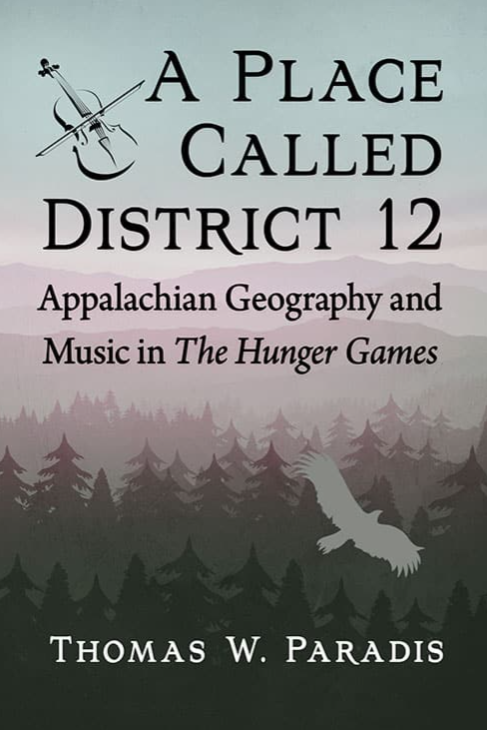
A Place Called District 12: Appalachian Geography and Music in the Hunger Games, by Thomas Paradis

For highlights and background, please see an Interview with author Tom Paradis about his new book, A Place Called District 12. Provided by Religious Studies Professor, James McGrath, Butler University (June 2022)
Overview of the Book (Click image or title above for McFarland Release Announcement)
In creating her post-apocalyptic world of the Hunger Games, author Suzanne Collins pulls from a wide array of real-world history and geography lurking just beneath her captivating story line. Now within her recent prequel, The Ballad of Songbirds and Snakes, Collins pulls us ever deeper into Appalachia’s extraordinary cultural diversity and its storied musical traditions. Here geographer Thomas W. Paradis invites you on his own tour of human geography, history, and culture that collectively provide the foundation for the saga’s novels and films.
Written for fans, educators, and students of any age, A Place Called District 12 provides insightful background on scenes from the novels and films from the original series and recent prequel. Some highlights include the following topics:
- A geographical revision of District 12’s location within the Appalachian Mountains.
- Historical geography, architecture, and urban design of District 12, the Capitol, the Corso, the president’s mansion, the Victors Village, and the Cornucopias, including segments about major filming locations.
- The historical development of Appalachian balladry, mountain string bands, early country music, and bluegrass, all of which are represented throughout the saga and District 12’s own bluegrass band, the Covey.
- Interpretations and meanings behind numerous key songs within the saga, including the “Valley Song,” “The Hanging Tree,” and “Keep on the Sunny Side”.
- The social history and working conditions of coal-mining communities on which Katniss’ home town is largely inspired.
- Katniss’ attachment to home, and how her personal identity is shaped by her multiple definitions of the home place.
Table of Contents
Acknowledgments
Preface
Introduction
PART 1: Setting the Geographic Stage
- District 12 of Central Appalachia
- Places and Spaces of District 12
- Katniss at Home
- An Appalachian Melting Pot
- Small Town in Panem
- Portraying the Seam
- Designing a Capital City
- Panem as World System
PART 2: The Music of District 12
- The Ballads of Appalachia
- Mountain String Bands
- District 12 Goes Country
- Bluegrass and the Covey
- Building the Bluegrass Sound
- A National Audience
- Maude Ivory the Songbird
Chapter Notes
Bibliography
Index

Burdock Everdeen’s Family Lineage: Who Is His Mother?
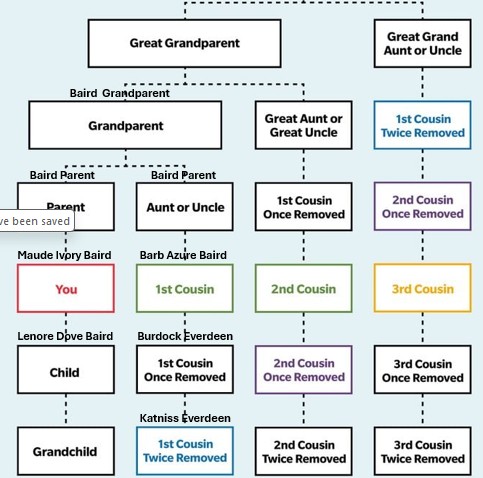
Another ongoing mystery from Sunrise involves Burdock’s own parents and, by association, his Covey’s family lineage. Collins’ narrative through Haymitch purposely hides this information as she often does. However, important clues abound, both overt and subtle. Early on, a teenage Burdock sees Lenore Dove up in the apple tree and says, “Hey, cuz, you allowed out here alone?” (SOR 7) Haymitch then tells us rather cryptically that Lenore Dove “wasn’t one of Burdock Everdeen’s cousins, but I knew he had some distant ones on his ma’s side.” Perhaps few lines in Sunrise have thrown off the fandom to the extent of this one, as this is where the popular assumption that Maude Ivory is Katniss’ paternal grandmother goes to die. There is no shame in buying hook, line, and sinker into this headcanon; I, too, had argued strongly about this probability given the wealth of evidence (Paradis). Instead, Maude Ivory is all but certainly Lenore Dove’s mother who died in childbirth (see this post), while Burdock is only a distant cousin according to Haymitch. It is important to keep in mind that Haymitch is an unreliable narrator who is not necessarily always accurate or fully knowledgeable. Still, these are carefully chosen words from Collins, providing us with vital clues as to Katniss’ true family lineage through Burdock and the Covey (see this post for a full District 12 Family Tree).
What we do know from book canon—as quoted above—is that Lenore Dove and Burdock Everdeen are not immediate first cousins, which makes sense given the known members of the Covey family from the time of Ballad. Aside from Clerk Carmine and Billy Taupe, there are no further sibling pairs in the Covey. Rather, the Covey Bairds are all first cousins themselves, as far as we know, namely Lucy Gray, Maude Ivory, and Barb Azure. Their respective parents had served as uncles and aunts, if not parents, to the three Baird cousins before being killed. This all lends more credibility to the notion that Burdock could indeed be Barb Azure’s son, as he would still technically be a “distant cousin” with Lenore Dove. While Collins had coded Barb Azure as LGBTQ+ in Ballad, it is certainly possible for her to raise a family of her own. Moreover, both her character and gravestone are conspicuously missing from Sunrise.
Given the probable Covey family tree depicted below, Burdock would be Lenore Dove’s “first cousin once removed” if Barb Azure is his mother. This still seems too close to be “distant cousins,” but Collins has not provided any additional knowledge about other Covey members waiting in the wings. The “once removed” title describes the relationship between the children of first cousins, which would apply in this case to the respective children of Maude Ivory and Barb Azure. They are not technically “second cousins” because they still share the same direct lineage from the grandparent of Maude Ivory, Barb Azure, and Lucy Gray. Now one generation later, however, Lenore Dove and Burdock are “once removed” because they share the same great-grandparent. At this point we know of no other Covey family members who had been involuntarily corralled in District 12 by Peacekeepers during wartime. Therefore, while Burdock could be a more distant “second cousin” as indicated below, it is highly unlikely that the three Covey girls already had other distant relatives in 12 that we don’t know about. By process of elimination, then, Burdock is logically Lenore Dove’s first cousin once removed, while Katniss Everdeen would be first cousin twice removed from any child that Lenore Dove (and Haymitch) might have had.
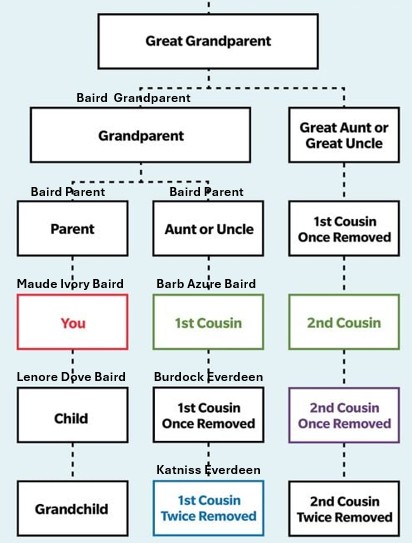
Whether Barb Azure turns out to be Burdock’s mother or not, Burdock is still related to the Covey. By association this means that Katniss is Covey as well, albeit with a diluted bloodline. Still, Katniss becomes culturally enmeshed in Covey traditions, lore, musical knowledge, and especially the “wildcrafting” and backwoods survival skills passed down by her determined father. She further inherits the musical legacy of Lucy Gray and Maude Ivory. I have previously made the case that Burdock was on a serious mission to train his older daughter to be self-sufficient in case anything should ever happen to him. And job well done. Essentially Katniss was raised in the woods, learning to swim at the lake before she could talk, navigating the Hob to learn how to trade, and most vitally, learning an array of life-saving, plant gathering, and hunting skills that would prove absolutely essential for her surviving both Games and the rebellion itself. For this reason, Burdock Everdeen could easily be recognized as the most influential deceased character of the original trilogy. (Paradis, 49-50)
Reference: Paradis, Thomas. 2022. A Place Called District 12: Appalachian Geography and Music in the Hunger Games. McFarland Press.
Graphic Source: adapted from Hochwald, L. “What is a Second Cousin vs. a Second Cousin Once Removed?” Reader’s Digest, 23 July, 2024.
Down the Mutt Berm: Sunrise Parallels with Alice in Wonderland

by Riley Turner, guest author and Anthropology student at Butler University
Suzanne Collins’ second prequel to the Hunger Games trilogy may be the boldest title in the series yet. Haymitch’s story takes readers for a wild ride with many twists and turns, including its vibrant, 70s-inspired Capitol, its enchanting, yet deadly 50th Games arena, its wide cast of characters that boasts both familiar and unfamiliar faces, and its insane world-building. With how dark, gory, and gut wrenching this dystopian novel can get, it therefore may seem farfetched to compare it to Lewis Carroll’s Alice’s Adventures in Wonderland (1865). After all, the latter is a fantastical tale that was originally meant for children, while the former is primarily aimed at young adults and teenagers. However, taking a closer look at Haymitch’s journey brings up many parallels that cannot be overlooked. Whether these were intentional by Suzanne Collins or not, they are begging to be brought to the attention of the fan base. With that being said, let’s dive into the rabbit hole, or mutt berm, of parallels that exist between these two stories.
To begin, let’s talk about one of Alice in Wonderland’s most well-known plot points: Alice following the white rabbit and falling down the rabbit hole into Wonderland. This marks the start of Alice’s wacky adventure, and the ensuing events of the book would not have transpired if this didn’t happen. While Haymitch doesn’t have this exact experience in Sunrise, many parts of his journey are surprisingly similar. For one thing, rabbits are also significant to Haymitch, albeit dove-colored ones. Just like Alice encounters the white rabbit multiple times throughout her story, Haymitch comes upon the dove-colored rabbits numerous times. He sees one when he first gets into the arena (SOR 211), when he is thinking about drinking from the stream (SOR 217), when he wakes up in the bushes (SOR 223), when he is stuck in the hedge maze (SOR 266), and when he is in the creepy mutt lab after the Games (SOR 329). And most of his encounters with them are quite influential to his story. Seeing the first one at the beginning of the Games gets him to focus, and seeing one die from drinking the stream water alerts him of the poisonous arena. Likewise, the one in the bushes shows him the food in his pack is safe to eat, and another one helps him escape the hedge maze. Finally, the rabbit in the mutt lab makes him realize just how awful of a situation he is in. These rabbits are essential to Haymitch, just as the white rabbit is to Alice.
Then, when looking at the rabbit hole that brings Alice into Wonderland, there are two things that are similar in Sunrise. First is the mutt berm, which Haymitch goes down in order to break the arena (SOR 247). Besides also being an unusual hole in the ground, the mutt berm is an important part in the progression of Haymitch’s story, just as the rabbit hole is to Alice’s. Without it, he would not have been able to carry out the carefully-crafted plan to break the arena. The rest of the novel’s events as we know them likely would have been different if Haymitch had not gone down this hole, just like the story of Alice in Wonderland, had Alice not gone down the rabbit hole.

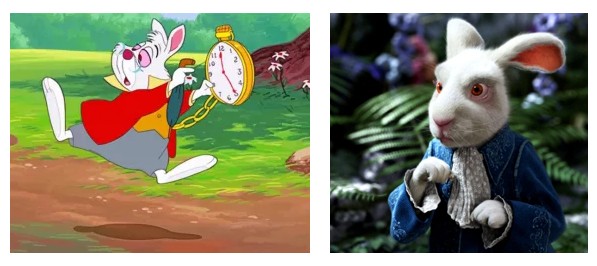
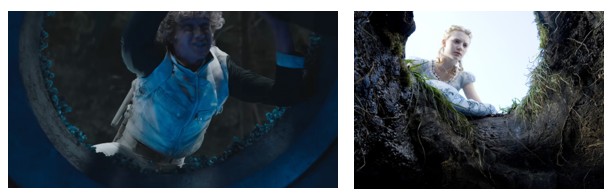
As a side note, this shot of Haymitch opening the mutt berm (below) in the Sunrise teaser trailer looks similar to Alice looking down the rabbit hole in Tim Burton’s live action Alice in Wonderland (2010) movie:
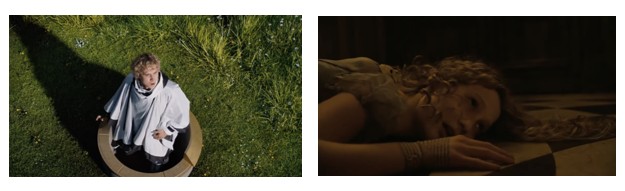
The other Sunrise comparison to the rabbit hole consists of the tribute podium and elevator (SOR 210). It may be bringing Haymitch up into the arena instead of down, but it functions similarly to the rabbit hole in Alice in Wonderland. Both are bringing the protagonist from a familiar world to an unfamiliar one, and returning to the familiar world isn’t an option. Our respective protagonists, Haymitch and Alice, are stuck in strange and mysterious places, and they must use their wits to navigate through them. Haymitch has broken off from the Newcomers alliance at this point as well, making him essentially as alone and friendless in the arena as Alice initially is in Wonderland. Not to mention that in the official Sunrise movie trailer, one of the last shots we see is of Haymitch looking stunned as he rises into the breathtaking arena on his podium, just as Alice is when she falls down the rabbit hole into Wonderland (below).
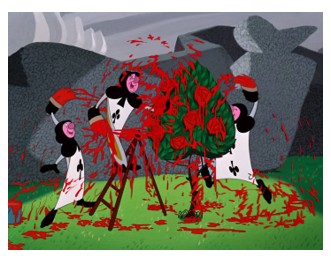
Another setting-related parallel worth discussing is the hedge maze. In Haymitch’s story, there’s one at the very edge of the arena (SOR 264), and in the Disney animated Alice in Wonderland (1951) specifically, the Queen of Hearts’ garden is a labyrinth-like hedge maze. Both are clearly very confusing environments in which the protagonist can easily get lost, but this isn’t the only similarity between them. In Haymitch’s maze, what look like holly berries on the hedge leaves are actually ladybug mutts that will attach themselves to a tribute’s skin, inflate, and explode with their blood (SOR 280). These ladybugs, along with the hedge maze and arena as a whole, were artificially created by the almighty Capitol for the 50th Hunger Games. Somewhat similarly, in the Alice in Wonderland movie, we see three of the queen’s card soldiers painting white roses in her garden red, after accidentally planting white roses instead of red ones. The red roses in the Alice in Wonderland hedge garden are therefore also artificial creations not unlike Haymitch’s environment in Sunrise.

Also worth noting is, within the Alice in Wonderland movie, the Queen of Hearts eventually finds out that those three card soldiers were painting white roses red to cover up their mistake. So, she says, “Off with their heads!” and sends the three of them to be killed for their incompetence. Ironically enough, something similar also happens in Haymitch’s story: three young Gamemakers who, mind you were working for the Capitol, are sent into the arena with armed tributes roaming about in order to fix a mutt berm (coincidentally also covered in red flowers). Whether this was a punishment or just the Capitol viewing its workers as expendable is unknown, but these three also do not make it out of their situation alive. Maysilee and Maritte kill them, with two even dying from head injuries (SOR 297-298). Just like those three card soldiers in the Alice in Wonderland movie, the three Gamemakers in Sunrise die trying to fix something to appease a higher power (the Queen of Hearts and the Capitol, respectfully).
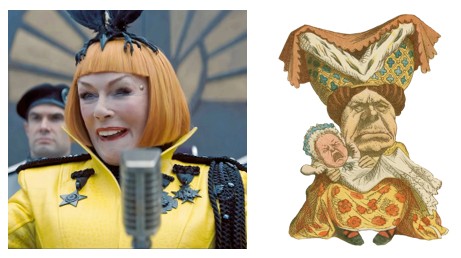
Transitioning now to character parallels, the first noteworthy one is between Drusilla Sickle and a character whose main appearance is in the Alice in Wonderland book: the Duchess. First of all, both characters are described as ugly, older women who are incredibly rude and dismissive of their stories’ respective protagonists. The Duchess is very rude to Alice when she visits her home in Wonderland, while Drusilla treats Haymitch and his fellow tributes as less than human for most of the book. Both characters also shift between their awful attitudes and more tolerable ones. The Duchess is more pleasant when Alice meets her at the Queen of Hearts’ croquet party, while Drusilla is clearly happier when she can sit down and have a drink. She’s also somewhat helpful towards Haymitch when he’s preparing for his interview with Caesar, which surprises him considering her earlier cruelness. Make no mistake though: based on what we see of them in their respective stories, Drusilla seems to be much more of a horrible character than the Duchess. But maybe that’s to be expected. Unlike the Duchess, Drusilla does come from a dystopian world where a death game for children is the norm.
There’s one more small easter egg parallel between these two characters worth mentioning. Remember how Drusilla condescendingly calls Haymitch and his fellow tributes “district piglets?” Well, in Alice in Wonderland, the Duchess has a baby that turns into a piglet in the time that Alice visits her at her home, and she seems to care very little for him. She even mentions beating and speaking severely to him. Does this sound like a certain grumpy escort we know? Why don’t we ask Maysilee?
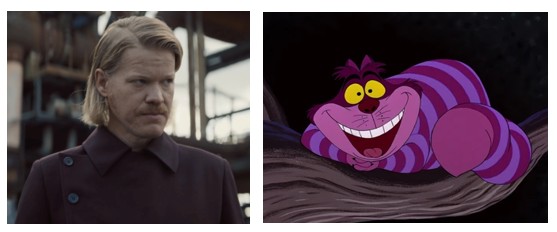
For our next character parallel, we move on to Plutarch and the Cheshire Cat. Not only is Plutarch wearing a violet jumpsuit when he first appears in Sunrise — the same color as the Cheshire Cat’s fur in the Disney film — but both characters are relatively neutral in the eyes of our protagonists. The Cheshire Cat stays out of most of the drama in Wonderland, while Plutarch is involved with both the rebels and the Capitol. This makes their alignment in their respective stories different, but they still leave both Alice and Haymitch questioning: “Whose side is this guy really on?” Both characters are also constantly surprising and confusing their respective protagonists with their actions. The Cheshire Cat fades in and out of existence and gives confusing answers to Alice’s questions, while Plutarch can be waiting hand and foot on President Snow one second and talking to Haymitch about rebellion the next. However, both the Cheshire Cat and Plutarch do prove to be helpful characters. The Cheshire Cat reveals to Alice the ways to reach the Mad Hatter, March Hare, and Queen of Hearts, while Plutarch gives Haymitch clues about the arena’s sun and mutt berms. So, while they might seem strange in the eyes of our protagonists, both characters clearly possess the means to assist them if they so choose.
One more notable aspect of this character parallel calls back to the Duchess and Drusilla. In the Alice in Wonderland book, the Cheshire Cat is technically the Duchess’s cat. He’s her pet. In an ironically similar vein in Sunrise, Plutarch almost acts like Drusilla’s loyal pet when he’s around her. He answers to her at the reaping, acting a lot like a cartoon villain’s little minion, and he showers her with compliments about her appearance and performance on the tribute train. Just like the Cheshire Cat, Plutarch does end up being his own complex character for the rest of Haymitch’s story. However, his actions around Drusilla at the beginning, not to mention his quick thinking and cool demeanor, really make him seem like her own loyal cat.
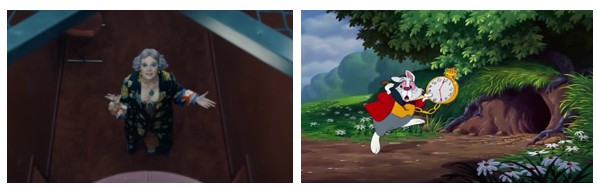
Finally for character parallels, we move on to Effie Trinket. In both the original Hunger Games trilogy as well as Sunrise, she has traits that can be attributed to two different Alice in Wonderland characters: the White Rabbit and the Mad Hatter. To start with her parallels to the White Rabbit, both characters are very concerned with punctuality. It’s very important to both of them that they get to where they are scheduled to be, though the White Rabbit definitely needs to work on actually being on time much more than Effie. Also, similarly to the White Rabbit being the character associated with Alice’s journey from the real world to Wonderland (following him down the rabbit hole), Effie can be seen in a similar vein for both Katniss and Haymitch. In the trilogy, Effie is the first character that Katniss (by extent the readers) meet from the eccentric Capitol (THG 17). Her unusual appearance, personality, and attitude are our first impressions of this strange place beyond District 12, just like how a talking rabbit with a waistcoat and pocketwatch are Alice’s first impression of Wonderland. As for Effie’s character in relation to Haymitch, she is the last person he sees before he rises up on his podium into the arena (SOR 210). Considering what I discussed earlier about how this podium can be seen as a parallel to the rabbit hole, Effie being there for Haymitch is similar to having his very own White Rabbit.
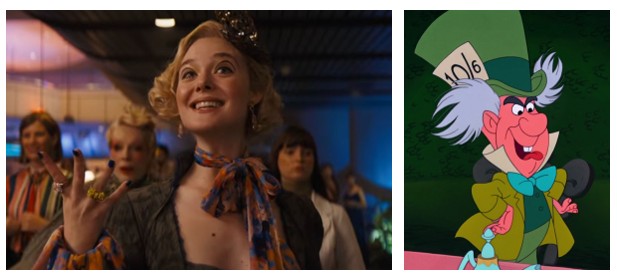
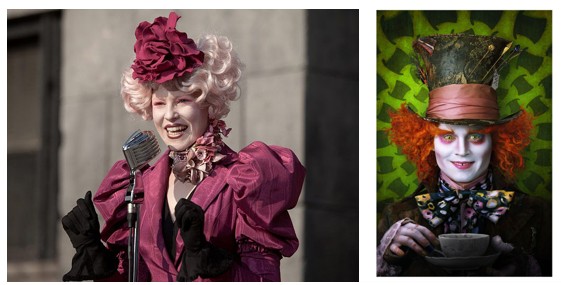
Effie further shares traits with the Mad Hatter. The most notable parallel comes from their physical appearances. Both characters dress very eccentrically, wearing bright colors and exaggerated clothing and accessories. And for these characters, it’s what they’re wearing on their heads that matters most. While the Mad Hatter’s most vital accessory is not surprisingly his hat, Effie takes most pride in her large collection of brightly colored wigs. Also of note is Effie’s “scary white grin” that Katniss describes in the original Hunger Games novel (17-18), which is a fitting description for how the Mad Hatter looks in Tim Burton’s live action Alice in Wonderland movie. Both characters have pale skin and vibrant makeup, and the Mad Hatter’s orange hair even matches the description of Effie’s wig in Catching Fire: pumpkin orange (40). Overall, these two characters are quite similar when it comes to their appearances, and the Mad Hatter certainly would fit right in with the bold fashions of the Capitol!
Besides their appearances, both Effie Trinket and the Mad Hatter are talented when it comes to dressing other characters. Effie saves the day in Sunrise by styling the District 12 tributes in Great Aunt Messalina and Great Uncle Silius’s black clothes. Likewise, in multiple iterations of Alice in Wonderland, the Mad Hatter makes hats and sells them to others. In the Tim Burton movie specifically, the Mad Hatter even makes a small dress for Alice to wear after she shrinks in size. Both Effie and the Mad Hatter are clearly quite crafty and generous when it comes to sharing their skills, but that’s not all they have in common. Personality-wise, both characters can be quite eccentric, which makes sense due to Effie being from the Capitol and the Mad Hatter from Wonderland. However, they have also shown themselves to be kind and welcoming. The Mad Hatter is friendly and helpful towards Alice during her time in Wonderland, while Effie tries to help Katniss, Peeta, and Haymitch feel better about their involvement in the Hunger Games (albeit often to the annoyance of Katniss in particular). Though they may be just as wacky as many other Capitol and Wonderland residents, at least Effie and the Mad Hatter choose to be kind to and help our protagonists in their own ways.
With that, I’ve covered some important parallels between Sunrise on the Reaping and Alice in Wonderland, or at least the ones I was able to recognize. Still, a case can be made for a variety of smaller or less significant parallels as well, though they may not warrant their own section here. Let’s take a brief look at a few to consider:
- Maysilee’s character has a few Alice in Wonderland-esque traits. She’s a blond, well-mannered young girl just like Alice; she also has to survive in the Wonderland-like arena; she has a twin, which could be a loose connection to twins Tweedle-Dee and Tweedle-Dum in the Alice in Wonderland story; and her use of table setups in the arena makes their meals resemble the Mad Hatter’s unbirthday tea party in the woods. While Haymitch is definitely our “Alice” in our comparisons between the two books, there’s no denying that Maysilee shares a few traits characteristic of her and her story as well.
- Wellie’s death, which involves her getting beheaded by Silka (SOR 323), calls back to the Queen of Hearts’ favorite method of execution: “Off with their heads!”
- During Haymitch and Silka’s fight at the end of the 50th Games, Haymitch severely injures her by gouging out her eye with his knife (SOR 325). In Tim Burton’s Alice in Wonderland movie, the Dormouse injures a large beast called the Bandersnatch by gouging out its eye. Neither injury kills the characters; it only serves to make them angrier. Ironically, while the human girl Silka ends up dead with an axe to her head (SOR 326), the Bandersnatch beast stays alive, gets its eye back, and becomes docile.
- The rolls and milk that President Snow gives Haymitch as his only food after the Games (SOR 331) could be seen as a parallel to the Eat Me! cookies (cake in the Tim Burton film) and Drink Me! drink that Alice is confronted with in Wonderland. Both are mysterious, yet enticing to our protagonists: Alice because her items literally say to eat and drink them, and Haymitch because they are the only things available to eat and drink.
- When the Queen of Hearts is playing croquet, she is often depicted using a long-necked, large/long-beaked pink bird as a mallet and a hedgehog as a ball. Both of these animals appear as mutts in the 50th Hunger Games: the long-necked, long-beaked pink birds are what kill Maysilee (SOR 306-307), and similar to a hedgehog, a porcupine mutt that shoots poisonous quills out of its back is battled by Haymitch and Maysilee (SOR 286). Ironically enough, in both stories, the ones in power are using these animals for the same reason: to play their own game. The Queen of Hearts is using them to play croquet and the Capitol is using them as obstacles and entertainment in the Hunger Games.
- The video games American McGee’s Alice (2000) and Alice Madness Returns (2011), which reimagine the story of Alice in Wonderland with darker and more disturbing settings, characters, and themes, involve Alice becoming traumatized after her whole family dies in a house fire. This is also how Haymitch’s family is killed by President Snow, and it’s one of the many reasons for his trauma that lasts through the trilogy (SOR 354).
Perhaps these small comparisons are a stretch; tiny similarities that exist purely by coincidence. After all, we don’t truly know if the story of Alice in Wonderland served as inspiration for any of the aspects of Sunrise on the Reaping, as Collins hasn’t mentioned anything related to this topic of which I am aware. Were the aforementioned parallels, including the larger ones, intentional references to Alice in Wonderland, or are we looking at two unrelated stories about protagonists getting thrust into strange, unknown worlds? Well, considering that Collins did take inspiration from Alice in Wonderland for her earlier Underland Chronicles (see Klein article), it’s far from out of the question. For now though, we can both enjoy and continue to analyze the Sunrise on the Reaping novel, as well as eagerly await the upcoming movie. Haymitch’s story is truly a wild one that fans are curious to learn more about, and only time will tell what the future holds for this thrilling series.
The Naming of Maysilee Donner: Not What You Might Think

Author’s Preface: With so much attention focused now on Maysilee’s character in Sunrise, it dawned on me that I still wasn’t sure about Collins’ inspirations for her first and last names. It seemed that previous writers from the trilogy era had not sufficiently solved this puzzle, so I finally decided to dig a bit more with my own research. This post includes the first part of my findings thus far, which I believe bring us much closer to understanding the Donner surname from the Catching Fire era. We will start here with a review of what is most likely about her first name, followed by a more in-depth argument for Collins’ likely associations with the historical Donner Party disaster. Feel free to leave a comment if you might be able to contribute further!
The Multiple Meanings of Maysilee
Like many other characters from District 12, Maysilee’s first name is a product of Collins’ imagination, one which V. Arrow describes simply as “a proprietary name of indeterminate origins.” Author Valerie Frankel agrees, though she provides some possible references to flowers and springtime. She offers, “Maysilee is another made-up name by Collins, one very close to Maylie. Maylie is a form of the English and Scottish name May, referring of course to the spring month. May is also another name for the hawthorn flower and sometimes short for Margaret.” The related names Maisie or Mayse are also used as variants of Margaret, meaning “pearl.” This could connote Maysilee’s passion for jewelry and fashion, as well as her relatively high-end social status, for what it is in District 12. With no need for tesserae, Maysilee’s reaping should have been as statistically unlikely as possible for a sixteen-year-old.
Frankel further suggests the name resembles “May’s Lily, whereby May represents spring and newfound life or rebirth, while the lily is the birth-flower for the month of May. The flower signifies “innocence, purity, and sweetness,” Frankel continues, “but also death, as it often appears at funerals.” Given Collins’ practice of connoting nature and flowers with her District 12 characters, the reference to May’s Lily likely makes the most sense here, as does its Scottish or related origins from the Celtic Isles. It is well documented that Collins’ District 12 leans heavily on the historical settlement patterns of Scots-Irish and otherwise British immigrants during America’s colonial period (Paradis). It is important to keep in mind that all these interpretations were based on Catching Fire, when Maysilee’s character was largely unknown—with nary a prequel in sight.
When Luck Runs Out: The Donner Name and Historical Connections
Even more ambiguous is the intended meaning of the family’s surname, though I hope to shed some light on it here. Frankel is correct that the name “instantly conjures a reference to the Donner Party, possibly the greatest tragedy of the American Pioneer Trail.” (Cattail) Most Americans further associate the event with cannibalism, which is not likely Collins’ intention with Maysilee’s own name. Let’s explore the basics of the historical Donner Party and its aftermath to consider an important parallel that even Wyatt Callow would agree has favorable odds.
In brief for purposes here, the Donner Party’s wagon train had departed Independence, Missouri on the Oregon Trail during the spring of 1846. Together with the Reed family, the party was joined along the way by others heading westward, making their total number close to 100 people. The party included a full mix of men, women, children, teens, and their hired hands and guides. It is important to note that an overland migration prior to the railroads required serious money and resources. Those making the journey already enjoyed varying amounts of wealth and land holdings. Generally speaking, their goal in heading west to California was to acquire more of the same.
What especially made the Donner Party different from all the others traveling that year was one fateful decision made along the way. By the 1840s western migration had become a veritable industry to support the growing number of California dreamers. All industries attract their share of grifters and schemers, and this case was no different. One of them was Lansford Hastings, who had written an ill-informed “guide” that promoted a new “cutoff” route that would apparently shave off several weeks and hundreds of miles from the journey. In reality his scam was devised to attract migrants to places featuring his own business operations, thereby profiteering from the presumed traffic flow. Unfortunately, he had never field tested his own “Hastings cutoff,” which ended up being several times more arduous than the original route and added a month or more to the overland ordeal.
Being the last party to depart Independence that season, they were already several weeks behind the favored schedule for making it across the mountains before winter. The migrants consequently decided to attempt the new cutoff, thereby crossing the Rocky Mountains and the Great Salt Lake Desert in present-day Utah. This ultimately proved unwise, as the group lost many of its cattle and wagons due to the desolate, rugged terrain and challenging river crossings. Long before they reached any snow in the Sierras, the party was already in dangerous disarray and perilously low on food and supplies. Their last stand occurred in early November while pinned down in the Sierra Nevada by a heavy snowfall near Truckee Lake, later renamed to Donner Lake in their honor. Food supplies dwindled, and a month later some of the group set off to seek help at Sutter’s Fort in modern-day Sacramento. No less than three rescue teams were sent during the ensuing winter months, providing some desperately needed food. These rescues succeeded with eventually extracting close to half of the original party to safety at Sutter’s Fort.
Most tragically, some of the remaining migrants—including one of the rescue parties—resorted to cannibalism, relying primarily on those already felled by starvation, illness, or extreme cold. The exception was two native Miwok guides, who were murdered and ultimately consumed during one of the rescue missions. Because indigenous people were perceived by Anglo-Americans as sub-human and savages (sound familiar?), the murderer was never brought to justice and was ultimately deemed a hero for saving lives. Aside from this isolated case, no solid evidence exists that anyone trapped in the mountains was murdered for purposes of sustenance. Upon completion of the rescue missions, 48 of approximately 87 original members of the Donner Party had survived.
With this basic history in mind, we are more prepared to consider parallels with Maysilee Donner’s own situation. As Valerie Frankel had noted, the most notorious association with the historical Donner Party was cannibalism. Still, no obvious connection with Maysilee, nor with her merchant-class family, seemed to make much sense. And the associations with constant struggle, survival, starvation, and dependence on nature appear to parallel the stories of Seam residents more than others. The Donners of District 12 were neither migrants nor courageous pioneers, but instead made their living among the relatively middle-class families of their community. They further enjoyed a close association with the town’s political elite, eventually marrying into the future mayor’s family, the Undersees. For her part, Maysilee had never known hunger, and she now admits as much in Sunrise. The only direct mentions of cannibalism within the series occur as a reference to the Dark Days when Coriolanus was a child, and with respect to a deranged tribute named Titus. Finding a reputable connection with Maysilee Donner would prove to be a stretch.
Knowing only what we did from Catching Fire, two additional associations between Maysilee and the historical Donner Party are entirely plausible. The first involves their shared socio-economic backgrounds in the middle class. As part of District 12’s “Merchant Class,” Maysilee’s family is relatively well off and has all of their basic needs met. Likewise, members of the historical Donner Party might have been reasonably described as middle class for the time. While certainly not privileged to be members of America’s urban elite, they managed the wherewithal to afford and assemble a substantial wagon train to make their way westward.
What makes this comparison more meaningful, however, is their respective turn of events for the worse. The Donner Party was the one group of migrants which decided to diverge from the well-traveled Oregon Trail. With a leap of faith, they collectively bought into the false advertising of Lansford Hastings to attempt his unproven cutoff instead. This was a rare one-off, even for the still-hazardous covered wagon era that preceded the railroads. In one respect, the Donner Party was unlucky in more ways than one, as they risked everything for the bet of arriving in California sooner than the rest. As it happened, the odds had not been in their favor. Theirs was a rare case of financially secure families meeting their untimely fate by traveling off the beaten path.
Similarly, Maysilee proved to be terribly unlucky as well, this time at the hands of the Capitol. With no need to take tesserae, hers was the rare case of a well-off merchant kid being reaped, just as Primrose Everdeen would be chosen 24 years later with only one slip in the jar. As far as Catching Fire goes, Maysilee’s luck had run out, a devastating turn of events not just for her own family but for those within her supporting social class and friendship network. She was the “one-off,” forced into a one-way trip to the Capitol to be thrown into the arena. In the end, neither Haymitch nor her merchant-class status could save her.
If this is the reason for Maysilee’s last name, it is a good one indeed. The Donner name in District 12 would be associated with an unlucky turn of events descending upon an unlikely social class. Just as the Donner Party’s migrants had taken the “road less traveled” to their ultimate fate, so too did Maysilee with a rare merchant-class ticket to the Capitol. This is most likely the primary reason Maysilee’s last name is Donner. In both cases, their luck ran out, much too soon.
(NOTE: There are numerous deeper associations between Maysilee and the Donner Party now with Sunrise out. Perhaps for a later post or companion book…)
Feature Image: Mckenna Grace as Maysilee Donner (Lionsgate/Hunger Games Wiki)
Decoding the Sunrise Title: David Hume’s Other Lesson

More than a reference to a literal sunrise on reaping day, Collins’ brilliant title manages to tap into one of the most famous philosophical arguments from the Enlightenment Era. While the lion’s share of attention probably focuses on Scottish philosopher David Hume’s concept of implicit submission, the key to the book’s title is found in a much briefer quote — also by Hume – placed subtly at the bottom of the novel’s epigraph (page of quotes). As quoted by Collins, Hume offers, “That the sun will not rise tomorrow is no less intelligible a proposition, and implies no more contradiction, than the affirmation, that it will rise.” Aside from decoding his eighteenth-century prose, some additional context around his isolated quote would be immensely helpful. Collins apparently agrees. She granted one of her rare interviews with Scholastic’s David Levithan to help explain the title, released just prior to the novel’s publication date (Collins, Scholastic). At the forefront of their substantial back-and-forth conversation was the book’s title and her personal inspiration for choosing it. She first recalls her initial encounter with Hume and his writings:
My dad introduced me to David Hume when I was a child, along with many other philosophers. He talked about them while using more kid-friendly examples. Like, in Hume’s case, sunrises and billiard balls. It was a little mind-bending but always interesting.
Suzanne Collins, Scholastic Interview
The first thing to note is the return of Collins’ father as an immensely influential figure in her life. She has previously indicated that he served as a vital source of inspiration and knowledge around the military and warfare tactics she infused into the original series and beyond. Along with her three older siblings, Suzanne had grown up with a career Air Force officer who had served in both the Korean and Vietnam wars. A grandfather and numerous uncles had served earlier in both world wars, providing further insights and knowledge about America’s war history and philosophy. Her particular passion for teaching Just War Theory is now well known from earlier interviews, having placed it as a central theme underpinning the original trilogy.
In the case of her latest prequel, Collins is pulling more from her father’s teachings in philosophy and political science (he had earned a Ph.D. in the latter), now with her own primary focus on the work of David Hume. In one respect she is passing on her father’s lessons in her own creative ways, now through untold millions of readers. It is also reasonable to suggest that, had Collins’ father not shared Hume’s lessons of “sunrises and billiard balls” as she passingly noted in her interview, we would not likely be reading a prequel titled Sunrise on the Reaping.
To best comprehend Hume’s profound contribution to the title, we should first back up to compare inductive versus deductive reasoning, just as Collins does within her interview. (I ask that you bear with me here, as this distinction provides the fundamental inspiration for the title.) In brief, deductive reasoning takes our flow of logic from general principles to the specific. Also referred to as deduction, the goal is to make use of general principles or premises to draw specific conclusions. For example, if the general premise is known to be true – such as, “all dogs have four legs,” then we can reasonably conclude that the poodle featured in the Heavensbee mansion portrait should have four legs as well.
Collins provides her own example of deductive reasoning, further describing it as “top-down logic.” She continues to explain, “It works from the general to the specific. Like, ‘All human beings need oxygen to survive. I am a human being. I need oxygen to survive.’ If your premise is true, then your conclusion is correct.” Her last point here is vital, in that the original premise needs to be accurate. Alternatively, we could begin with the premise that all older men with curly, gray hair are dictators. Should I also have curly, gray hair, we could logically deduce that I am a dictator as well, which is, quite happily, false. The untrue premise leads us to an equally false conclusion about my own preferred governing style.
This brings us to inductive reasoning, or logically moving from the specific to the general. The logic of induction, or inference, relies upon any number of isolated and limited observations in the empirical (real) world to draw more general conclusions. This is more of a bottom-up approach to generate new premises or hypotheses, whereas deductive reasoning is more top-down. In the worlds of social or physical sciences, there is typically a “constant interplay” between inductive and deductive reasoning which hopefully leads researchers “steadily closer to a truth that can be verified with certainty.” (Lanese, LiveScience)
The catch with inductive reasoning is that it depends on the completeness, or total number, of observations. One simple example involves an opaque bag of coins. Someone pulls five coins from the bag, all of which are pennies. We might then logically infer that the sixth coin pulled from the bag will also be a penny. Although all the initial observations produced pennies, however, we cannot rely on inductive reasoning to conclude that the next coin will necessarily be a penny as well. It could easily be a nickel or anything else. However, since the strength of the inference is based on the completeness of the observations, we could try, say, fifty observations rather than five. If all fifty attempts produce pennies, we could make a stronger inference through inductive reasoning that the next coin will likewise be a penny. In turn, we could even form an initial conclusion that all the coins in the bag are pennies, thereby moving logically from specific observations to a general premise. But should we interpret this conclusion as new knowledge that can be steadfastly relied upon in the future? David Hume would say “no, not in the least.” To do so would be faulty reasoning. And Lenore Dove would agree, as we will see.
Hume wrote extensively about what is now referred to as the “problem of induction.” By forming inductive conclusions based on isolated, past experiences, he posited, we fall into the trap of “the future will resemble the past” principle. In the case of the bag of coins, numerous observations were made, and all the extracted coins turned out to be pennies. Inductive logic would therefore have us predict that future extractions will resemble the past – that is, the next coin to be pulled will also be a penny. But Hume would ask us, “How do you know?” To assume that the future will resemble the past is just that – an assumption – not a conclusion, and certainly not “new knowledge” about the bag of coins. Based on his Enquiry Concerning Human Understanding (1748), Hume teaches that a skeptical response is more appropriate to such inductive arguments. All we can truthfully conclude about the bag of coins is that “We don’t know.” For Hume, we should withhold conclusions based on assumptions about the future. All we have to base them on is our observations of the past. (Brissey, Philosophy Now)
Collins teaches us similarly, stating that “inductive reasoning goes from the specific to the general. ‘My cat Zorro loves yogurt. Your cat Fluffy loves yogurt. Therefore, all cats love yogurt.’ But do they? Your conclusion might be considered probable if you witnessed a bunch of other cats loving yogurt, but it’s not a certainty.” (Collins, Scholastic) Again, we simply do not know, nor can we definitively conclude, that all cats love yogurt. In a nutshell, this dilemma describes the “problem of induction.” That is, to form a definitive conclusion about something, it is necessary to first understand the “foundation” of the inference, or logic, that the inference is based upon. The “problem,” however, rests in Hume’s argument that it is impossible to do so. We cannot accurately draw conclusive inferences about the future by observing the past.
It is this fundamental inductive fallacy around which Collins wraps her entire second prequel. She reiterates Hume’s question within her interview, asking if the sun is “guaranteed to rise tomorrow morning? David Hume would say no. If you say yes, you’re using faulty inductive reasoning. Just because the sun rose yesterday and it rose this morning, there’s no guarantee it will rise tomorrow… You can say you feel it’s highly probable that it will rise tomorrow based on your observations, but that’s as certain as you can get.” Beyond this rather academic argument, she does acknowledge that people still reasonably plan out their lives by making such inferences from the past. Hume would agree as well, as he does not dispute in his writings that humans regularly make inferences. We must do so to navigate through our day-to-day lives in predictable, largely reliable ways.
This all should help us better understand the Hume quote provided in the epigraph, and why Collins chose it: “That the sun will not rise tomorrow is no less intelligible a proposition, and implies no more contradiction, than the affirmation, that it will rise.” He is basically saying that it is equally reasonable to propose that the sun will either rise, or not rise, the next day. This is because there is no definitive way to absolutely know one way or another based entirely on what has been observed in the past.
For her part, Lenore Dove goes “full Hume” on Haymitch, with him struggling to keep up. She says, “And that’s part of our trouble. Thinking things are inevitable. Not believing change is possible.” Poor Haymitch still isn’t quite understanding her own reasoning, she correctly surmises, so she launches into one of Hume’s most fundamental arguments related to the “future will resemble the past” principle:
Think about it. You’re saying, ‘Today is my birthday, and there’s a reaping. Last year on my birthday, there was also a reaping. So every year, there will be a reaping on my birthday. But you have no way of knowing that. I mean, the reaping didn’t even exist until fifty years ago. Give me one good reason why it should keep happening just because it’s your birthday.
Lenore Dove (SOR 11)
She is essentially applying Hume’s faulty inductive reasoning argument. Just because Haymitch had experienced a reaping on all sixteen birthdays, that does not guarantee one will also take place the following year. This leads into Collins’ second fundamental idea from David Hume, that of implicit submission (see this post). As narrator, Haymitch reflects on Lenore Dove’s optimism, telling us, “while it’s a fine idea, thinking about a world with no reaping, I don’t really see it happening. The Capitol has all the power and that’s that.” (SOR 11) At this point he does not yet believe change is possible and is still inclined to “submit implicitly” to the authority and the will of the Capitol.
With all of this, we might (finally) better comprehend the subtle though powerful meaning behind the book’s title. Collins – through Lenore Dove – is applying Hume’s previous sunrise example to the reaping itself. She demonstrates how relatively fragile the Hunger Games and their associated reapings really are. As we understand today, the sun’s daily appearance has been occurring for billions of years, making it one of humanity’s surest bets that Wyatt could possibly make. And yet, due to inductive reasoning, the past does not guarantee the future, since we cannot know with absolute certainty what will happen the next day.
If this is true with respect to sunrises, then something like the 50-year-old reaping ceremony is much less certain. By the second Quarter Quell, we only have fifty past cases of the reaping from which to form an inductive assumption about the future. What, then, is Lenore Dove’s moral to her story? The bottom line is that Haymitch should not view the annual reaping as unshakable. Change can happen, and she urges Haymitch to at least imagine that change is possible. Otherwise, Hume’s implicit submission kicks in and people simply accept the Games as inevitable. Collins sums up her title this way:
That’s where the title came from. Sunrise on the Reaping. Lenore Dove’s convinced it’s not a certainty. She can imagine a world without it. The future can be different than the past. She makes Haymitch promise that he will fight to make sure there is never another sunrise on the reaping. It becomes his dramatic goal, his mission, and his reason for living. But it takes many years to achieve.
Suzanne Collins, Scholastic Interview
Collins has consequently devised a brilliant title for a masterful story, itself built around one of the most significant philosophical arguments from the Enlightenment. Rather than referencing the literal sunrise on reaping day, the title represents no less than a call to action from Lenore Dove to imagine and strive for a brighter future. And unbeknownst to her, the Capitol’s Plutarch Heavensbee is already thinking through potential approaches to accomplish just that. He ultimately picks up where Lenore Dove leaves off, at the other end of Haymitch’s train ride to the Capitol. As we learn later in Sunrise, Plutarch is cunning enough to play the long game (see this post), and he and Beetee both cajole Haymitch into playing along with their seditious plans. Between their questionable scheming and Lenore Dove’s promise, Haymitch’s inner rebelliousness remains just bright enough to eventually help spark one Katniss Everdeen to success. Moreover, he would ultimately stay alive to realize his promise and tell his story.
Source of Feature Image: Charles Leon, “Will the Sun Rise Tomorrow?”
How are Haymitch and Katniss Alike? PART 2

As discussed in Part 1, the original trilogy features a subplot that follows the growing familial — if challenging– bond between Haymitch and Katniss. Now in Part 2, we’ll focus on how the Sunrise prequel enhances our understanding of both complicated characters. Admittedly, the second prequel does not speak to this relationship directly as Katniss had done (perhaps with the exception of the Epilogue). Collins is as subtle as she is thorough, however. In Sunrise she continues to develop the parallels between two of our favorite characters. For those looking to verify Katniss’ (and Peeta’s) realization of how much she resembles her troubled mentor, there is plenty to consider and probably too much for inclusion in a single post here. For now, we’ll focus below on several categories of parallels between them, namely their similar (and somewhat contrasting) family structures, their experiences with food and drink, a shared outdoor tutor by the name of Burdock Everdeen, and parallel friendships with younger tributes.
Comparable Family Situations
Certain parallels between Haymitch’s and Katniss’ family structures have been widely shared, though it is useful to review them here. Regardless of film casting choices, both of our protagonists are “Seam,” in terms of their manufactured racial origin and home place in District 12. Katniss describes Haymitch as displaying the Seam look, with dark, curly hair and gray eyes — and humorously, that he was “something of a looker” during his teenage years.
It follows that their families are similarly dependent upon coal extraction for their household income, and both lose a father during their early teenage years to the mines. The causes of both deaths remain suspicious as well. Just as Katniss suggests a lingering mystery surrounding the explosion that killed her father (Burdock), Haymitch comments about the mystery around the mine fire that killed his Pa. He explains that his Abernathy ancestors were “known rebels back in the day,” and that they still carry the “scent of sedition.” (SOR 5) He then speaks of the mystery around his Pa’s own death: “Rumors spread after my father’s death, rumors that the fire had not been an accident. Some say he died sabotaging the mine, others that his crew was targeted by the Capitol bosses for being a pack of troublemakers. So it could be my kin’s the problem.” Likewise, to this day a popular fan theory holds that the mine explosion that killed Katniss’ father was not an accident. Instead, the incident can possibly be traced back to his talk of an uprising down in the mines.
Furthermore, both Katniss and Haymitch have younger siblings they would do anything to protect. The youngsters also look up to their respective older sibling as a role model, if not a pseudo-parent. Something less noticed is that both Sid and Prim display early aspirations toward academic studies in the sciences. And to their credit, both Katniss and Haymitch lovingly encourage and nurture these interests despite the Games hanging over their heads. Prim may not consciously know it yet during the 74th Games, but she is predisposed to a career in health care due to informal training at her mother’s side. In Sid’s case, he looks to the stars and delights in giving his family a tour of the constellations — humorously including the “water dipper,” a variant on the Big and Little Dippers noted by astronomers and various civilizations that came before him. He then points out the “bowhunter,” which he claims looks like Burdock, a reference to his skills with a bow and arrow that he will one day teach his daughter. (Sidebar: the “bowhunter” constellation is likely what we call Sagittarius, the Archer. Originally recorded by the 2nd century astronomer, Ptolemy, the constellation is usually represented by a centaur drawing a bow. Sound like Katniss?) One is left to wonder what happier lives and careers would have awaited both youngsters had they survived the oppressive system of Panem and the ensuing rebellion. This brings us to the final and most tragic parallel, as both siblings suffer untimely deaths at the hands of their oppressors, whether directly or otherwise. Both Katniss and Haymitch are forced to live with their own powerlessness to prevent this outcome, despite a similarly fierce determination throughout their respective storylines.
Aside from these parallels, Collins points out important contrasts between their respective situations. In her exclusive interview (Barnes & Noble edition) with David Levithan at Scholastic, she first emphasizes that Katniss’ parents are both non-functional, or at least emotionally unavailable. She explains, “Katniss loses her mother to grief and depression when her father dies and becomes her family’s provider and protector at age eleven.” In contrast, she continues, “Haymitch doesn’t have to take full responsibility for himself until he’s reaped.” This is because Haymitch’s mother (Willamae) is a fully engaged parent who is striving to move forward after Pa’s early death. Collins explains, “I think this has allowed him to be more open-hearted and optimistic than the other two heading into the story.” Earlier in the interview, Levithan suggests that, despite a life that has “had its sadness,” Haymitch has largely experienced a “good life so far.” Going into the reaping, this is a markedly different situation than what either Katniss or Coriolanus had thus far experienced. Collins agrees and responds, “Yes, his life has been largely good. A loving family, good friends, the love of his life. A sweet part-time job that may lead to a profitable, if illegal, career… He’s happy except for the shadow of the Games that hangs over them all. So, emotionally, his loss is the greatest because he has the most to lose.” The final contrast, then, is how the stories end for these three characters. Both Katniss and Coriolanus retain “loved ones to the end,” she claims. (Well, Coriolanus may be a stretch, but perhaps he feels some form of love for his granddaughter and unmentioned family?) In contrast, she continues, Snow “tries to strip Haymitch of everything: family, friends, lover, job, community, liberty, happiness, and the freedom to love anyone. His personal stakes couldn’t be higher.” Perhaps in the end, however, the optimist might suggest that Haymitch does eventually come around, gradually opening his heart to Katniss and her new family by the time of his Epilogue. For this reason, Snow does not ultimately “land on top.”
Food and Drink
Much has been written about the meanings of food throughout the original trilogy, and this culinary topic remains prominent throughout the prequels. As Valerie Frankel emphasizes in her own companion book (Sinister Sunrise), our eating practices and food preferences play a major role in constructing our own cultural identities. Essentially, “You are what you eat.” Collins knows this well, serving her readers with a veritable smorgasbord of American and Classical Roman foods. Frankel explains that Capitol residents “feast on Roman food like roast suckling pig and American food like pumpkin soup and strawberry ice cream. Such worldbuilding helps establish the incredibly opulent Capitol as a satire of both cultures as they waste food and take it for granted while seeking more and fancier alternatives” (Sinister Sunrise, 67).
I would add that within Collins’ own worldbuilding of Panem— which, to remind us, is Latin for “bread” — she is further distinguishing between two fundamental regional culture traditions. Foods associated with Appalachia provide Haymitch and Katniss with an emotional sense of home, while the Capitol provides its own citizens with an untold variety of exotic and exquisite recipes. A further distinction exists within District 12, between the Seam and merchant class, with respect to the foods they can afford and acquire. This becomes all the more prominent when comparing the experiences of Maysilee and Haymitch throughout Sunrise. With all of this in mind, let’s look at some highlights of some obvious and subtle food references that help connect Haymitch and Katniss and their own upbringings.
Bean and Ham Hock Soup: This favorite dish of Haymitch is mentioned numerous times throughout Sunrise. We learn it is associated with funerals and mourning rituals in District 12 and serves as a poignant memory of his father’s funeral and ensuing meal. On one level Haymitch cannot stop raving about its taste and smell, while also triggering pleasant associations with his home and family in the Seam. Mags presumably learns of this connection and purposely serves the dish in the apartment for dinner (91). This cannot be a random coincidence. Wiress explains that “Mags ordered this specially from the kitchen,” which may be a clue that Mags had done her research. Haymitch savors his comfort food, saying, “I take a spoonful and let the taste of home course through me, strengthening me for what’s to come.” (91)
The soup is clearly analogous to Katniss’ own favorite Capitol dish, lamb stew with dried plums served over wild rice. In this way, Collins deftly provides both Haymitch and Katniss with favorite dishes that are reprised throughout their respective stories. And it is Mags who likely gives Haymitch the idea of silently communicating by sending favorite foods into the arena. Just as she sends in soup for Haymitch (and strawberry ice cream for Maysilee – see this post), Haymitch “pays it forward” by communicating with the gifts he sends (or does not send) into Katniss’ own arenas. Upon receiving his own gift of food, Haymitch quickly concludes, “Mags. Trying to reach us, to let us know we are not alone in our pain, to give us strength to go on” (SOR 273). We can therefore credit Mags with Haymitch’s system of communicating covertly in the arena with Katniss. It is this strategy of coded messaging through parachutes that helps forge a stronger bond of mutual trust between them (see Part 1 for more on this).
Exotic Food and Drink: Both Haymitch and Katniss augment their subsistence diets from the Seam with an endless barrage of unfamiliar exotic foods and drinks in the Capitol. In a likely attempt to shock her younger readers, Collins reveals some common foods we take for granted that never make it into isolated District 12. Other foods become occasionally available for the wealthier merchant class but are simply unaffordable in the Seam. She takes this approach within the storylines of both characters. When Katniss thinks she is seeing an “elegant glass of orange juice,” for instance (HG 55), she recalls having only tasted an orange once before, when her father brought one home for New Year’s. Peeta then introduces Katniss to hot chocolate, which neither of them had seen back in 12. In Haymitch’s case, he has never tasted bananas, olives, or sardines, which some keen fans have compared with Katniss’ own Capitol food encounters. He is further unimpressed with the pineapple on his ill-fated birthday cake. Not only do these cases highlight the lack of specialized, imported foods in the impoverished Seam, but also solidify how eating habits and preferences contribute to one’s cultural identity and connections with home.
Coffee and Breakfast: The American fascination with big breakfasts is treated similarly in both of their stories as well. Katniss tells us that her mother “adores coffee, which we could almost never afford.” (HG 55) Either way, Katniss is not a fan, as it simply tastes “bitter and thin” to her (apparently Starbucks had not yet entered the District 12 market). Haymitch has no more use for coffee than does Katniss, yet another similarity between them. In contrast, both Asterid (Katniss’ mother) and Maysilee enjoy the black drink, thereby coding the beverage as a privilege for those who can afford it. Haymitch’s class consciousness plays out through such interactions with Maysilee, and the topic of coffee provides one more indicator of their respective household incomes back home. Asked if she is going to eat one morning, Maysilee replies, “I’m not a breakfast person.” (94) Haymitch tells us, “You can see why she drives people nuts. If there’s a breakfast available in the Seam, everybody’s just pleased to see it.” He then teases Maysilee with a dry sense of humor Katniss would appreciate: A big breakfast is “going to come in handy in the arena. Especially if you’re not a lunch or supper person either.” Mags agrees, and Maysilee begrudgingly takes a tiny bite of bacon, only re-emphasizing her privileged daintiness.
In this respect, Collins portrays Maysilee as similar to Capitol residents who take food availability for granted. Plenty of comfortable American families can easily relate to someone in their bathrobe shuffling around the kitchen, waking up with a fresh cup of coffee. That’s Maysilee. From District 12, where even the more fortunate residents are supposed to be relatively impoverished. In contrast, Haymitch views her refusal to eat breakfast as strange, not to mention impractical. In these and many other cases, Haymitch and Katniss display similar perceptions of food in their lives, which is literally necessary for their mere survival. For Seam residents, families don’t eat unless it is illegally caught, foraged, milked, or grown in household gardens. This is more reminiscent of traditional Appalachian subsistence farming, which our characters from the Seam represent well throughout all five books in the saga.
White Liquor and Related Spirits: Just one more heartbreaking aspect of Sunrise appears early on, when we discover that Haymitch was not fond of alcohol until after his 50th Games. Despite being known as the town drunk and a laughable character in the first novel, it becomes apparent later that his uncontrolled alcoholism is a product of post-traumatic stress disorder (PTSD). This is confirmed throughout Sunrise, when he tells us he drinks to forget. But his teenage years were different, as he tells us before his reaping. When Hattie gives him a bottle for his birthday, she tells him he’s old enough to drink now. He replies, “I have to agree and, though I’m not a drinker myself, I’m glad to get the bottle. I can easily sell it or trade it or possibly pass it on to Lenore Dove’s uncle, Clerk Carmine, so that he might have a kinder opinion of me. (SOR 5) Likewise, Katniss is not an early fan of white liquor or alcohol in general. In the trilogy she has a difficult time imagining how Haymitch can drink the stuff, and it takes some time for her to warm up to a normal glass of wine. Near the end of the first novel, she makes an important decision, thinking, “The idea scares me some. I think of Haymitch, with all his money. What did his life become? He lives alone, no wife or children, most of his waking hours drunk. I don’t want to end up like that.” (HG 311) Later in Catching Fire, however, she shows early signs of starting down Haymitch’s dark path, when the pair of them starts to drink together. Peeta finally puts an end to it, emptying the bottles and coaching both Haymitch and Katniss to train for the 75th Games. Peeta had likely played an instrumental role in reversing Katniss’ own slippery slope toward alcoholism.
A Shared Mentor and Similar Skillsets
Burdock’s Lessons: Katniss wasn’t the only one who picked up skills from her father. One astonishing surprise from the latest prequel was the extent to which Haymitch hung out with Burdock and friends and acquired strikingly similar skills and outdoor experiences. On one sense, Burdock unwittingly provided both Haymitch and Katniss with fundamental outdoor survival skills that would become invaluable within their respective Games.The parallels seem to begin with apples. Katniss explained early on that, “In the fall, a few brave souls sneak into the woods to harvest apples. But always in sight of the Meadow.” (HG 5) Haymitch’s own story begins similarly, with he and his friends harvesting apples, flashing back to the time he met Lenore Dove tossing apples down from a tree. He recalls, “My friend Burdock had finally worn me down, saying he did it all the time and there was nothing to it and there were still apples if you could climb. And I could climb and I loved apples. Plus, him being younger than me made me feel like a big scaredy-cat if I didn’t.” (SOR 6) Beyond this, Haymitch occasionally peppers his narrative with subtle credits to Burdock for his experiences with various outdoor skills. More of them are discussed below.
Climbing Trees: Speaking of apple trees, Haymitch is amazingly adept at climbing them and does so several times in the arena. For his second night, he nonchalantly explains, “I’m not dizzy now, so I pick a sizable tree with thick foliage near the butterfly bush and climb about thirty feet into the branches. I pitch my hammock between two sturdy limbs, making sure that if one side gives way, I’ll have a fork to catch me.” (SOR 235) This all seems like second nature for Haymitch, and it would not take much imagination to pretend that Katniss was the narrator here instead. And much like Katniss in Catching Fire, Haymitch decides to climb to the top of a tree to scan the arena. This scene could actually be one of Collins’ intentional callbacks to the trilogy. His main goal is to look for Ampert, saying, “I come upon the binoculars and try them out. That inspires me to climb higher and get a better sense of the lay of the land. Near the tippy-top of the tree, which towers over most, I can see a great distance.” (SOR 238) Not much earlier, he stops to reflect on his accomplishments thus far, considering how he earned his recent parachute: “While I breakfast, I review why, from the Capitol sponsors’ perspective, I think I’ve earned this expensive gift. I evaded the bloodbath with supplies and weapons, I survived poisoning, I made fire, cooked food, torched some butterflies, and found a tree to sleep in. Conclusion: I’m fairly resourceful and clearly selfish enough to win.” (237) Again, this could have been written word-for-word by Katniss, who likewise gradually gains confidence throughout her first Games.
Throwing Knives: Another subtle connection with Katniss and the trilogy involves knives. When Maysilee surprisingly suggests that her fellow tributes should try the knife-throwing station, Haymitch is mildly impressed that she “hits more than she misses.” (See this post for more on Maysilee’s own puzzling skillset.) Then we learn about Haymitch’s own dexterity with knives — he “sticks it every time” — which seems to date back to childhood. He explains, “I’m not a complete stranger to knife games, although a fondness for my toes keeps me away from mumblety-peg. A target on an old shed or tree – well, that’s fair game. Blair’s really good and I’m not too shabby myself. I think of my brand-new birthday pocketknife that I didn’t get to throw even once, and hope Sid gets some joy from it.” (SOR 101) In this subtle way we learn how Katniss learned her own knife skills, through her father, Burdock.
Haymitch continues his fondness for knives into Catching Fire, when he jumps up in surprise, “wielding a knife” as Katniss douses him with water to wake him up. She quickly remembers, Certainly another symptom of his PTSD, Katniss explains, “I forgot he always sleeps with one clutched in his hand.” (CF 14) Later, she begins to train with Peeta and Haymitch like the Careers, to gain strength and agility for the 75th Games. Katniss realizes the extent to which Haymitch’s body has declined, however, telling us, “After all the years of abuse, Haymitch’s body resists improvement. He’s still remarkably strong, but the shortest run winds him. And you’d think a guy who sleeps every night with a knife might actually be able to hit the side of a house with one, but his hands shake so badly it takes weeks for him to achieve even that.” (CF 184)
What is likely an all-but-forgotten mention in passing by Katniss, Collins takes us back in Sunrise to help us understand when this habit of paranoia began. While trading night watches with Maysilee, Haymitch tells us, “Maysilee has let me sleep most of the night. When we switch places, I’m determined to give her the same opportunity. Ax and knife at hand, I keep the fire burning with bits of fuel until the sun rises on our fifth day in the arena.” (274) While on his shift, he must be prepared for any threat by keeping his ax and knife at the ready. More poignantly, he later experiences one of his first (if not the first) nightmare, painting a sordid picture for us: “…other ghosts, filled with hate and rage, visit me in the night. Panache seems to have little to do but hunt me down and Silka thinks I owe her a crown. The terror bleeds into my waking hours. I start sleeping with a knife in my hand.” (374) And thus we learn where his habit began.
Fast Runners: A less noticed ability shared by Haymitch and Katniss involves their speed on foot. It’s instructive to return to the original novel where Katniss allows herself a rare pat on the back — twice. First she tells us, “I’m thinking that it’s lucky I’m a fast runner when Peeta nudges my arm and I jump.” (HG 95). Later when contemplating a run at the Cornucopia against Haymitch’s instructions, she tells herself, “I’m fast. I can sprint faster than any of the girls in our school although a couple can beat me in distance races. But this forty-yard length, this is what I am built for. (HG 149) Returning to the Sunrise prequel, my first thought was the potential parallel between Katniss and Woodbine Chance, as Haymitch tells us the whole family is known for their quickness on foot (though not fast enough for Woodbine, he notes). But Haymitch can run with the best of them as well. During the chaos of the tribute parade, Maysilee encourages him to protect Louella’s lifeless body from the Peacekeepers: “She doesn’t belong to them,” snaps Maysilee. “Don’t just hand her over. Make them fight for her. Run!” Haymitch responds with, “So I do. And I’m a fast runner.” (SOR 77). This is the same language Katniss uses in the first novel. Coincidence, or subtle callback?
Katniss and Rue, Haymitch and Ampert
The close if ill-fated friendship that developed between Katniss and Rue is now legendary. After only a short time in their Games, Rue had earned a special place in Katniss’ heart, for the primary reason that Rue reminded her of Prim, and — by extension — of home. By the time she allies with Rue in the arena, Katniss had already demonstrated her sentiments of attachment for home, especially for her mother and Prim. It is made crystal clear that the one motivating factor keeping Katniss alive is her sister. Her interactions with Rue only enhance her memories of home, with Rue becoming an unwitting surrogate for Prim in the arena. Katniss tells us that Rue is the twelve year old who reminded her so much of Prim, though she only appears to be ten (THG 98). She then makes a meaningful association between Rue and a small flower of the same name back in 12. Although she imagines Haymitch’s displeasure with wanting Rue for an ally, she explains, “Because she’s a survivor, and I trust her, and why not admit it? She reminds me of Prim.” (THG 201) One could further argue that her strong bond with Rue — as an extension of home — is what leads to Katniss’ first real act of defiance, that of memorializing Rue’s death by kindly preparing her body and placing flowers around her for all to see.
For his part, Haymitch meets his own surrogate for his younger brother Sid, by the name of Ampert. By the time he finds Ampert in the arena, Haymitch had already promised Beetee to watch over his ill-fated son right to the end. The bond that has already been nurtured between them, however, becomes more apparent when Ampert immediately throws his arms around him upon their reunion. Haymitch tells us, “I just hug him back and say, ‘Hey, buddy.’ I’m surprised by how small he feels, because he’s such a take-charge kind of kid. But he’s only about Sid’s size and plenty scared.” (SOR 239) From this point, the two of them will work together as allies and friends just as Katniss and Rue would do 24 years later. Both pairs of allies are similarly homesick, as Haymitch points out for their part. After Ampert refers to the butterfly bush as their “home,” Haymitch muses, “Home. He calls it their home. Is it because he misses his own so much? Twelve years old . . . barely five feet tall . . . his voice still hasn’t even changed. If I’m homesick, what must it be like for him?” (SOR 242) Just as Katniss and Rue often think of home, so do Haymitch and Ampert. The strong, emotional attachment that Katniss and Haymitch feel for the homeplace is a continuous thread throughout both of their respective stories. Then before Haymitch makes his courageous descent into Sub-A, they both presume it will be their final goodbye. Haymitch tells us, “I slide my knife into his belt, muss his hair like I do Sid’s, and say, ‘Best ally ever.'” (SOR 247) His thoughts of Sid at home thus continue during this emotional parting.
The more dramatic and heart wrenching goodbye comes later, however. After following the squirrel mutts back to Ampert, a shocked Haymitch surveys only his “pearly white bones,” a subtle callback (or Easter egg) to Lucy Gray’s reference to her mother in Ballad. He first thinks of Beetee and how his own heart must be breaking into “fragments so small it can never be repaired.” He then tells us, “Mine pounds like a drum as a wave of rage surges into it.” He emits a howl that “bounces off the fake sky and echoes around the arena.” His anger and defiance kick in as it did with Katniss upon saying goodbye to Rue. He says, “I want to kill them all. Snow, the Gamemakers, every person in the Capitol who has been party to this atrocity.” (SOR 252) Haymitch’s empathetic and compassionate heart is devastated, and he breaks down in sadness and rage. This mirrors Katniss’ own experience quite closely with the death of Rue. In this way, both lives of the younger surrogates end tragically at the hands of an oppressive regime, only fueling their caretakers’ determination to bring the system down.
Source of Featured Image: Screenrant, custom image by Yeider Chacon
How are Haymitch and Katniss Alike? Exploring a Trilogy Subplot that Carries Over to Sunrise: PART 1

(Author’s Note: Due to length, Part 1 below focuses on the trilogy, while Part 2 focuses on Sunrise on the Reaping.)
Though not exactly a “hot topic,” the rocky relationship between Haymitch and Katniss serves as an intriguing subplot within the original trilogy. According to authors at Reedsy and Storybilder, to name just a few, a subplot is a secondary storyline that runs parallel to or beneath the main plot, designed to enrich the main narrative. Subplots “can be as simple as a professional rivalry or as complex as a political conspiracy” (Reedsy). They allow writers to feature or explore additional themes of the novel, which might involve greater character development, relationship growth among two or more characters, or provide a more nuanced understanding of worldbuilding that supports the main plot. The growth of mutual respect and friendship that builds between Haymitch and Katniss appears to accomplish all of these things quite well. What might be less apparent is how Collins continues to unveil parallels between these two victors within her second prequel. For now, let’s return to the trilogy to recall some highlights of their contentious yet growing relationship.
Although they butt heads and trade insults from the beginning, Haymitch and Katniss gradually learn to trust and respect one another. Collins deftly weaves their lives together for character development and to compare their parallel experiences. Early in the first novel, of course, they don’t get off “on the right foot,” so to speak, viewing each other with probably some combination of distrust, contempt, and a lot of mutual misunderstanding. Katniss provides her first impression of him in Chapter 4, telling us, “I don’t know Haymitch, but I’ve seen him often enough in the Hob, tossing handfuls of money on the counter of the woman who sells white liquor. He’ll be incoherent by the time we reach the Capitol.” She seems to view him with contempt and condescension throughout the first chapters, especially for his uncontrolled drinking. Much like us at this point, she does not yet understand his traumatic past. For his part, Haymitch’s first impression of Katniss is of someone who is dislikable, arrogant, stubborn, and immature (Check, check, check, and check, she might admit). Still, he eventually comes to view her as worthy of mentoring, telling her, “All right, I’ll make a deal with you. You don’t interfere with my drinking, and I’ll stay sober enough to help you… But you have to do exactly what I say.” At this point they at least start to give each other a chance.
It is Peeta who further jolts her perception of Haymitch, though much later during the famous cave scene. “I always knew you were his favorite,” says Peeta, to which she responds, “Please, he can’t stand being in the same room with me.” (HG 259) He mutters back, “Because you’re just alike.” She decides to ignore his comment because it’s not a decent time to insult Haymitch. By this time, however, Katniss has developed a more trusting relationship with him and admits to even imagining his thoughts. When she tries to kiss Peeta, a parachute arrives with a pot of broth. She realizes, “Haymitch couldn’t be sending me a clearer message. One kiss equals one pot of broth. I can almost hear him snarl. ‘You’re supposed to be in love, sweetheart. The boy’s dying. Give me something I can work with!'” (HG 261)
This is probably one of the more endearing aspects of their growing bond, doubling as an intriguing strategy during the Games. Haymitch has been silently communicating with Katniss based on what he sends — or does not send — into the arena. She eventually connects the dots with the following revelation:
“It’s funny. Haymitch and I don’t get along well in person, but maybe Peeta is right about us being alike because he seems able to communicate with me by the timing of his gifts… He hasn’t made much effort to connect with Peeta really. Perhaps he thinks a bowl of broth would just be a bowl of broth to Peeta, whereas I’ll see the strings attached to it.” (HG 305)
By this time, their relationship has at least evolved into one of mutual trust and understanding. They are coming to know and respect one another as a collaborative team, even if neither of them is particularly warm or likable. A clear indicator of their early bonding occurs just after Katniss wins her first Games. She says, “I run for them and surprise even myself when I launch into Haymitch’s arms first. When he whispers in my ear, ‘Nice job, sweetheart,’ it doesn’t sound sarcastic.” (HG 352) A new partnership and even friendship has been forged, which will carry them into their next challenges. By the time of the 75th Games in Catching Fire, Katniss even recognizes Haymitch as family. This word sneaks out of her mouth while trying to rationalize visiting him after the Quell announcement. She tells us,
I bite my lip because once he’s said it, I’m afraid that’s what I do want. For Peeta to live, even if it means Haymitch’s death. No, I don’t. He’s dreadful, of course, but Haymitch is my family now (emphasis added). What did I come for? I think. What could I possibly want here? “I came for a drink,” I say. (CF 177)
Soon thereafter, Katniss and Peeta secretly view the heavily edited 50th Games, not yet realizing how much of the truthful footage had been removed. Regardless, she gains confidence after learning more about Haymitch’s own experiences, saying, “I think I finally know who Haymitch is. And I’m beginning to know who I am. And surely, two people who have caused the Capitol so much trouble can think of a way to get Peeta home alive.” (CF 203) Not only is she better understanding Haymitch’s personality and troubled past, but she is also continuing to discover her own identity and sense of self. In one sense, Haymitch is unwittingly assisting with that journey by holding up a mirror to her face.
By the wrap-up of Mockingjay, both Katniss and Haymitch have at least admitted to themselves how they view each other as some sort of family. Perhaps they still remain too stubborn and guarded to admit as much. But Collins ultimately ends the trilogy with both of them back in 12 looking out for one another. As readers, we can see between the lines of what is left unsaid between them. On the hovercraft headed back to 12, she pointedly asks him why he is going back as well. He makes an excuse that “they can’t seem to find a place” for him in the Capitol. After some thought, she realizes he could go anywhere he wanted because he hasn’t assassinated anyone — unlike someone else we know. Forming her own conclusion, she thinks, “If he’s coming back to 12, it’s because he’s been ordered to.” She asks him bluntly, “You have to look after me, don’t you? As my mentor?” He simply shrugs in response, and Katniss realizes what he means: “My mother’s not coming back.”
Without denying it, Haymitch is thus assuming the role of a guardian or perhaps a close uncle figure. In the final few paragraphs of the Epilogue, Katniss clearly views the three of them as a family unit, saying, “We learn to keep busy again. Peeta bakes. I hunt. Haymitch drinks until the liquor runs out, and then raises geese until the next train arrives.” Just before this, she describes the memorial book they begin to assemble, thanks to some fresh parchment paper sent by Dr. Aurelius from the Capitol. She says nonchalantly, “Haymitch finally joins us, contributing twenty-three years of tributes he was forced to mentor.”
Of course, these otherwise mundane, forgettable comments now hold valuable new meaning with Sunrise on the Reaping. (Spoiler Alert!) In the prequel’s Epilogue, Haymitch reflects on how his beloved Lenore Dove has in some way grown older with him, as if she is still alive. But she tells him that he cannot join her yet because, as Haymitch tells us, “I have to look after my family.” (SOR 381) In this way Collins confirms that Haymitch likewise perceives a familial relationship with Katniss and Peeta sometime after Mockingjay. This is likely the principal reason he has returned to 12 after the revolution. Perhaps he was ordered to do so at first, as Katniss surmised. Still, his own internal reasoning was probably more emotional. He felt a sense of evolved kinship than he would not care to admit out in the open. He now had someone to care for, and to care about, once again. Through some inner voice, Lenore Dove supported and encouraged the idea to give him a valuable reason to keep on living. He admits, “I did not want to let them in, her and Peeta, but the walls of a person’s heart are not impregnable…” (SOR 381) And just as Katniss had spied Haymitch at the Hob, Haymitch reveals how he had watched his friend Burdock with his young daughter there as well.
Collins further aligns the two Epilogues even more closely, elaborating upon what Katniss tells us in Mockingjay. He does indeed raise Geese, which Collins admits in her exclusive interview for the Barnes & Noble edition that her mention of geese in Mockingjay was “not random.” She had planned in some way, at least, to return to Haymitch’s story in the future if possible. This is big news in itself, one of numerous admissions that she was long ago considering potential prequels and their characters. Now with Sunrise, Haymitch explains the former “geese” reference, as Katniss and Peeta assist with his newfound hobby. Katniss provides eggs from the forest, and Peeta assembles an incubator. Haymitch further confirms that he only dries out when the train is late, spending his time leading his geese around the Meadow as Lenore Dove once did. In these and other ways, Collins masterfully has her two epilogues essentially speaking to one another, reinforcing the post-Mockingjay storyline.
(NOW AVAILABLE: Part 2 of this discussion, focused on how Collins develops the similarities between Haymitch and Katniss within her prequel.)
Featured Image Source: Screenrant, custom artwork by Yeider Chacon
How the Sunrise Film Might (or Should) Tell Haymitch’s Story

With the fandom all abuzz about the likely return of Jennifer Lawrence, Josh Hutcherson, and Woody Harrelson for cameo appearances in Sunrise, why should we necessarily need to wait until the story’s conclusion to enjoy this treat? Although not aligned directly with the novel, there seems to be an opportunity for the goose to lay a golden egg here (pun intended). Why not begin the film with the three of them in post-Mockingjay District 12, then returning later to conclude the story? Let’s look at the logic here and why it would be a win-win situation for the fans and the franchise.
As readers know well, Haymitch admits in the Epilogue how he could no longer remain silent about his own past. He finally begins to contribute to the memorial book Katniss had described in Mockingjay. “I finally told our story,” he tells us. As one reader, I had the sudden revelation that the entire SOTR prequel effectively served as his story for Katniss and Peeta! The novel constitutes his own personal journey back in time, essentially reliving his experiences. One could easily envision — should the Lionsgate folks somehow agree — opening the film with current-day (post-Mockingjay) Haymitch in District 12 preparing to tell his story. Then he flashes back to the 50th Games and the prequel’s related adventures as he tells the story for the memorial book.
This is not an uncommon approach for screenwriting, known in filmmaking circles as the storyteller device. According to Dave Trottier of Script, this device is one of five common flashback situations utilized for feature films. Basically the principal narrator, or storyteller, introduces and concludes the story, sandwiching the featured plot itself. Trottier cites Saving Private Ryan with Tom Hanks as a classic example of this approach. The film’s opening is set in present-day with the main character narrating the story. The first act then flashes back immediately to the main storyline, continuing for much of the film’s duration. Later in the third act, the story flashes forward again to present day for the wrap-up.
Would this not be an incredible approach for the impending Sunrise film? Producers within the Hunger Games franchise have taken plenty of questionable liberties with the storylines and characters before (some of which I can’t get passed), so this approach would not be a substantial leap for them. As of this writing, we can be certain that Sunrise will conclude with some version of Haymitch’s emotional Epilogue from the novel. Evidence is further circulating that points to the probable return of the aforementioned trilogy franchise actors to do so. Why not double down with Katniss and Peeta assembling their book, and Haymitch raising his geese at the start of the film before he flashes back? I imagine I would not be the only enthusiast to applaud such a decision. This would be a smashing win for the franchise at the box office, and an equally satisfying — and refreshingly creative — diversion for enthusiasts who are eager to see the return of Lawrence and friends. Indeed, this may not be the time to (finally) stick to Collins’ own canon. Of course, feel free to disagree… We’ll see if Lionsgate does too.
Sunrise on the 70s: Shag Carpet, Wood Paneling, and Orange Everywhere

WARNING: Spoiler Alert for Capitol design trends in Sunrise on the Reaping
Upon finishing his first read of Sunrise on the Reaping, a student of mine keenly observed, “The color orange is everywhere in this book. What’s with all the orange?” I admittedly had not focused initially on how much orange is “painted” throughout the story, though he was certainly correct. The color clearly holds multiple meanings for various reasons, not the least being Maysilee’s secret about that orange paint (see this post for a focus on Maysilee). In this case, however, Suzanne Collins is clearly pointing somewhat nostalgically to the fashions and decor of middle-class suburban homes of the 1970s and into the 80s. It should come as no surprise, then, if the ensuing Sunrise film becomes the next prequel “period piece” featuring this eclectic, colorful and rather rebellious decade (more on this below).
While becoming acquainted with the Capitol, Haymitch provides some telling descriptions. The newly provided tribute apartment, for instance, had a “strange, impersonal quality,” and was apparently “decorated by someone whose taste runs to fluffy things and burnt orange” (SOR 91). He is likely experiencing his first orange shag carpet if this pattern is upheld, perhaps the most synonymous symbol of 1970s decor. After explaining how the apartment was an upgrade from the previous tribute barracks, Mags directs Haymitch into a room with “two beds covered with fuzzy orange spreads,” with pajamas included (92). Upon arrival, a “disgruntled” peacekeeper had led them “into a lobby with fake wood paneling and into an elevator that smells like old socks and cheap perfume” (86). One more observation comes from Haymitch when Effie’s makeup box spills on the floor, as “tubes of color roll across the burnt-orange carpet.” (174)
Anyone who remembers America’s auto suburbs of the 1970s can likely picture raised-ranch or split-level homes that featured fake-wood paneling, burnt-orange or avocado-green carpet, and related earth tones and “fluffy things” like pillows and throws. For those not fortunate to have spent their indoor teenage years enjoying such surroundings, “shag” carpet gets its name from its thick, deep pile made of yarn strands usually more than an inch long. This particular carpet and its darker (burnt) orange or related earth tones became a cultural statement of its own, fitting in quite well with Collins’ own rebellious theme. According to one historical account, “its deep pile and funky aesthetic… defined an era of bold self-expression and cozy rebellion against the clean lines of mid-century modern minimalism.” Completing the 1970s post-modernist vibe were the ever-present wood paneled walls and — outside the home — fake-paneled automobiles.
Sarah Lichtman, an associate professor of design history, adds that the minimalist, mid-century modern decor from the 1950s and 60s gave way to softer designs that largely reflected “a shift in the ethos of the period.” She continues to paint a picture of the transition into the 1970s: “It’s a tumultuous time: You have the Vietnam War, there’s lots of social and political unrest… There’s also a lot of drug experimentation — not everybody, but that was part of what’s happening.” Families fortunate enough to partake in this quiet rebelliousness reflected an increased demand for comfortable and safer-feeling interiors. This cultural shift opened the door for the softer shag and wall-to-wall carpeting that were gradually becoming trendy.
Lichtman believes this social tumult created a heightened desire for comfortable, safe-feeling interiors, which helped lay the initial groundwork for the appeal of shag carpeting beginning in the 1960s. She explains, “There’s a sort of turning inward in the home, almost these womb-like spaces that you can see in some of the furnishings and objects that are starting to happen… I think shag carpeting is part of that softness that was coming into the interior” (Donovan and Sullivan, 2025). This was part of a larger trend in interior flooring, that of wall-to-wall carpeting. Technological advancements allowed carpet makers more freedom to use cheaper synthetic materials like nylon, which largely replaced real wool. Until after World War II, most people relied on area rugs to cover wood flooring; for centuries prior, fully carpeted rooms were considered a luxury. By the 1960s, however, the cost for wall-to-wall carpeting went down considerably and it became the standard expectation for newer homes throughout the twentieth century and beyond. In the decades following the war, more styles became available, and this led to experimentation.
One of those rather successful experiments was shag. As Jake Rossen writes, “Modern manufacturing and dye processes made it possible to opt for, say, orange shag to complement orange kitchen cabinets. This may seem like a bold choice now, but at the time there was a Technicolor attitude toward style” (Rossen, 2025). The trend was short-lived, however, as cleaning hassles proved to be its “Achilles heel.” The long strands of fiber quickly harbored dirt and debris deep down, largely unreachable by standard vacuum cleaners or carpet cleaning solutions. Rossen continues, “Shag enthusiasts often took a special carpet rake to the fibers to loosen grime. It acted as a kind of grooming tool, restoring the carpet’s fluff (Others just used an actual garden rake.) Ultimately it was an additional chore that homeowners grew to find tedious.”
Collins has apparently borrowed heavily from these popular 1970s interior design trends, as Haymitch has described above. The Western Development Museum in Canada’s Saskatchewan Province provides a nostalgic glimpse into how the Capitol’s decor around the 50th Games might have appeared. The museum recreated a 1970s living room which comes “fully loaded” with orange shag carpet, wood paneling, and recliner chairs. One of the museum’s coordinators, Corinne Daelick, explains their room in this article: “It’s a three-tone orange shag rug on the floor… Wood paneling on one wall and nice orange wallpaper on the other walls.” The article’s next sentence drives home the color choice, stating, “Orange is also featured on the furniture” (see accompanying photo below, and featured image above).

The Plastic Revolution: On Board and Off
Beyond Collins’ fascination with orange in her latest prequel, she further taps into the 1970s with a focus on standardized cheap plastic furniture. In the novel she decorates the Capitol’s evolving passenger train interiors much as early Amtrak or city transit riders would have encountered during the same decade. Haymitch makes a point to notice such things, despite having been effectively kidnapped from District 12 only hours earlier. He tells us, “Plutarch orders the Peacekeepers to uncuff me, then leads me down the rocking hallway of the train to another compartment. Molded plastic seats in an array of neon colors line the sides of the car” (39). Later he describes the food service and alerts us once again to the plastic: “Tibby wheels in a cart laden with the dinner stuff. Everything seems to be made of plastic in this train: cart, seats, utensils, cups, plates. Easy to spray down and sanitize after we’re out, I guess” (43). If nothing else, Maysilee should have been proud of his attention to interior design.
As railroad history writers have pointed out, the interiors of railway passenger trains tended to reflect the popular decor of urban society. The look and design of Panem’s passenger trains are thus an extension of the Capitol into the more peripheral regions of the country. In this case, Collins has decorated Panem’s trains of young Haymitch’s time with the colorful if tacky, mass-produced furnishings that exploded in America and Europe during the 1970s and 80s. Haymitch’s train seems to include everything but the Tupperware parties (Collins missed an opportunity here!).
During Amtrak’s first decade of the 1970s, our own national passenger rail service was still cobbling together older railroad equipment from the earlier private luxury trains that once plied the nation (see image below). And the federal budget for maintaining a skeleton passenger network in the US was extremely tight. Trains were all but out, and cheaper auto and air travel were in. By necessity, everything got simplified, both on board and inside the makeshift cubical rail stations with — you guessed it — standard-issue plastic seating. In Panem’s case, we seem to be witnessing the transition from 1920s and 40s-era railroad travel featured in Songbirds and Snakes to more streamlined trains with cheaper decor some 40 years later. That said, we do not yet see the luxurious, high-speed trains from the original series that dart around Panem at 200 miles per hour. No, during the 50th Games our hapless tributes are still traveling on rather conventional railroad trains on steel rails that Americans would have recognized during the mid-to-late 20th century.

A 1970s Period Piece? A Look at the Teaser Trailer
Will the highly-anticipated feature film for Sunrise become the next historical period piece of the saga? I would easily take one of Wyatt Callow’s good bets that this will be the case. The producers clearly had a fun time framing Ballad as a period piece set in the late 1950s reconstruction of communist-era East Berlin, as I discuss within my companion book, Behind the Ballads (yes, a shameless plug). Logic would have it that we would be treated to a 1970s and 80s period piece with Sunrise, thereby mirroring a similar historical progression within North America and Europe several decades later. Even Collins’ bizarre inclusion of toad licking seems focused on the shadier, psychedelic world of drug experimentation during this time, as noted earlier (see accompanying post). And there may be some “Flower Power” and Hippie counter-culture hangover from the 1960s as well, given such a focus on bright colors and an arena full of all things fluffy, colorful, and so deadly.
While we don’t see much of the Capitol within the film’s official teaser trailer released on Nov. 20, 2025, one might notice some subtle influences of the 70s trickling into various scenes. The District 12 reaping alone features nothing less then Drusilla’s bright orange hair, a scruffy-looking orange backdrop on the facade of the Justice Building, and — yes — even the orange colored reaping cards for District 12(!). Most of the countdown numbers and associated frames likewise feature various shades of sepia and/or burnt orange. I would expect that inside the Capitol itself will be much more of the same. Only time will tell the extent to which we will experience a 1970s “extreme makeover” of the Capitol. Would disco balls be out of the question? Perhaps the Victory Tour at the President’s mansion will feature some Boogie Nights!
Pa Abernathy’s Big Metaphor: Painting Posters and Reclaiming the Narrative
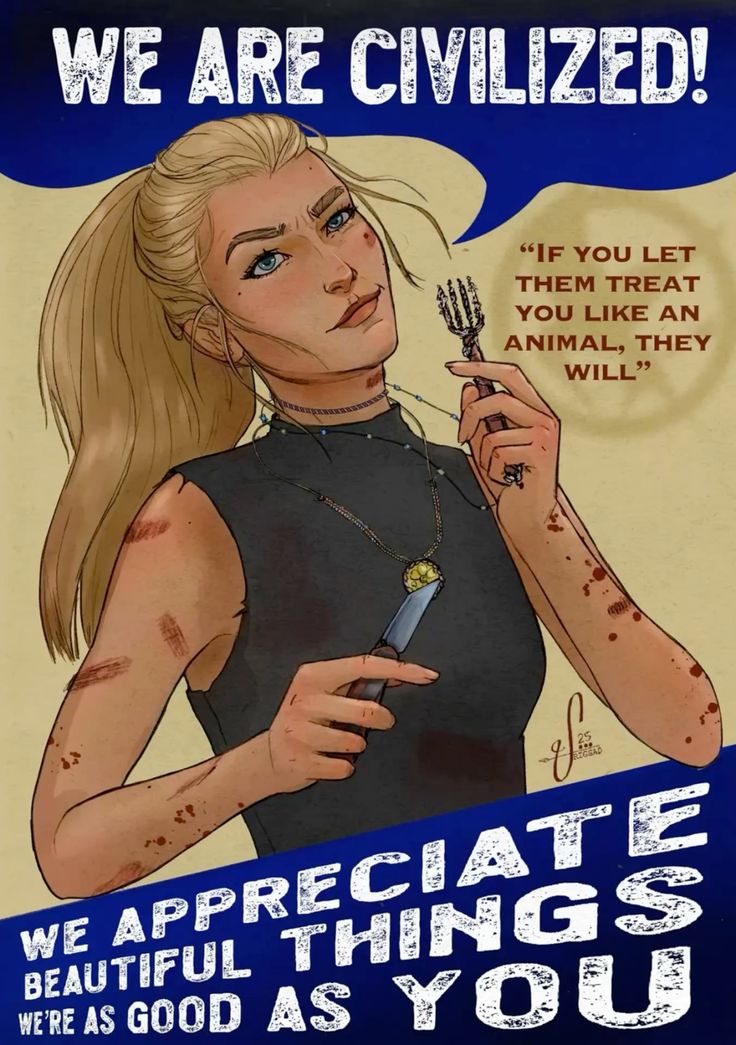
Warning: Spoilers ahead for Sunrise on the Reaping
Author’s Fun Note: Sarshee Whitcomb is likely named for author and poet, James Whitcomb Riley (1849-1916), known as the “Hoosier poet” in Indiana for his accomplishments in children’s poetry and as a best-selling author. Given that Suzanne Collins completed her bachelor’s degree at IU-Bloomington, this local prominent author certainly did not escape her attention.
Aside from the speedy Woodbine Chance who nearly escapes the reaping, another unsung tribute plays a significant role in the plot of Sunrise. Sarshee Whitcomb is introduced to us gradually within the spectacular whirlwind that is the first two chapters (Wow!). Haymitch eventually takes a breath and recalls that Sarshee was the daughter of his Pa’s old crew boss in the mines who was reaped several years earlier. Her father had died of black lung disease before the reaping, leaving Sarshee orphaned and without family visitors. Haymitch therefore went along with his parents to the Justice Building to say goodbye, assuring that she would not be entirely alone during her final minutes in District 12. In one respect this compassionate act serves as yet another indicator of the Seam’s strong community ties and their mutual support for one another. More to the point of Collins’ storyline, however, it is Sarshee’s unwitting story of saying goodbye that sets up one of the most compelling themes of Sunrise — that of “painting posters.”
The first to mention the notion of painting posters was actually Haymitch’s Ma, Willamae Abernathy. During the the drama of the reaping, she asks Haymitch, “You remember what Pa said to the Whitcomb child?” Ma says urgently. “It still goes.” This triggers Haymitch’s memory just long enough to recall his Pa telling Sarshee, “Don’t let them use you, Sarshee, Don’t — ” (SOR 34). At this point, Drusilla interrupts and Haymitch is tazed and forced onto the train. Now underway, he relaxes somewhat and recalls what his Pa had said to Sarshee in the Justice Building:
Don’t let them use you, Sarshee. Don’t let them paint their posters with your blood. Not if you can help it. – Pa Abernathy (SOR 49)
As the story’s narrator, Haymitch then thinks aloud for us to consider what this means. He says, “That’s what Ma wanted me to remember. Even though – maybe especially because – she had just let Plutarch use her and Sid like puppets. She had failed, but wanted me to be strong.” (49) What Haymitch may not have considered yet was that his Ma certainly made this strategic decision to gain some precious time with her oldest son.
We can interpret Pa Abernathy’s original “painting posters with your blood” as a metaphor for how oppressive regimes utilize propaganda to control their narrative. While the “posters” represent the government’s control of information through propaganda, the “blood” represents the population being exploited for the benefit of those in power — or those with the money — which is always one and the same. Basically Pa was imploring Sarshee to not validate the Capitol’s narrative with her own actions or images.
Haymitch puts it another way, just after his name is called during the second take of the reaping. He sees the camera cut to Lenore Dove, who “isn’t crying, so Plutarch won’t get his tearful good-bye. Not from her and not from me. They will not use our tears for their entertainment“ (SOR 28). Perhaps ironically, this latter quote has been deployed extensively for Scholastic’s marketing campaigns to promote the prequel (wink), which further indicates the centrality of Collins’ vital message. Although Haymitch had not realized it yet at the reaping, he had already “painted his own poster” of resistance by refusing to let the Capitol’s propaganda machine use their sorrowful goodbyes for good television.
For his part, Haymitch first makes the connection between resisting authority and painting posters during the tribute parade fiasco. He correctly supposes the Capitol will likely remove Louella’s body to hide their own incompetence and to avoid any potential negative publicity. He reflects, “This is not the blood they want to paint their posters with.” At this point Haymitch’s courage starts to build, thinking of options for active defiance. He considers, “maybe it does make a difference if I resist as best I can. Maybe this is where I paint my own poster.” (78) His next decision is incredible, ending with Haymitch holding Louella’s lifeless body in front of a stunned President Snow.
After Haymitch works out the full meaning of his Pa’s directive, he quickly turns the phrase to his own advantage. As noted above, he considers that he might paint his own poster instead, essentially appropriating the “poster” metaphor as a symbol of resistance against the Capitol. And so it goes for the remainder of the novel. Eventually he shares the poster metaphor with Maysilee, which makes for some thoughtful dialogue between the duo. As the story’s narrator, Haymitch relates the following conversation:
We sit smack down in the clump of katniss, side by side, completely done in. I can barely hear her whisper. “One of us has to win this thing.” My eyes travel up the long stems to the arrow-shaped leaves, the white petals, concealing us from Capitol cameras. “Why’s that?” I whisper back. “One of us has to be the worst victor in history. Tear up their scripts, tear down their celebrations, set fire to the Victor’s Village. Refuse to play their game.” Reminds me of Pa. “Make sure they don’t use our blood to paint their posters?” “Exactly. We’ll paint our own posters. And I know just where we can get the paint.” In a gesture I remember from the schoolyard long ago, she extends her pinkie. “Swear it.” I encircle it with my own and our pinkies lock tight. They will never let me be a victor, not after my attempt to break the arena, but I can swear to try to keep her alive. “One of us paints the posters.” (290)
There’s a lot to unpack here. First is the reference to Katniss and the connotation that she is protecting these early rebels to eventually take on the cause herself. Then Maysilee becomes determined to burn it all down, refusing to “play their game.” This is Haymitch’s opening to suggest they paint their own posters of defiance, to which she agrees. Then she throws in the quip about knowing where they can find the paint, a reference to her ongoing secret about Lenore Dove. At this point the comment passes over Haymitch’s head. The pinkie swear then sets up a life-long promise, to paint the ultimate poster of rebellion against the Capitol and the Games. Though not believing he can win, he promises to his newfound sibling that one of them will get the job done. Later back home, he will make a similar — and even more dramatic — promise to the ghost of Lenore Dove.
Haymitch and Maysilee continue to find ways to “paint their own posters” of defiance within the arena. They often do so in an attempt to maintain their sense of humanity while refusing to validate the Capitol’s narrative that district residents are no better than animals. This is why a defiant Maysilee is intent on demonstrating that all district people are equal to or better (and smarter) than her Capitol counterparts. She demands cutlery and plates on the train, and she lays out a stunning breakfast setting for Haymitch and herself within the arena. She is taking the advice given to Sarshee Whitcomb to heart. When Haymitch thanks her for setting out a “breakfast so fancy,” Maysilee responds, “Thought I’d kick off the day with a poster.” (294) This language becomes a secret code between them in the arena, since those overseeing the Games presumably have no knowledge of Pa’s earlier “poster” metaphor.
Haymitch then makes the connection between Maysilee’s behaviors and her own style of defiance. He reflects,
And I remember her words that first day on the train. “Listen, Louella, if you let them treat you like an animal, they will. So don’t let them.” This morning’s poster says, We’re civilized. We appreciate beautiful things. We’re as good as you. It’s an extension of her whole campaign to show the Capitol our value. Will they know that she’s referring to rebellion? I doubt it. They don’t know what Pa’s told me. A poster could merely be promoting us as tributes. And what harm is there in a few flower napkins anyway? “Nice paint job,” I say, and actually get a smile. (294)
The poster metaphor further relates to another of Collins’ central themes, that of implicit submission. This is introduced in a quote by philosopher David Hume within the novel’s opening epigraph. To paraphrase, Hume (or more directly, Collins) is asking why so many people passively consent to a small cadre of leaders with little initiative to resist or rebel (go here for a more thorough focus on implicit submission and David Hume). By directing Sarshee to not let them paint their posters with her blood, Pa was appealing her to not tacitly give in to authority — to not implicitly submit. Haymitch connects these related concepts in the following exchange with Plutarch:
“No more implicit submission for you, Haymitch Abernathy. Blow that water tank sky high. The entire country needs you to.” I can’t help but think of Pa’s directive to Sarshee Whitcomb. Seems like a lot to lay on my doorstep. Fix this mess for us, or else. (SOR 197)
Basically, to implicitly submit to authority is to allow them to “paint their posters with your blood.” Both concepts imply a lack of willpower or courage to resist oppressive regimes and their leaders. By this time in the story, both Haymitch and Maysilee have found a variety of ways to paint their own posters as noted above. Then Haymitch turns to an act of kindness to demonstrate a shared sense of humanity and exploitation common to all the tributes — Careers and Newcomers alike. In a rather tearjerking scene, he notices Silka taking a break below his tree, and he makes an instant decision to demonstrate unity among the tributes:
I become intensely aware of the three of us, huddled around this tree, the last trio of human heartbeats in the arena. Sad, desperate, but also a rare moment of district unity in the Games. You know what would make it even better? I drop a handful of chocolate balls into the night. A startled sound. The sobs soften to sniffles. A candy wrapper crackles. Quiet. Not a bad poster, all in all. (314)
This is a subtle though powerful statement of kindness, unity, and empathy toward a tribute who is designated by the Capitol to be a lethal enemy. The last thing Capitol residents and oddsmakers want to see are tributes being kind to one another. This is nothing less than a serious act of defiance against the Capitol, against the spirit of the Games (designed to divide rather than unify the districts), and against a cold-hearted president.
This act is reminiscent of a similar act of kindness and compassion that would openly defy the Capitol a quarter century later in the form of one Katniss Everdeen. She comforts Rue in her final minutes of life and places flowers around her body to honor Rue’s death and life. While she may not recognize her act as a conscious act of defiance, it is still precisely that. Kindness has no place in the Games. Katniss had painted her own poster without knowing it, and she would do so many times thereafter (along with many of her peers). Another post — perhaps Part 2 to this one — might apply Pa Abernathy’s big metaphor of painting posters to the original trilogy.
Then in final dramatic fashion — in what may constitute the very climax of the storyline — Haymitch hits the bottle hard and finds himself in a back alley of the District 12 townscape. He awakes to find himself staring at a message of graffiti in bright orange paint: NO CAPITOL, NO HANGING TREE! NO CAPITOL, NO REAPING! He quickly recognizes the message as a “rebel play on the Capitol’s propaganda,” and a “rallying cry beyond the Peacekeepers’ radar” (373). He then makes a stunning connection, saying,
Full of surprises. Full of secrets, even from me. But Maysilee had put it together. Orange paint on her fingernails. This is Lenore Dove’s work. Her sign. Her message to me now. Her reminder that I must prevent another sunrise on the reaping. And it says, “You promised me.” With that, she condemns me to life. (373)
It turns out that Maysilee’s big secret was that she knew what Lenore Dove was up to with the orange paint. She still had traces of it on her fingernails after painting her own “poster” (quite literally) on an alley building wall. And Haymitch also solved the meaning of Maysilee’s earlier comment: “Well, your gal’s full of surprises. Guess she got the jump on us after all.” (373) She knew that Lenore Dove had already been painting her own posters in various ways to reclaim the narrative from the Capitol’s propaganda. She refused from the beginning to not allow the Capitol to use her blood for their entertainment. And finally — now as a ghostly reminder — she has convinced Haymitch to dedicate his life to doing the same. From this point, the trilogy beckons and an unsuspecting daughter of one Burdock Everdeen will pick up Lenore Dove’s baton. The Mockingjay is born.
Credit for Feature Image: Fan Art by “25 riggad,” Pinterest (posted by Tara Lynn)
What Lies Beneath the Snow: How Lucy Gray, Coriolanus, and Sejanus Explore Human Nature Throughout Songbirds and Snakes

(Author’s Note: Material here is adapted from sections of my companion book, Behind the Ballads.)
There’s no doubt that featuring Coriolanus Snow in the first prequel caused some controversy. Despite what Coryo may think, however, it’s not all about him. We find that beneath the surface of Collins’ plot and main character is a grander purpose. The novel was designed in its entirety to encourage our exploration of human nature and the related governing systems that may or may not serve us well. This was no trivial undertaking on Collins’ part (for more, see her incredible Scholastic interview). Differing notions of what explains human beings have led to spin-off political structures around the world, including that of the United States. The first hint of Collins’ fundamental purpose for writing the prequel came with her comments below on the day of its release, May 19, 2020:
With this book, I wanted to explore the state of nature, who we are, and what we perceive is required for our survival. The reconstruction period ten years after the war, commonly referred to as the Dark Days—as the country of Panem struggles back to its feet—provides fertile ground for characters to grapple with these questions and thereby define their views of humanity. (“News Room”)
While easy—or tempting—to overlook in favor of diving into the 10th Games, Collins’ one-page epigraph offers five thought-provoking quotes to set the stage for her story. And probably more to the point for readers and viewers of Ballad, this material helps us unlock the varied worldviews of Coriolanus, Sejanus, and Lucy Gray. What better way to learn about the great thinkers of Europe’s Enlightenment Era than to read an absorbing Hunger Games prequel? The remainder of this post will consider each character in turn.
Lucy Gray, Rousseau, and Frankenstein

Lucy Gray’s philosophy on life is especially highlighted in two conversations with Coriolanus in both the book and film. As the happy couple is leaving District 12 for a promising new life in the wilderness, Coriolanus mentions that people are “mostly awful.” This provides an opening for Lucy Gray. She says, “People aren’t so bad, really… It’s what the world does to them. Like us, in the arena. We did things in there we’d never have considered if they’d just left us alone” (BSS 492). Following more dialogue, she adds, “I think there’s a natural goodness built into human beings. You know when you’ve stepped across the line into evil, and it’s your life’s challenge to try and stay on the right side of that line.” In the so-called “nature versus nurture” debate, she basically believes we are all born as decent and pure beings. Only later does the world potentially corrupt and eat away at that goodness.
Lucy Grays’s overarching philosophy can be matched most closely with that of the Enlightenment thinker, Jean-Jacques Rousseau (1712-1778) (Frankel, “Songbirds”). In the prequel’s epigraph Collins provides a quote from Rousseau’s The Social Contract (1762): “Man is born free; and everywhere he is in chains.” This succinctly states his belief that people are born with inherent goodness until rendered corrupt by society’s myriad of challenges and hardships.
This line of thought translates into Rousseau’s ideal form of government. His central political doctrine is that a state can be legitimate only if it is guided by the “general will” of its members. The people will enjoy the protection provided by the state while still retaining their individual freedoms. In The Social Contract Rousseau tackled what he considered to be the fundamental question of politics—that is, how to reconcile the freedom of the individual with the authority of the state (“Jean Jacques”). He argued that the laws of the state are ideally willed and approved by the citizens themselves. Thus, one is simply following the people’s collective will by obeying the laws. As a result, the subjects of this government essentially remain free. As Frankel suggests, “The Covey model this peaceful, utopian self-rule. If Lucy Gray were to build a government, she would choose this kind” (Frankel, “Songbirds” 41-42). Since people are naturally decent, she believes they can police themselves.
Collins’ epigraph also includes a quote from Mary Shelley’s Frankenstein in support of Rousseau: “I thought of the promise of virtues which he had displayed on the opening of his existence and the subsequent blight of all kindly feeling by the loathing and scorn which his protectors had manifested towards him.” In her book, Shelley applies Rousseau’s theories by creating Frankenstein with a blank slate who has unlimited potential. While he begins his manufactured life completely benevolent and harmless, it is the incessant mistreatment and abuse from ignorant humans that turn him violent. As Frankel writes, “Certainly, the entire Hunger Games series stresses this, with characters from Peeta to Cato explaining that the games have made them killers” (Frankel, “Songbirds”). Lucy Gray demonstrates that people are inherently decent by saving Coriolanus not once, but twice—inside the tribute truck and during the arena bombing. Though genuinely grateful, Coriolanus remains puzzled and wonders why she didn’t simply escape from the arena when given the chance.
Lucy Gray’s behavior counters Coriolanus’ belief that people are self-centered and therefore need to be forcefully controlled. Rousseau’s connection between individual freedom of choice and the innate decency of humans is critical to his argument against authoritarian government. To renounce freedom in favor of another person’s authority is contrary to one’s morality (“Jean Jacques”). Nonetheless, Coriolanus ultimately comes to prefer the strict authoritarian controls promoted by Thomas Hobbes, as explored below.
Coriolanus, Gaul, and Thomas Hobbes

Another opening quote in the epigraph features the philosopher Thomas Hobbes, taken from his Leviathan (1651): “Hereby it is manifest, that during the time men live without a common Power to keep them all in awe, they are in that condition which is called Warre; and such a warre, as is of every man, against every man.” Cutting to the chase here, Coriolanus can be considered Hobbes reincarnate—a veritable avatar of Hobbesian thinking on the state of humanity. And in his time Hobbes believed that humanity’s normal state was one of perpetual war. Not fun. And definitely “not candy,” to quote Ballad’s own Lucky Flickerman.
To better understand Coriolanus, then, we must turn to Hobbes, whose upbringing was shaped by the incessant brutality of the English Civil War. His own childhood was fundamentally affected by observing his country’s political disintegration. He came to believe that even the most oppressive government would be favorable to the horrors and chaos produced by civil war. He further argued that continued stability could only be guaranteed if people agreed to refrain from undermining the regime. Perhaps most apropos for Coriolanus, Hobbes pressed for a reciprocal relationship between political obedience and peace.
To emphasize his point, Hobbes invited his contemporaries to consider what life would be like in a state of nature—or said another way, a society without a centralized government. In return for providing so-called peace and security for the districts, as his propaganda video claims, the districts supply resources the Capitol needs. This basic thinking represents a colonial economic system. Extractive resources like lumber, coal, and grain flow from the exploited colonies (e.g. colonial America) to the colonizing power (e.g. Britain) for the manufacturing of everyday products. In the real world, at least some of those products filter back to the colonies for purchase in peripheral markets. Not so much in Panem’s districts, however.
As one might expect, Hobbes’ preference for an authoritarian state did not sit well with England’s common folk. He spent a decade in exile in Paris, having left England in 1640 and not returning until 1651. His exile was related to the ongoing civil war and his stalwart perspectives on the conflict. Because he supported the royalists, Hobbes may have feared punishment due to his persistent defense of absolute sovereignty. He wrote Leviathan while finishing his sojourn in France, and it was published the year of his return to England in 1651.
Hobbes became famous for his elaborate writings on what came to be known as social contract theory. Essentially, he justified political principles around which a population should unite to govern themselves. Most famously, he applied his theory of the social contract to his astonishing conclusion that citizens should limit their freedoms and submit to an absolute sovereign power. Rather than take him seriously, however, his perspective has often been used as a foil to argue for more democratic political systems (“Hobbes’s”).
Strangely, Hobbes somehow left a giant loophole within his social contract theory. That is, he reserves the right of a government’s subjects—its people—to disobey the state’s commands when deemed necessary. Say what? The people retain the right, he argues, to defend themselves against a sovereign power—that is, to resist, rebel, and disobey—when their lives are in danger, or when their families or even their honor are at stake. Those who have studied Hobbes have been understandably intrigued, if not puzzled, with what he calls the “true liberties of subjects.” More recent commentators have viewed this as the Achilles’ heel of Hobbes’ theory (“Hobbes’s”).
Perhaps had the younger Snow studied Hobbes more thoroughly, he may have taken this important qualification to heart. Katniss and her rebel followers sure did.
Coming full circle, Dr. Gaul reframes Hobbes’ core beliefs as the trifecta of chaos, control, and contract. Coriolanus struggles with these concepts off and on throughout much of the prequel. As a follow-up to his essay on what he liked about the war, Dr. Gaul asks Coriolanus to elaborate on the value of control. Coriolanus tells her, “Chaos happens. What else is there to say?” to which Gaul responds, “Oh, a good deal, I think. Start with that. Chaos. No control, no law, no government at all. Like being in the arena. Where do we go from there? What sort of agreement is necessary if we’re to live in peace? What sort of social contract is required for survival?” (BSS 244).
As readers attempt to follow his thinking, we thereby witness the young Snow’s education in Hobbesian theory. Within his final essay to Dr. Gaul, Coriolanus concludes, “Without the control to enforce the contract, chaos reigned. The power that controlled needed to be greater than the people—otherwise, they would challenge it. The only entity capable of this was the Capitol” (BSS 292).
Upon returning from his adventures in District 12, he encounters Dr. Gaul for a follow-up conversation. She asks, “Did you think about the Hunger Games?” Elaborating from his earlier thoughts, he says, “They’re not just to punish the districts, they’re part of the eternal war… And they’re a reminder of what we did to each other, what we have the potential to do again, because of who we are.” Dr. Gaul then asks who we are, to which he responds, “Creatures who need the Capitol to survive” (BSS 508-9). And right there is the Hobbesian perspective undressed.
Sejanus and John Locke
We gain more insights into Sejanus’ character through his own belief system. Collins’ epigraph also provides a quote from Enlightenment thinker John Locke (1632-1704): “The state of nature has a law of nature to govern it, which obliges every one: and reason, which is that law, teaches all mankind, who will but consult it, that being all equal and independent, no one ought to harm another in his life, health, liberty, or possessions…” (Second Treatise of Government, 1689). As Locke’s quote attests, the natural condition of humans is characterized by freedom and equality. To preserve one’s liberty, health, and property is a natural-born right that everyone enjoys.
However, Locke further recognized that natural law was insufficient to protect people’s lives and property. A set of common laws is also necessary, created through a voluntary “social contract” in which the people willingly give up some power to a central government. Should the government not fulfill its obligation, the people have a natural right to form a new one. Consequently, the public holds the right to resist authority. No less than America’s Founders took Locke’s philosophies to heart as they proceeded with their own populous rebellion. Thomas Jefferson and his peers embraced Locke’s fundamental ideas and inscribed them into the Declaration of Independence.
During the 17th and 18th centuries it was common for philosophers to write about natural rights theory and the notion of the social contract. Natural rights are those that humans are said to enjoy before a centralized government comes into being. For instance, we all have the right to struggle for our own survival, just like other animals. This is Locke’s fundamental view as well. To explain the importance of government, Locke proposes that living conditions in the state of nature are unsatisfactory. In turn, people agree to transfer some of their natural-born rights to a central government to protect people’s lives, liberty, and property. This essentially describes the notion of social contract theory.
Although government is necessary to uphold the people’s will, Locke spends much of his writing in opposition to authoritarianism. Rather, sovereignty resides in the people. He was radical for his time in further calling for the separation of Church and State in his Letter Concerning Toleration. Locke preferred that each of us use our own reasoning to search for truth rather than simply accepting the opinions of so-called authorities (“John”).
With his unwavering concern for human rights, Sejanus becomes the unwitting personification of John Locke and his worldview. We first witness this parallel when an emotional Sejanus explains why he had suggested trading tributes—that is, Marcus for Lucy Gray. He erupts, “It’s just this whole Hunger Games thing is making me crazy! I mean, what are we doing? Putting kids in an arena to kill each other? It feels wrong on so many levels. Animals protect their young, right? And so do we. We try to protect children! It’s built into us as human beings. Who really wants to do this? It’s unnatural!” (BSS 76).
Later he courageously lashes out at Dr. Gaul, arguing, “You’ve no right to starve people, to punish them for no reason. No right to take away their life and freedom. Those are things everyone is born with, and they’re not yours for the taking. Winning a war doesn’t give you that right. Having more weapons doesn’t give you that right. Being from the Capitol doesn’t give you that right. Nothing does” (BSS 160). The film’s Sejanus includes a variation on this powerful statement. He adds that Panem’s government exists to protect everyone—district and Capitol citizen alike. Either way, Sejanus’ notion of inalienable rights could have easily been voiced by John Locke himself.
In sum, with all of these timeless ideas to ponder, Snow may indeed land on top. But what lies beneath may exist the most enlightening story of all.
References
Frankel, V. Songbirds, Snakes & Sacrifice: Collins’ Prequel References and Philosophies Explained. LitCrit Press, 2020.
“Hobbes’s Moral and Political Philosophy.” Stanford Encyclopedia of Philosophy, revised 12 September, 2022.
“Jean Jacques Rousseau.” Stanford Encyclopedia of Philosophy, revised 21 April, 2023.
“John Locke.” Stanford Encyclopedia of Philosophy, revised 07 July, 2022.
“News Room,” Scholastic.com, 04 October 2019.
IMAGES: Lucy Gray headshot (ENews); Sejanus headshot (Lionsgate); Coriolanus headshot (CBR); Featured Post Image (DrydenWire)
Meet the Author
 Tom Paradis

This site inspired by a first-year seminar on the Hunger Games at Butler University.