The World of Panem
Interpreting Society, Geography, and Characters of the Hunger Games
Inside the Baffling Gamemaker Scene in Sunrise: Fight, Flight, Freeze, or Implicit Submission?
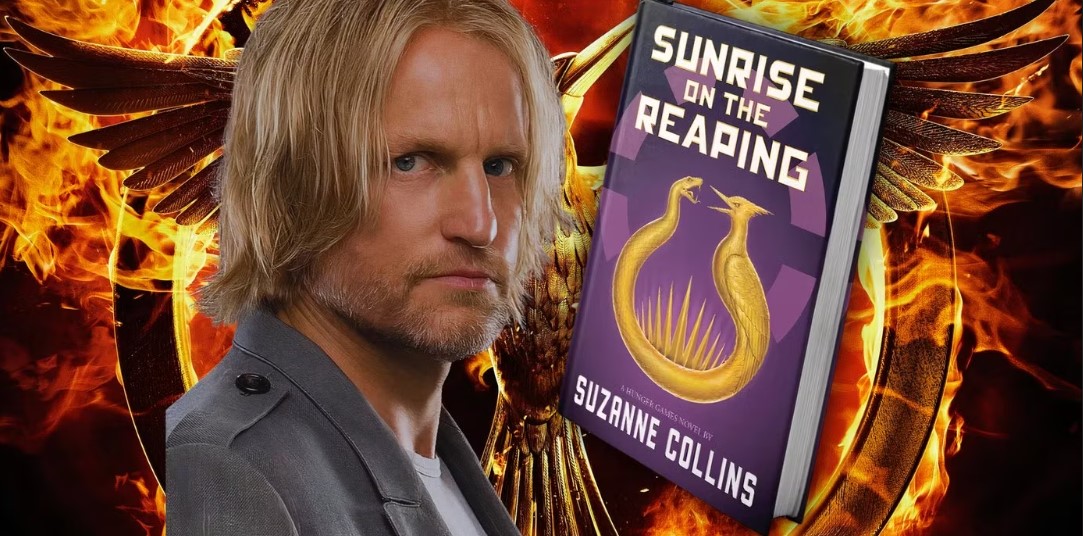
WARNING: SPOILERS AHEAD for Sunrise on the Reaping
After a lighthearted moment with Haymitch and Maysilee tromping toward the hedge, the pair is suddenly surprised by a Career ambush (p. 296). Notably, their water jug breaks, the knife having narrowly missed both of them. So far, this is standard fare for Hunger Games action written by Suzanne Collins. Then in mid-chase, Haymitch finds himself on his butt as he slides on an ice-like substance into a clearing. He tries to make sense of an “incomprehensible image,” namely three young Gamemakers in their signature white outfits, one of them with, well, a mop . . . in the forest (another issue). The two female Gamemakers are diligently repairing something with their high-pitched, whining drill, which Haymitch had mistaken earlier for a giant mosquito mutt.
It can be assumed that the presence of young Gamemakers in the arena is due somehow to Haymitch’s destruction of the water tank. Still, questions remain as to just why they were sent in the first place, and without decent communication, weapons, or instant warning systems — but I digress. Upon the tributes’ slippery arrivals, everyone simply freezes in their tracks, at least for an instance while they all take in the bizarre scene. Haymitch comes to a halt only a few feet from the Gamemaker trio, and he conjures an image of slime that resembles the product of boiling okra (say what?). This is only half of why this scene is so strange on its own merit, but let’s focus on Haymitch’s response and that of others. Was he really so worried about repercussions from the all-powerful Capitol? Even he’s not so sure later. It’s more likely that a combination of implicit submission and psychological response mechanisms can better explain his own (in)actions. Consequently, Haymitch’s brain is likely more complicated than Plutarch (or David Hume) would have us believe.
Summarizing the Gamemaker Scene
Much like his confused readers, Haymitch tells us that everyone at the clearing initially freezes to absorb the situation. Breaking the ice (pun intended), Silka then rams into the clearing and goes down, knocking over a bucket of slime in her clumsiness. This is at least worth a chuckle, but also causes the indignant male Gamemaker to display his Capitol-esque sense of superiority and Effie-like focus on the mundane with a “Hey! Watch it!” (297). This is ironic, given Haymitch’s observation that mopping is a “bottom-of-the-ladder job,” then adding what we are all likely thinking: “so, finding a Gamemaker at it seems bizarre.”
Agreed. This whole scene seems totally out of place and time — both at this point in Collins’ story line, and within a hyper-controlled if damaged arena. In any case, the naive Gamemakers seal their collective fates when they accuse the tributes of being in “absolute violation of the rules,” and that if they don’t withdraw, “there will be repercussions.” Maysilee lets loose with “That’d be a lot more impressive if you weren’t shaking like a leaf,” as she readies her blowgun. She recognizes they are expendable and tells them so, since they were apparently sent here to “tidy up for us” (297). As the trio makes a hasty retreat back to the mutt portal, Maritte’s trident flies over Maysilee and kills the mopper, while Maysilee sends a poison dart into the woman with the drill. The lone survivor is so scared she jumps down into the portal only to meet her own death on Sub-A. This leaves Maritte, Silka, and Maysilee to face off until the bombs and tear gas start falling, and everyone clears out to recover. The hovercraft conveniently leaves Haymitch and Maysilee alone, however, as he guesses it could only track one set of tributes. Alrighty then.
More than Implicit Submission?
For a plot scene only two pages long (297-98), the number of questions it elicits could easily fill twice that space. Perhaps this is a credit to Collins’ own brilliance with creative writing and storytelling. If nothing else, this strange encounter with Gamemakers inside the arena encourages us to think more deeply — always one of Collins’ main goals. In that spirit, let’s try to answer Haymitch’s own question of why he reacts as he does in different situations.
Haymitch’s Implicit Submission: Does Collins intend this scene as another instance of implicit submission? To some extent, sure. As Maysilee calms down and forgives Haymitch afterward, he reflects seriously on why he froze up and did nothing, telling us, “I think of the moment with the knives in training, of the country as a whole, and how we just keep submitting to the Capitol’s rule. Why?” (300) This question actually encapsulates Collins’ fundamental lesson of her entire novel. In the book’s epigraph (page of quotes), she features a central quote from Enlightenment philosopher David Hume, who observes, “Nothing appears more surprising to those, who consider human affairs with a philosophical eye, than the easiness with which the many are governed by the few; and the implicit submission, with which men resign their own sentiments and passions to those of their rulers.” If Collins intended just one central purpose for this otherwise crazy scene inside the arena, this is probably it. Much of the dialogue that follows between Maysilee and Haymitch is devoted to this very question. Still, poor Haymitch fails to land on a satisfactory answer for himself as he narrates below:
Well, I feel terrible, and utterly lack a defense. My knife was in hand, the Gamemakers in easy reach. No one better positioned to kill them. Plutarch’s voice taunts me. “The question is, why didn’t you?” I can’t say I’m not a killer anymore. That leaves brainwashed or cowardly… I don’t know what it was. Just programmed to be walked all over, I guess.
A despondent haymitch abernathy
Fight, Flight, Freeze, or Fawn: Another possible answer to help understand his responses to stressful situations might involve human psychology more than implicit submission (at least in isolated cases like this one). Many of us have heard about the “fight or flight” mechanism, whereby each human will instinctively either flee from a threat or face it head on. This article from Simply Psychology provides a useful overview of these bodily reactions, including two additional ones more recently recognized by scientists: freeze or fawn (see below). The author begins bluntly, “The primary function of the brain is not to keep one happy or calm, but to keep one alive.” This seems somehow fitting for our future Haymitch, who sarcastically advises Katniss to “stay alive.” This is admittedly one’s primary goal inside the arena — aside from various altruistic efforts to keep someone else alive instead (I’m talking to you, Katniss, Peeta, Mags, Johanna, and so forth…)
Rather than simply succumbing to implicit submission and lack of political willpower, we might better attribute Haymitch’s inconsistent responses to complex human psychology and brain functioning. Here are the four recognized response mechanisms as adapted from the article cited above:
- Fight: Aggressively confronting or standing up to an immediate threat or crisis.
- Flight: Escaping danger by removing oneself from the situation.
- Freeze: Becoming immobile or unable to act toward an immediate threat.
- Fawn: Trying to either appease or please the threat to avoid conflict or harm.
Given Collins’ ongoing interest in raising awareness of mental health issues and trauma, this topic applies to Sunrise quite well. As Haymitch admits himself, he personally froze during training when they had an opportunity to attack the Peacekeepers, and he apparently froze here again during the Gamemaker encounter (though one could argue that Maysilee and Maritte clearly didn’t need his help). Sure, an “implicit” fear of the powerful Capitol may have contributed to both instances. But then, the kinder version of Maysilee also gave him credit for a number of courageous acts, including stealing the chariot during the ill-fated tribute parade, carrying Louella’s body up to President Snow, and plenty of other instances that Maysilee has yet to learn about (let’s not forget him drinking the milk in Plutarch’s mansion, or keeping Lou Lou’s body away from the hovercraft). And Haymitch does choose to fight in at least two violent scenes: one when he kills two Careers in self defense just prior to Panache’s appearance, and later when he willingly takes on Silka in the arena finale. He could have frozen or flown instead. He might have even demonstrated a version of “fawning,” when trying to talk Panache down from attacking him (though this may have just been smart strategy). What explains these contrasting reactions in different situations?
It could be argued that Haymitch demonstrates all four responses depending on the situation, as reviewed above. In certain cases like the Gamemaker incident, he simply freezes with inaction. This becomes clear from Maysilee’s interpretation later when she yells at him for apparently not having her back. Another even more pertinent question might be why both Maysilee and Maritte chose to attack the Gamemakers in the first place. They were clearly defenseless and scared out of their wits (the third of whom instantly took the “flight” option and jumped to her death). Even Silka questions this behavior, correctly stating they would be punished for it (by not being allowed to win). Haymitch had also frozen with indecision in the District 12 square during the reaping. There are consequently plenty of behaviors here to interpret, as the Gamemakers and tributes alike respond in a variety of unpredictable ways in the face of an imminent threat.
Aside from trying to placate Panache, one could not likely accuse Haymitch of fawning, either. At no time does he seek to please President Snow or his minions. In contrast, the master of fawning behavior seems to be Plutarch, and Haymitch despises him for it. According to the article cited above, “fawning helps avoid conflict and keeps important relationships intact — even if those relationships aren’t healthy.” The act of fawning involves some variation of appeasement or submission to avoid harm, which Plutarch arguably does when kissing up to President Snow in his mansion or falsely reassuring Drusilla about her own appearances and behaviors.
Just as Maysilee decides to do, we should probably give Haymitch some leeway on his various responses to continuous traumatic situations, and as a sixteen-year-old no less. More important, he should certainly give himself a break as well (easier said than done, of course). Between these ingrained, evolutionary human responses and Hume’s question of implicit submission, Haymitch can’t catch a break. He and all of his counterparts have enough on their plates just to stay alive while retaining some semblance of personal dignity. It further reinforces perhaps the biggest lesson of Sunrise, that the science of human psychology is in itself a complex arena to venture into. A big round of thanks goes to Suzanne Collins for helping bring more of this to light — not to fawn or anything.
Meet the Author
 Tom Paradis

This site inspired by a first-year seminar on the Hunger Games at Butler University.