The World of Panem
Interpreting Society, Geography, and Characters of the Hunger Games
Trajan Heavensbee: A Featured Ancestor in Sunrise Appears First in a Surprising Place.
WARNING: SPOILERS AHEAD for Sunrise on the Reaping
Beyond all the familiar names and revelations we encounter in Sunrise, none made my jaw drop more than the mention of Trajan Heavensbee’s portrait in the family mansion. We “meet the Heavensbees” through Haymitch’s cynical eyes while being introduced to Plutarch’s home. “There’s no shortage of Heavensbees,” Haymitch notes dryly, as “they watch over us through several halls, flaunting their signature possessions … Dripping in wealth, every last one of them” (SOTR 120). He then turns into a room to find a portrait of “an old man with a white beard holding out an open book,” who appears to be smiling down from above the fireplace. “Trajan Heavensbee,” Plutarch tells him, one of his great-great (he forgets how many) grandfathers. He adds, “The only one who’s been of any use really. This was his library.”
And this is where I lost it.
Prior to Plutarch’s introduction of his apparently storied ancestor, it is all but certain that Trajan does not appear in any of Collins’ previous four books. Only his more recent — and lesser known — ancestor, Hilarius, makes cameo appearances in Songbirds and Snakes (book and film alike). Hilarius had mentored little Wovey from District 8 in the first prequel. Even President Snow recalls him in Sunrise, telling Haymitch that he had been one of his classmates, a “useless whiner” (127). We do not yet know how Hilarius is related to Plutarch, though that might be another story. More to the point here, Haymitch spends some quality time in Trajan’s extensive library, mostly reflecting on the gross inequities between the wealthy Capitol oligarchs and the working-class district people.
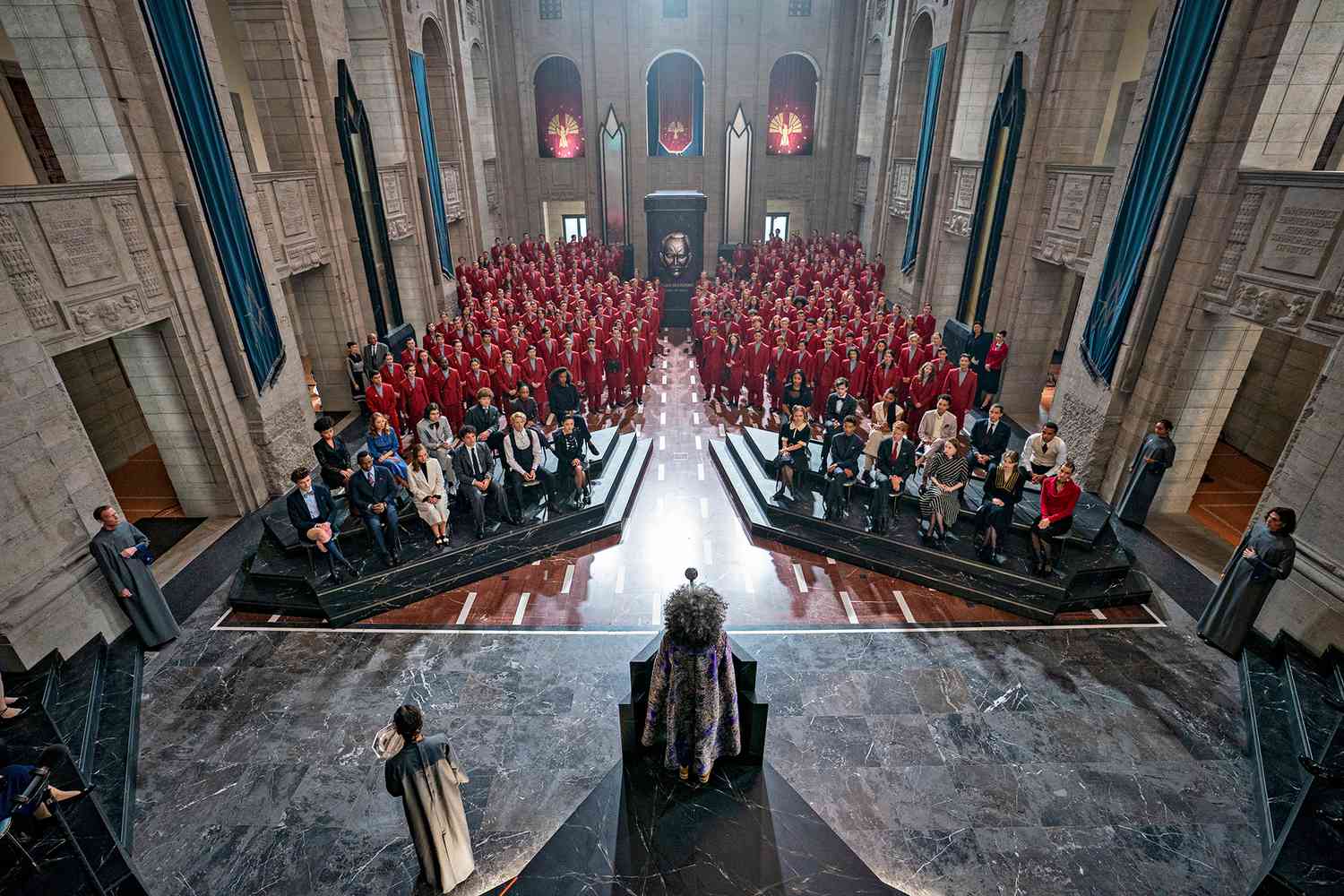
In a strange type of “reverse Easter Egg,” however, Trajan does actually show up elsewhere prior to his formal introduction in Sunrise. Viewers of the Ballad film can sneak a peek of him while the student mentors are watching the reaping ceremony from Heavensbee Hall. We see Dean Highbottom (Peter Dinklage) explaining the Games while he shuffles down the center isle. Behind him is an oversized if forgettable gold-plated bust of someone’s head, likely an important figure to Panem. Curious as ever, I spent some effort craning my neck to look behind Highbottom to see the inscription, which is never fully visible in one shot. But we can see enough to put together the phrase, “Trajan Heavensbee, Father of Panem.” It is in this way that we are subtly introduced to Trajan through a rare Easter egg in a film that points to a later book that had not yet been released (see below).

This raises several questions, including who was responsible for placing Trajan as a subtle backdrop in the Ballad film, and whether they were aware that Collins would feature him in her later, as-yet unannounced Sunrise prequel. I had presumed that the Ballad producers had invented him for some reason, perhaps just to enhance the Heavensbee Hall filming site (in the actual “Bear Hall” of “Old City Hall” in Berlin). Director Francis Lawrence and his producer colleagues are well known for placing all sorts of Easter eggs and callbacks in that film, as in the previous films. There was no mention that I found of Trajan in my numerous re-reads of the Ballad novel. But then Trajan makes his glorious introduction in Sunrise, yet still not mentioned as the “Father of Panem.”
What most likely explains Trajan’s appearance in Ballad prior to the Sunrise novel has to do with an interview by Scholastic’s David Levithan (source coming…). Collins had already finished at least a draft of Sunrise on the Reaping by December, 2023 when she began sharing it with Scholastic. She was clearly already writing it during the production of the Ballad film, which was released only a month prior to Collins sharing her draft for Sunrise. It would make logical sense, then, that Collins likely suggested the addition of Trajan’s plaque to the Ballad film while serving as a consultant on its production. She already knew that Trajan would make his formal appearance in her as-yet unannounced 2nd prequel. This is unsubstantiated, of course, though is the only logical conclusion I can produce at this point.
As for the deeper meaning of Trajan’s name, one should not be so surprised that he fits well into Collins’ naming system for her characters. Those from the Capitol are imbued with historical names of important Classical or Roman figures, or at least those who appear in Shakespeare’s various plays (especially from the likes of “Coriolanus” and “Julius Caesar”). Trajan is no different. His historical counterpart is considered to be the second of the “Five Good Emperors” of Rome, from 98-117 CE. He was one of Rome’s more philanthropic rulers who oversaw extensive public works projects and led Rome to its greatest territorial extent. It would make logical sense (in the spirit of Lenore Dove once again) that Collins tapped this relatively favored Roman ruler for the eventual founder of Panem.
It turns out that the historical Trajan knew the Greco-Roman scholar and historian, Plutarch, quite well. Classical Plutarch had earned many followers and admirers during his lengthy life, becoming quite a celebrity within the Roman Empire. His public duties eventually took him to Rome where he lectured on philosophy and made numerous friends as well. He was further recognized by the emperors Trajan and Hadrian, with Trajan having bestowed the high honour of ornamenta consularia upon him. As “Lucky” Flickerman might say to Collins for her creative character parallels once again, “Take . . a . . bow!”
Meet the Author
 Tom Paradis

This site inspired by a first-year seminar on the Hunger Games at Butler University.

 The World of Panem