The World of Panem
Interpreting Society, Geography, and Characters of the Hunger Games
Two Generations of Donners: The Sweetshop, Marshmallows, Mayor’s House, Piano, Merrilee’s Illness, Canaries, and the Mockingjay Pin (Whew!)
WARNING: SPOILERS AHEAD for Sunrise on the Reaping, and the Trilogy!
Haymitch first introduces us to the Donners’ sweetshop when he buys a “little white paper bag of multicolored gumdrops — Lenore Dove’s favorite,” to share with her later (16-17). The purpose of this sentence is twofold: first, to reintroduce us to the Donner family, and second as a sinister foreshadowing of Lenore Dove’s later fate. Lenore Dove claims she can detect the unique taste of each “rainbow” gumdrop, though Haymitch is convinced they all taste the same. This latter statement likely foreshadows a later discussion between Maysilee and Haymitch about the stale marshmallows her parents sell, indicating their habit of deceiving or short-changing their customers. Maysilee is not particularly proud of this fact, and she even ties it in with the ongoing conversation around propaganda. Quite humorously, the marshmallow thread surfaces at least two other times, including when Haymitch admits that he has “fallen for the ‘chewy marshmallow’ scam more than once” (47). And discerning fans have not overlooked the “rainbow” gumdrops, providing a subtle callback to Lucy Gray’s iconic rainbow dress and related imagery in Ballad. This has led to unending conversation in the fandom about just who is Lenore Dove’s mother (Hint: try Maude Ivory, as argued in this post. Collins seems to point us in that direction herself).
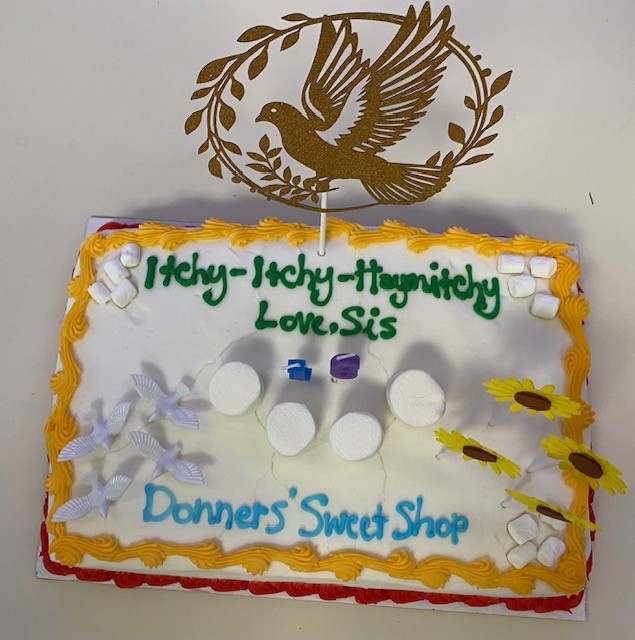
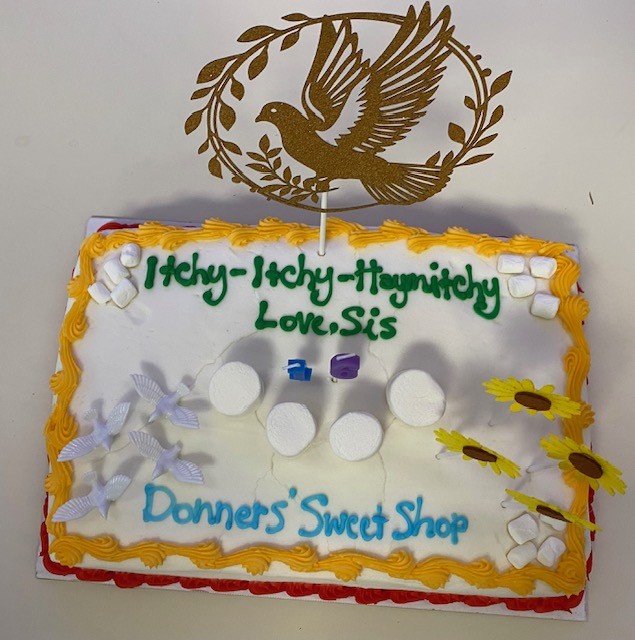
Above: A “Maysilee Cake” for Haymitch’s Birthday. What symbols can you find from Sunrise? (Final Butler FYS Class Celebration, April 2025.)
It turns out the sweetshop survives into Katniss’ storyline, but barely. When describing the Capitol for the first time, Katniss says, “All the colors seem artificial, the pinks too deep, the greens too bright, the yellows painful to the eyes, like the flat round disks of hard candy we can never afford to buy at the tiny sweet shop in District 12″ (THG 59). The topic emerges one more time much later in Catching Fire, just before Katniss learns she will be going back into the arena for the 75th Games. She and her family are watching the Capitol’s broadcast to introduce the Quarter Quell, and Katniss’ mother (Asterid) shares a memory, saying, “I had a friend who went that year.” She continues, “Maysilee Donner. Her parents owned the sweet shop. They gave me her songbird after. A canary” (CF 172).
This is our first introduction to Maysilee Donner, and the first time Katniss and Prim have heard about her as well. The big news for purposes here is that Asterid inherited Maysilee’s canary from the twins’ parents. One might wonder why Merrilee didn’t keep the bird, though Collins doesn’t provide any obvious reason. Perhaps the Donners were too distraught (see section about Merrilee below), and Asterid had probably been the twins’ closest friend. The canary reference is also worth noting. Later in Catching Fire, Beetee tells his fellow tributes that Wiress is intuitive and can sense things before anyone else, like a canary in a coal mine. Being from Twelve, Katniss explains to Finnick and Johanna how a canary is deployed for warning miners about bad air when the bird stops singing. This is one of many historical references to coal mining throughout the saga (another topic).
And now, we discover a fun callback to the canary in Sunrise! True to Asterid’s story in Catching Fire, Maysilee tells her peers at the tribute apartment that she had a pet canary named Lou Lou. She recommends using this name to identify “fake Louella,” and Haymitch and the others end up agreeing. And this is how Lou Lou gets her name, from Maysilee’s songbird (SOTR 139). Also worth a chuckle is Haymitch’s comment that Lenore Dove was “infuriated” that anyone would cage a songbird. This certainly didn’t help diffuse the animosity she and Maysilee had felt for one another.
Back to the sweetshop, the Donners are no longer associated with the business by the time of the trilogy (and “sweet shop” is now one word in Sunrise…). As noted above, Asterid had mentioned Maysilee’s parents in the past tense, and Katniss mentions nothing of the current owners. Merrilee has long since married Mayor Undersee and moved into the mayor’s house. Nor do we know the eventual fate of the twins’ parents, Mr. and Mrs. Donner. And as for Maysilee, well, she wasn’t escaping the arena alive to run the shop herself — whether she wanted to or not (she emphatically did not). It’s cool that Collins took her original little mention of the “sweet shop” and created a whole backstory about the Donner family.
A Piano at the Mayor’s House
This brings us to the mayor’s house, which is chocked full of lore and connections throughout the trilogy and both prequels. We return to this storied location rather promptly in Sunrise, though it remains questionable whether it is the same physical house. As Haymitch is introducing us more to Lenore Dove’s background, we learn that she is something of a standout on the piano. After all, this is her Covey instrument, with ivory keys and all. There’s a lot of meaning here as well. First, Haymitch mentions that the “only real piano in District 12” is found at the mayor’s house. Lenore Dove and her uncles had worked out a deal with the mayor that allowed her to practice occasionally, in return for playing it during various hosted events there (SOTR 8-9). This strategically sets up Maysilee’s secret about Lenore Dove and her orange fingernails (see related post on this topic). The whole backstory to her secret plays out right there at the mayor’s house, during one of Lenore Dove’s performances.
Collins drops further hints about the succession of mayors as well. Haymitch informs us in passing that Mayor Allister presides over the 50th Reaping. He says, “The mayor tries for a neutral tone, but her voice leaks disapproval in a way that guarantees she’ll be replaced soon” (SOTR 20). The gender pronoun is also well placed, indicating that — at least occasionally in District 12 — there is some level of gender equity in leadership roles as there is elsewhere in Panem. More notable is Haymitch’s comment about the mayor’s distaste for the Games, and that she might not be around much longer because of it. Mayor Allister does not seem to be connected by family to the Donners (though it’s possible I’m missing more subtle details), and perhaps Collins’ narrative here indicates an opening for this to eventually happen with a new mayor. I had personally wondered with the release of Sunrise whether we would learn more about a younger Mayor Undersee, likely then a similar age to Maysilee and friends. Alas, we do not. But it does set up the opportunity for the future mayor to meet and marry Merrilee Donner and to eventually bring Madge into the world.
And it should be noted that Mayor Undersee seems like a decent guy himself, perhaps with a relatively kind heart like that of Mayor Allister. Katniss infers in the first book that Mayor Undersee deserves credit for reducing the heavy hand of the Capitol in District 12. When speaking of how badly she and Gale could have been whipped or worse for hunting, she tells us that “our mayor, Madge’s father, doesn’t seem to have much taste for such events” (THG 203). This likely points to why President Snow did not ultimately spare Mayor Undersee or his family from the firebombing of Twelve, as he was certainly not improving the lax enforcement. Katniss confirms there was no sign of the family upon her return to Twelve after the war.
A more uplifting topic involves that lone piano in District 12. It is no accident that Haymitch (i.e. Collins) pulls this into Lenore Dove’s story in Sunrise. Beyond the mayor’s house, “she makes do with the instrument she is playing now, which she calls her tune box” (SOTR 8-9). Haymitch describes it earlier as an “ancient piano accordion,” which in all probability is handed down from its former owner in Ballad, Billy Taupe (yes, wow!). Where else would she acquire such a thing? Given that Lenore Dove’s character and dress habits reflect a blending of her former Covey relatives, this is likely yet another connection that Collins teases us with.
While the accordion apparently goes missing by Katniss’ time, the mayor’s piano does not. In fact, it takes center stage once again at the mayor’s house for a second generation. Returning to the trilogy, it turns out that Madge had played the piano as well, right there in her own home! What other lone piano could possibly exist? Knowing Collins as we do (or think we do), this has to be the very same piano handed down from Mayor Allister’s time. The piano serves as a sort of stage prop for an insightful conversation between Madge and Katniss in Catching Fire. When Katniss visits Madge at her home for the Victory Tour dinner on the eve of the Harvest Festival (how or why the Harvest Festival even exists remains a curiosity), she informs us that Madge has been trying to teach her the piano, though Katniss prefers mostly to listen to her play. In turn — perhaps more amusingly — Katniss has been taking Madge to the woods to learn how to shoot (CF 87). The main point here, however, consists of the clever interconnectedness between Sunrise and the trilogy between Madge, Lenore Dove, Maysilee, the mayor’s house, and that lone piano in District 12.
Merrilee Donner, Then and Now (Sunrise and Trilogy)
It’s during that same conversation between Katniss and Madge that we gain an important piece of information about Madge’s mother, Merrilee, as we know her now. Madge says that her parents aren’t around much, due to her father’s mayoral obligations and her mother’s recurring illness. Katniss explains to us that Madge’s mother “gets fierce headaches” that keep her confined to bed for days. On just such a day during Katniss’ recent visit, they couldn’t play the piano because “the sound caused her mother pain” (CF 87). This is a curious choice of words, as we are meant to assume the piano is making Merrilee’s headaches worse. But the “pain” could be interpreted as mental anguish or triggering memories from her youth when Maysilee was abducted for the Games. Merilee had apparently depended upon her twin sister quite a bit. Haymitch tells us as much in Sunrise, saying that “Merrilee isn’t too bad, except she tends to go along with everything Maysilee does” (SOTR 41).
Merrilee’s chronic illness and related trauma were actually foreshadowed in Sunrise. In a touching moment during the 50th Games, Maysilee asks Haymitch a heart-wrenching question about whether Merrilee will still be a twin after she dies in the arena. Haymitch reinforces that she will always be a twin, adding that he also had twin sisters before they died prematurely just after birth. He had even looked to the Donner twins out of curiosity about what it might have been like to have twins for sisters. Maysilee then considers what Merrilee’s life will be like back in Twelve without her. She confirms the foreshadowing by simply stating, “This is going to be hard on her” (SOTR 283). Haymitch could foresee a troublesome outcome as well. As a reflective response to Maysilee, he tells us:
After the Games comes the fallout from the Games. Spreading out like ripples in a pond when you toss in a rock. Concentric circles of damage, washing over the dead tributes’ families, their friends, their neighbors, to the ends of the districts.
Haymitch Abernathy (283)
Soon thereafter, these “ripples in the pond” wash over the surviving twin, Merrilee. Based on Madge’s own comments 25 years later, a serious part of Merrilee’s heart and identity had been lost with Maysilee’s murder. While it is satisfying to see that Merrilee would go on to have a loving family of her own, she was clearly never the same person after the 50th Games.
Even with the privilege afforded to the mayor’s family, effective treatment for Merrilee’s own mental illness and associated headaches was hit or miss. She does have access to the Capitol’s pain killer called morphling, which becomes apparent when Katniss’ mother is trying to stabilize Gale after the whipping. Everyone is surprised when Madge appears at the door in the middle of a blinding snowstorm. She is humorously described as a “snow-caked figure” delivering a package to Katniss, who continues to narrate:
She holds out a small, damp cardboard box to me. “Use these for your friend,” she says. I take off the lid of the box, revealing half a dozen vials of clear liquid. “They’re my mother’s. She said I could take them. Use them, please.” She runs back into the storm before we can stop her. “Crazy girl,” Haymitch mutters as we follow my mother into the kitchen.
(Katniss Everdeen, CF 115-116)
Upon questioning, Katniss’ mother (Asterid) demonstrates the purpose of morphling as she injects it into Gale. Of course, this is Collins’ own twist on morphine. More to the point, not only is Madge taking another risk by sneaking past authorities (as she did to join Katniss in the woods), she is further demonstrating her family’s access to important medications that many in Twelve do not enjoy. This is only one instance of Collins’ ongoing commentary on extreme health-care inequities within our own society. That said, even the privilege of the mayor’s family is limited. When Katniss suggests to Madge that they take her mother to the Capitol to “fix her up” (smile), Madge explains this is not possible without a special Capitol invite (CF 87).
The Mockingjay Metaphor and a Pin for Katniss
Beyond a doubt the most significant link between Madge and Maysilee is the now-famous mockingjay pin. Much like Lucretius “Lucky” Flickerman in Ballad, this little gold token needs no introduction. Essentially Katniss becomes an unwitting participant in the generational saga of the Donner family. For quite some time she treats the gold pin with indifference — either forgetting about it, questioning it, or trying to give it away — first to Rue, then back to Madge (both of them refuse, of course). Cinna keeps returning it to her right up until his death. It seems that Katniss had showed little more interest in the pin than had Maysilee before her. Katniss was simply dumbfounded when Madge appeared to say goodbye after the reaping. When Madge asks her to wear the pin in the arena as her token, Katniss thinks, “Wearing a token from my district is about the last thing on my mind” (HG 38). But Madge persists, leaning in to fix it onto Katniss’ dress. Then she makes Katniss promise to wear it, leaving her clearly befuddled. Madge follows this with a kiss on the cheek, leading Katniss to think, “maybe Madge really has been my friend all along.” Little did Katniss know just how meaningful that pin was to the Donner family, going back several generations. It is difficult not to believe that Collins had a plan for continuing this story all along…

THE MOCKINGJAY AS METAPHOR: Later in Catching Fire, Katniss and Madge become closer friends, even visiting each other’s homes (Madge likes Katniss’ home better). Katniss admits to the awkward process of learning how to be friends in the first place. Both of them had been content to be alone at school until they started eating lunch together. Then during the Victory Tour dinner at the mayor’s house, Katniss finally asks Madge about the mockingjay pin. The only clue from Madge — who didn’t know much herself — was telling Katniss that it belonged to her aunt, and that she thinks “it’s been in the family a long time” (CF 91). How true! It is during this same conversation when Collins reveals a significant metaphor between Katniss and the mockingjay bird. After debating with Madge whether mockingjays were natural songbirds or not, Katniss tells us, “A mockingbird is just a songbird. A mockingjay is a creature the Capitol never intended to exist… They hadn’t anticipated its will to live” (CF 92).
In this way, the mockingjay bird and its symbolic pin serve as a metaphor for Katniss’ own life and identity. Neither mockingjays nor Katniss were supposed to exist, and the Capitol certainly did not anticipate either of their respective wills to live. Collins had confirmed this metaphorical interpretation during a past interview for School Library Journal in 2010, prior to releasing her third novel, Mockingjay. She explains, “Katniss is something like a mockingjay in and of herself. She is a girl who should never have existed. And the reason she does exist is that she comes from District 12, which is sort of the joke of the 12 districts of Panem.” She adds later, “So in that way, too, Katniss is the mockingjay. She is the thing that should never have been created, that the Capitol never intended to happen.” It so happens, then, that Madge’s pin — descended down from Tam Amber to Maysilee’s grandmother, father, and herself — becomes the fundamental symbol of Katniss’ own will to survive in Twelve, and later still, the unifying symbol of rebellion that brings down the Capitol. (See this post for a Mockingjay Pin Family Tree which traces its path through District 12.)
The big, big, big question thus remains to this day (for many of us), as to just why did the very first Hunger Games film not include such a vital yet overlooked character as Madge? Instead we have Katniss (Jennifer Lawrence) being gifted the pin at the Hob by someone many presume to be Greasy Sae (but likely isn’t, since she’s not selling soup or other food). Though certainly done to shorten the film’s run time and cast of characters, this shift in the storyline greatly distorted the pin’s origin story and the Katniss-Madge relationship. Of course, hindsight is 20/20 as they say, and screenwriters likely had not yet envisioned two prequels emerging a decade later. At least now we can trace the pin all the way back to the Covey’s Tam Amber, though further mysteries remain about Maysilee’s grandmother and how she acquired the pin herself. Perhaps Collins is saving this loose end for a future third prequel? (See this post about more loose ends in Sunrise.)
The origin story of the famed mockingjay pin is delivered to us gradually in Part 1 of Sunrise. Keeping an eye out for any hint of the pin’s backstory, I immediately smiled upon reading the following passage:
Besides playing a crazy good mandolin, Tam Amber’s the best hand forger in District 12. He’s the go-to blacksmith for new gadgets or broken parts for old machines. Burdock has a dozen of his arrow tips that he treats like gold, and some of the richer folks in town have jewelry he made from actual gold or silver, melted down from heirlooms and refashioned.
Haymitch abernathy (SOTR 11-12)
Not only do we learn of Tam Amber’s continued existence and his later career choice, the fact that richer folks have some of his jewelry made from gold was enough to raise eyebrows. He has to be the designer of the mockingjay pin, I mused upon the first read. Later we learn more of the backstory, along with a subtle statement about Maysilee’s grandmother that is easy to overlook (I admittedly did just that upon the first read). When Maysilee asks to see Haymitch’s flint striker on the train because she collects jewelry, Haymitch finally tells us the story:
You don’t hear that much in District 12, but Mr. Donner spoils his girls rotten. Lenore Dove told me that, on their thirteenth birthday, he gave them pure gold pins that had belonged to his mother. They’d been fashioned by Tam Amber over thirty years ago. I never saw them, but Merrilee’s featured a hummingbird and Maysilee’s a mockingjay, birds being one of the Covey’s great loves. Apparently, Merrilee wore hers all of five minutes before she lost it down a well. Maysilee threw a fit over hers, saying a mockingjay was an ugly old thing and why couldn’t Tam Amber melt it down and make her something pretty like a butterfly? When he declined, she stuffed the pin in the back of a drawer and never wore it once.
Haymitch Abernathy (SOTR 54-55)
And thus we discover that Madge’s pretty gold pin in The Hunger Games was born three generations earlier by the Covey’s own Tam Amber, along with the hummingbird pin for Merrilee. The statement above is easy to overlook because Haymitch says somewhat cryptically that the pins had first belonged to Mr. Donner’s mother. Maysilee then buries it in a drawer before being reaped for the Games. She does agree to give the pin a second look, due to Haymitch’s prodding later — if she makes it out of the arena. But ultimately we do not yet find out how the pin is transferred from Maysilee’s drawer to Madge decades later. Whether Merrilee or Mayor Undersee eventually discover it and give it to Madge as a memento remains a mystery (and perhaps Collins is content to leave it that way). At least now we have a pretty clear path for the Mockingjay pin, from its creator, Tam Amber to Katniss (see this District 12 and Mockingjay Pin Family Tree).
What remains to be seen is the role of the Donner twins’ grandmother in all of this, as she could have been gifted the pins from Tam Amber if they were somehow related. Or, perhaps she purchased them as yet another of his customers from the Merchant Class. What is clear is that Maysilee’s grandmother was an influential part of her life, and that she lived and worked at the Donners’ sweetshop (having snuck candy to Haymitch on occasion). There is still much to learn about her role in the family and — as numerous fans are now considering — a possible family connection between Maysilee and the Covey (see this post for more on this notion).
Still wondering about that strawberry ice cream conveniently ignored above? Check out this post which separates out this conversation as its own topic.
2 Comments on “Two Generations of Donners: The Sweetshop, Marshmallows, Mayor’s House, Piano, Merrilee’s Illness, Canaries, and the Mockingjay Pin (Whew!)”
Leave a comment
Meet the Author
 Tom Paradis

This site inspired by a first-year seminar on the Hunger Games at Butler University.

 The World of Panem
Pingback: A Strawberry Easter Egg: Why Mags Sends Ice Cream Into the Arena and Connections to the Trilogy – The World of Panem
Pingback: A District 12 (and Mockingjay Pin) Family Tree: What We Learn from Sunrise on the Reaping – The World of Panem