The World of Panem
Interpreting Society, Geography, and Characters of the Hunger Games
Inside the Dome: Plutarch, Haymitch, and Renaissance Architecture in District 11

WARNING: SPOILERS AHEAD for Sunrise on the Reaping and (for newcomers), the trilogy!
One seemingly overlooked curiosity in Collins’ saga is how much we learn about the District 11 Justice Building, both inside and out. And now in Sunrise, Plutarch becomes an essential part of this ongoing story. Much of our knowledge was first revealed in Catching Fire with Katniss’ detailed descriptions of this local seat of Capitol authority. Even Effie was impressed with the place, claiming she is “something of an expert in architectural design” (CF 69). During the Victory Tour she decides to have a look around the place because “district ruins were going to be all the rage this year.” She is then unceremoniously escorted out by two rude peacekeepers. After telling her awful story, Katniss silently believes the incident was due to the fact that she, Peeta, and Haymitch went missing inside for some time earlier. Let’s discuss their own risky adventure inside the dome and the big, big, big mystery that Plutarch finally solves for us. Then we’ll return to the architectural details later.
Following their genuine if ill-fated speeches in District 11, Katniss and Peeta are whisked inside the Justice Building by Haymitch. Though not exactly a “hot topic” on Hunger Games fan sites, a curious question has remained unanswered since the release of the second novel — that is, just how did Haymitch know so much about the building’s interior? Katniss ponders this very question as she describes their hike into the dome:
As far as I know, Haymitch has only been here once, when he was on his Victory Tour decades ago. But he must have a remarkable memory or reliable instincts, because he leads us up through a maze of twisting staircases and increasingly narrow halls. At times he has to stop and force a door. By the protesting squeak of the hinges you can tell it’s been a long time since it was opened. Eventually we climb a ladder to a trapdoor. When Haymitch pushes it aside, we find ourselves in the dome of the Justice Building. It’s a huge place filled with broken furniture, piles of books and ledgers, and rusty weapons … Haymitch kicks the trapdoor shut and turns on us.
Katniss Everdeen (CF 64)
This is yet another case that begs the question of whether Suzanne Collins had at least some notion that she would eventually fill in this backstory. Probably a lot of us brushed off this loose end by thinking as Katniss did, that Haymitch had been here during his own Victory Tour, and that’s that. But she also leaves the door open (pun intended) by wondering aloud in her narrative just how he knows the place so well. This is Collins’ classic approach to get us thinking, through one of her character’s internal dialogues. It would not be an incredible surprise to discover that Collins purposely left this hole in Haymitch’s backstory untold so that she might return to it someday (as she has now thankfully done). She admitted as much in her exclusive interview in Sunrise (Barnes & Noble edition), saying that Haymitch’s raising geese in Mockingjay was “not random.” If she had at least planned one day to fill in that connection, she could have very easily considered a future Justice Building backstory as well.
It turns out that 25 years before Katniss, Haymitch did indeed learn about the Justice Building’s intricate floorplan. In contrast to Katniss’ elaborate description of her path to the dome, however, Haymitch suffices to say that Plutarch “spirits” him up multiple stairways and into the attic. (At this point I was thinking, Ah ha, here it is!) Plutarch then informs him that the attic is the only place that isn’t bugged (SOTR, Ch 27). And just as Haymitch led a difficult conversation with Katniss and Peeta in the dome (i.e. attic) 25 years later, here he is on the flip side of such a conversation with Plutarch Heavensbee, of all people. And who would have further guessed that Plutarch would be trying to recruit him for his greater cause right there in the same place? And the layer of dust seems just as thick as it would be for Katniss and Peeta, among other commonalities. For creative backstories, this one certainly takes the cake. As Lucky Flickerman says to Dr. Gaul in Ballad, Suzanne Collins can certainly “take . . . a . . . bow!”
From the U.S. Capitol Building to the Justice Building
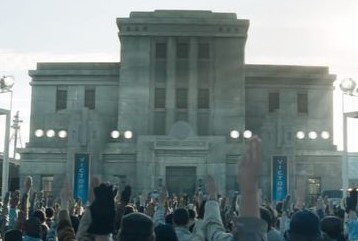
Whether Effie was really an architectural expert or not — her prep team wasn’t so sure — the District 11 Justice Building is, strangely, one of the more fascinating architectural pieces in the whole saga. As is often the case, even the widely acclaimed film, Catching Fire, did not do it “justice.” The exterior used in the film (pictured here) may have been appropriately fascist, pointing to the sterile modernism of the Soviet Block. But there is little of accuracy here that Katniss describes from canon.
Through the eyes of Katniss, she is nearly awestruck with the “huge marble structure” that must have been at one time a “thing of beauty.” She further describes its derelict condition, its facade in ruins with ivy taking over (CF 56). She then goes on to describe “what Effie calls the verandah (correct!), “the tiled expanse between the front doors and the stairs that’s shaded by a roof supported by columns.” While Collins could very well have been trying to paint an image of a traditional, pre-bellum (pre-Civil War) plantation house in the South, the architecture for such structures was inspired heavily by earlier Renaissance-era European styles from roughly the 15th and 16th centuries. In brief for purposes here, the prominence of earlier Greek temples and columns (think the Parthenon in Athens) became a fixture of Renaissance and neoclassical architectural designs, which then spread gradually into North America.

Another unique architectural form often adorned such public and religious structures during the Renaissance — that of the rounded central dome. The first Renaissance dome was ingeniously designed by Filippo Brunelleschi on the cathedral in Florence, Italy during the 1300s, after which his engineering and style spread across Europe and, eventually, into the British Colonies and United States. The US Capitol Building is now the most famous — and the most copied — of late-Renaissance domes in America. Many smaller-scale state capitol buildings have been inspired by the US Capitol, such as the California State Capitol in Sacramento (pictured above). Notice the glorious temple-front entrance, Greek columns, and verandah underneath, all set beneath the Renaissance-styled dome. Though smaller and greatly simplified, we can imagine the actual District 11 Justice Building as looking something like this.
Thanks to Katniss, we also discover that the Justice Building’s interior is also replete with Renaissance-style design elements. These include a “magnificent curved marble staircase,” which takes the three of them to an aging yet elegant room upstairs. The walls and perhaps ceiling are adorned with imagery of fruit, flowers, and “fat children with wings” (those would be cherubs) looking down from all angles (CF 64). The ceilings are a neck-breaking twenty feet high, as one would find within a palace of Renaissance-era nobility. Haymitch’s mind must have been more on his “respite and nepenthe” than on architectural flourishes during his first visit…
Consequently, the notion of placing domes atop local government buildings in the United States is owed directly to their association with America’s democratic ideal. The dome as a distinct element of American institutional architecture ultimately spread into the states and into many county courthouses and city halls. Perhaps this is why Collins has Plutarch openly recruiting Haymitch in this grand place, symbolically thinking of a future revolution to restore their own democratic ideals.
Feature Image: California State Capitol Building, Sacramento, CA (www.encirclephotos.com)
Meet the Author
 Tom Paradis

This site inspired by a first-year seminar on the Hunger Games at Butler University.

 The World of Panem