The World of Panem
Interpreting Society, Geography, and Characters of the Hunger Games
Sunrise on the 70s: Shag Carpet, Wood Paneling, and Orange Everywhere
WARNING: Spoiler Alert for Capitol design trends in Sunrise on the Reaping
Upon finishing his first read of Sunrise on the Reaping, a student of mine keenly observed, “The color orange is everywhere in this book. What’s with all the orange?” I admittedly had not focused initially on how much orange is “painted” throughout the story, though he was certainly correct. The color clearly holds multiple meanings for various reasons, not the least being Maysilee’s secret about that orange paint (see this post for a focus on Maysilee). In this case, however, Suzanne Collins is clearly pointing somewhat nostalgically to the fashions and decor of middle-class suburban homes of the 1970s and into the 80s. It should come as no surprise, then, if the ensuing Sunrise film becomes the next prequel “period piece” featuring this eclectic, colorful and rather rebellious decade (more on this below).
While becoming acquainted with the Capitol, Haymitch provides some telling descriptions. The newly provided tribute apartment, for instance, had a “strange, impersonal quality,” and was apparently “decorated by someone whose taste runs to fluffy things and burnt orange” (SOR 91). He is likely experiencing his first orange shag carpet if this pattern is upheld, perhaps the most synonymous symbol of 1970s decor. After explaining how the apartment was an upgrade from the previous tribute barracks, Mags directs Haymitch into a room with “two beds covered with fuzzy orange spreads,” with pajamas included (92). Upon arrival, a “disgruntled” peacekeeper had led them “into a lobby with fake wood paneling and into an elevator that smells like old socks and cheap perfume” (86). One more observation comes from Haymitch when Effie’s makeup box spills on the floor, as “tubes of color roll across the burnt-orange carpet.” (174)
Anyone who remembers America’s auto suburbs of the 1970s can likely picture raised-ranch or split-level homes that featured fake-wood paneling, burnt-orange or avocado-green carpet, and related earth tones and “fluffy things” like pillows and throws. For those not fortunate to have spent their indoor teenage years enjoying such surroundings, “shag” carpet gets its name from its thick, deep pile made of yarn strands usually more than an inch long. This particular carpet and its darker (burnt) orange or related earth tones became a cultural statement of its own, fitting in quite well with Collins’ own rebellious theme. According to one historical account, “its deep pile and funky aesthetic… defined an era of bold self-expression and cozy rebellion against the clean lines of mid-century modern minimalism.” Completing the 1970s post-modernist vibe were the ever-present wood paneled walls and — outside the home — fake-paneled automobiles.
Sarah Lichtman, an associate professor of design history, adds that the minimalist, mid-century modern decor from the 1950s and 60s gave way to softer designs that largely reflected “a shift in the ethos of the period.” She continues to paint a picture of the transition into the 1970s: “It’s a tumultuous time: You have the Vietnam War, there’s lots of social and political unrest… There’s also a lot of drug experimentation — not everybody, but that was part of what’s happening.” Families fortunate enough to partake in this quiet rebelliousness reflected an increased demand for comfortable and safer-feeling interiors. This cultural shift opened the door for the softer shag and wall-to-wall carpeting that were gradually becoming trendy.
Lichtman believes this social tumult created a heightened desire for comfortable, safe-feeling interiors, which helped lay the initial groundwork for the appeal of shag carpeting beginning in the 1960s. She explains, “There’s a sort of turning inward in the home, almost these womb-like spaces that you can see in some of the furnishings and objects that are starting to happen… I think shag carpeting is part of that softness that was coming into the interior” (Donovan and Sullivan, 2025). This was part of a larger trend in interior flooring, that of wall-to-wall carpeting. Technological advancements allowed carpet makers more freedom to use cheaper synthetic materials like nylon, which largely replaced real wool. Until after World War II, most people relied on area rugs to cover wood flooring; for centuries prior, fully carpeted rooms were considered a luxury. By the 1960s, however, the cost for wall-to-wall carpeting went down considerably and it became the standard expectation for newer homes throughout the twentieth century and beyond. In the decades following the war, more styles became available, and this led to experimentation.
One of those rather successful experiments was shag. As Jake Rossen writes, “Modern manufacturing and dye processes made it possible to opt for, say, orange shag to complement orange kitchen cabinets. This may seem like a bold choice now, but at the time there was a Technicolor attitude toward style” (Rossen, 2025). The trend was short-lived, however, as cleaning hassles proved to be its “Achilles heel.” The long strands of fiber quickly harbored dirt and debris deep down, largely unreachable by standard vacuum cleaners or carpet cleaning solutions. Rossen continues, “Shag enthusiasts often took a special carpet rake to the fibers to loosen grime. It acted as a kind of grooming tool, restoring the carpet’s fluff (Others just used an actual garden rake.) Ultimately it was an additional chore that homeowners grew to find tedious.”
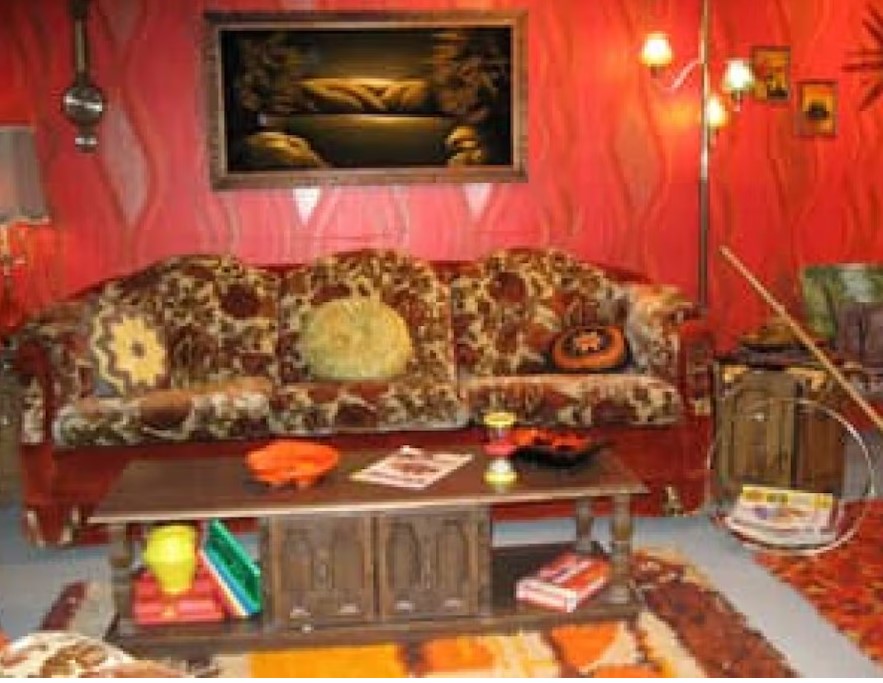
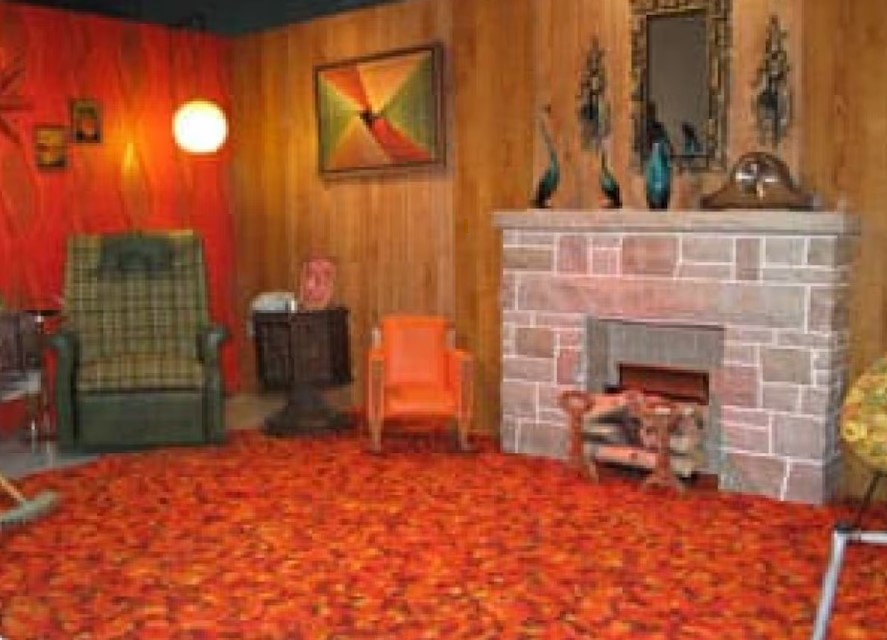
Collins has apparently borrowed heavily from these popular 1970s interior design trends, as Haymitch has described above. The Western Development Museum in Canada’s Saskatchewan Province provides a nostalgic glimpse into how the Capitol’s decor around the 50th Games might have appeared. The museum recreated a 1970s living room which comes “fully loaded” with orange shag carpet, wood paneling, and recliner chairs. One of the museum’s coordinators, Corinne Daelick, explains their room in this article: “It’s a three-tone orange shag rug on the floor… Wood paneling on one wall and nice orange wallpaper on the other walls.” The article’s next sentence drives home the color choice, stating, “Orange is also featured on the furniture” (see accompanying photo below, and featured image above).
The Plastic Revolution: On Board and Off
Beyond Collins’ fascination with orange in her latest prequel, she further taps into the 1970s with a focus on standardized cheap plastic furniture. In the novel she decorates the Capitol’s evolving passenger train interiors much as early Amtrak or city transit riders would have encountered during the same decade. Haymitch makes a point to notice such things, despite having been effectively kidnapped from District 12 only hours earlier. He tells us, “Plutarch orders the Peacekeepers to uncuff me, then leads me down the rocking hallway of the train to another compartment. Molded plastic seats in an array of neon colors line the sides of the car” (39). Later he describes the food service and alerts us once again to the plastic: “Tibby wheels in a cart laden with the dinner stuff. Everything seems to be made of plastic in this train: cart, seats, utensils, cups, plates. Easy to spray down and sanitize after we’re out, I guess” (43). If nothing else, Maysilee should have been proud of his attention to interior design.
As railroad history writers have pointed out, the interiors of railway passenger trains tended to reflect the popular decor of urban society. The look and design of Panem’s passenger trains are thus an extension of the Capitol into the more peripheral regions of the country. In this case, Collins has decorated Panem’s trains of young Haymitch’s time with the colorful if tacky, mass-produced furnishings that exploded in America and Europe during the 1970s and 80s. Haymitch’s train seems to include everything but the Tupperware parties (Collins missed an opportunity here!).
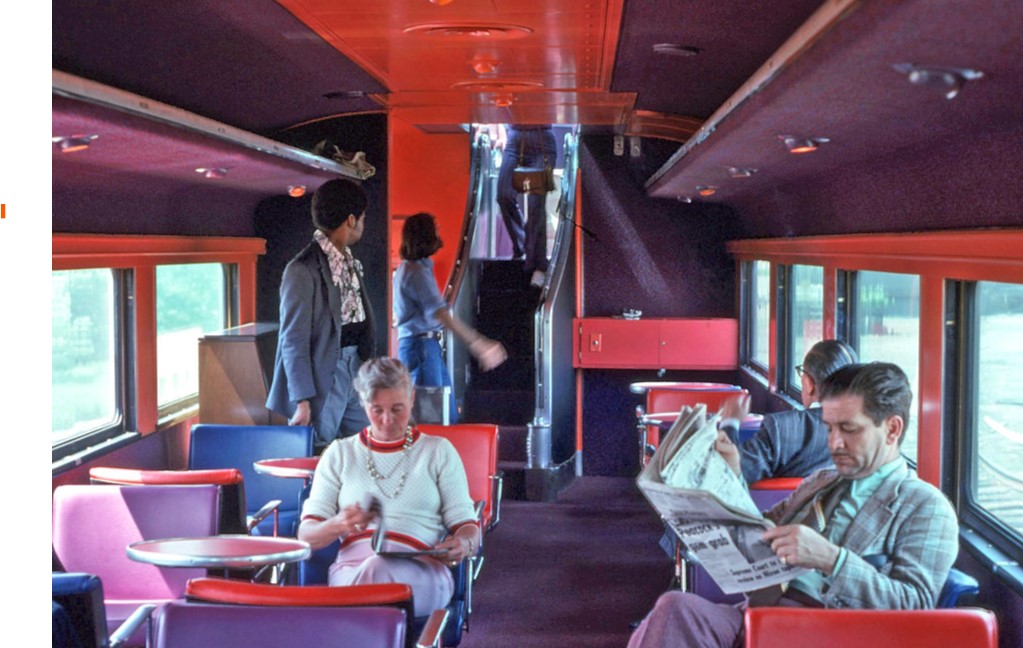
During Amtrak’s first decade of the 1970s, our own national passenger rail service was still cobbling together older railroad equipment from the earlier private luxury trains that once plied the nation (see image below). And the federal budget for maintaining a skeleton passenger network in the US was extremely tight. Trains were all but out, and cheaper auto and air travel were in. By necessity, everything got simplified, both on board and inside the makeshift cubical rail stations with — you guessed it — standard-issue plastic seating. In Panem’s case, we seem to be witnessing the transition from 1920s and 40s-era railroad travel featured in Songbirds and Snakes to more streamlined trains with cheaper decor some 40 years later. That said, we do not yet see the luxurious, high-speed trains from the original series that dart around Panem at 200 miles per hour. No, during the 50th Games our hapless tributes are still traveling on rather conventional railroad trains on steel rails that Americans would have recognized during the mid-to-late 20th century.
A 1970s Period Piece? A Look at the Teaser Trailer
Will the highly-anticipated feature film for Sunrise become the next historical period piece of the saga? I would easily take one of Wyatt Callow’s good bets that this will be the case. The producers clearly had a fun time framing Ballad as a period piece set in the late 1950s reconstruction of communist-era East Berlin, as I discuss within my companion book, Behind the Ballads (yes, a shameless plug). Logic would have it that we would be treated to a 1970s and 80s period piece with Sunrise, thereby mirroring a similar historical progression within North America and Europe several decades later. Even Collins’ bizarre inclusion of toad licking seems focused on the shadier, psychedelic world of drug experimentation during this time, as noted earlier (see accompanying post). And there may be some “Flower Power” and Hippie counter-culture hangover from the 1960s as well, given such a focus on bright colors and an arena full of all things fluffy, colorful, and so deadly.
While we don’t see much of the Capitol within the film’s official teaser trailer released on Nov. 20, 2025, one might notice some subtle influences of the 70s trickling into various scenes. The District 12 reaping alone features nothing less then Drusilla’s bright orange hair, a scruffy-looking orange backdrop on the facade of the Justice Building, and — yes — even the orange colored reaping cards for District 12(!). Most of the countdown numbers and associated frames likewise feature various shades of sepia and/or burnt orange. I would expect that inside the Capitol itself will be much more of the same. Only time will tell the extent to which we will experience a 1970s “extreme makeover” of the Capitol. Would disco balls be out of the question? Perhaps the Victory Tour at the President’s mansion will feature some Boogie Nights!
2 Comments on “Sunrise on the 70s: Shag Carpet, Wood Paneling, and Orange Everywhere”
Leave a comment
Meet the Author
 Tom Paradis

This site inspired by a first-year seminar on the Hunger Games at Butler University.

 The World of Panem
Pingback: The Mysterious Maysilee Donner: Unexpected Skills, Covey Connections, and that Orange Paint – The World of Panem
Pingback: Toad Licking is a (Deathly) Thing: A Psychedelic Throwback to the 1970s. – The World of Panem