The World of Panem
Interpreting Society, Geography, and Characters of the Hunger Games
Two Generations of Donners: The Sweetshop, Marshmallows, Mayor’s House, Piano, Merrilee’s Illness, Canaries, and the Mockingjay Pin (Whew!)
WARNING: SPOILERS AHEAD for Sunrise on the Reaping, and the Trilogy!
Haymitch first introduces us to the Donners’ sweetshop when he buys a “little white paper bag of multicolored gumdrops — Lenore Dove’s favorite,” to share with her later (16-17). The purpose of this sentence is twofold: first, to reintroduce us to the Donner family, and second as a sinister foreshadowing of Lenore Dove’s later fate. Lenore Dove claims she can detect the unique taste of each “rainbow” gumdrop, though Haymitch is convinced they all taste the same. This latter statement likely foreshadows a later discussion between Maysilee and Haymitch about the stale marshmallows her parents sell, indicating their habit of deceiving or short-changing their customers. Maysilee is not particularly proud of this fact, and she even ties it in with the ongoing conversation around propaganda. Quite humorously, the marshmallow thread surfaces at least two other times, including when Haymitch admits that he has “fallen for the ‘chewy marshmallow’ scam more than once” (47). And discerning fans have not overlooked the “rainbow” gumdrops, providing a subtle callback to Lucy Gray’s iconic rainbow dress and related imagery in Ballad. This has led to unending conversation in the fandom about just who is Lenore Dove’s mother (Hint: try Maude Ivory, as argued in this post. Collins seems to point us in that direction herself).
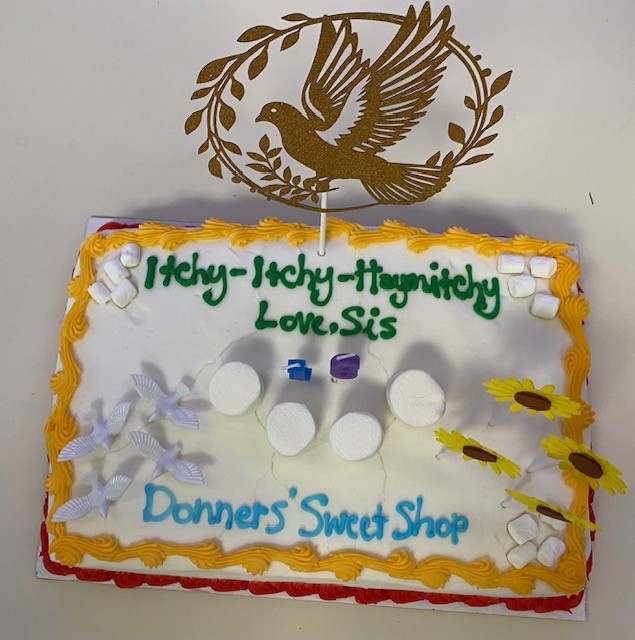
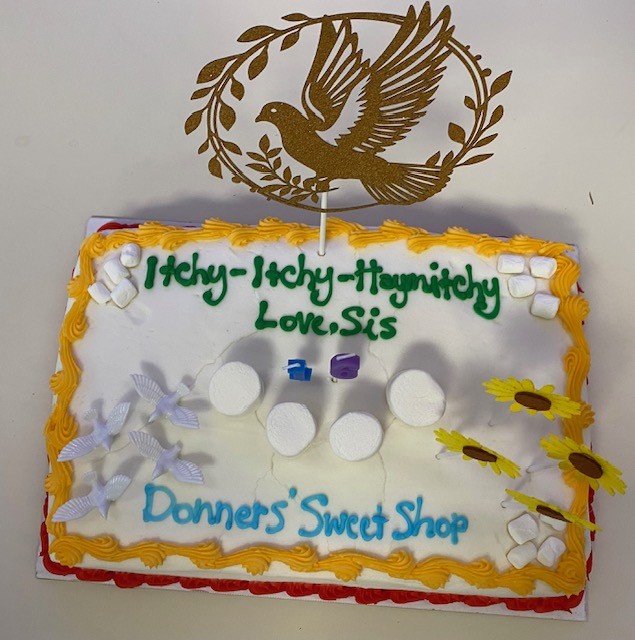
Above: A “Maysilee Cake” for Haymitch’s Birthday. What symbols can you find from Sunrise? (Final Butler FYS Class Celebration, April 2025.)
It turns out the sweetshop survives into Katniss’ storyline, but barely. When describing the Capitol for the first time, Katniss says, “All the colors seem artificial, the pinks too deep, the greens too bright, the yellows painful to the eyes, like the flat round disks of hard candy we can never afford to buy at the tiny sweet shop in District 12″ (THG 59). The topic emerges one more time much later in Catching Fire, just before Katniss learns she will be going back into the arena for the 75th Games. She and her family are watching the Capitol’s broadcast to introduce the Quarter Quell, and Katniss’ mother (Asterid) shares a memory, saying, “I had a friend who went that year.” She continues, “Maysilee Donner. Her parents owned the sweet shop. They gave me her songbird after. A canary” (CF 172).
This is our first introduction to Maysilee Donner, and the first time Katniss and Prim have heard about her as well. The big news for purposes here is that Asterid inherited Maysilee’s canary from the twins’ parents. One might wonder why Merrilee didn’t keep the bird, though Collins doesn’t provide any obvious reason. Perhaps the Donners were too distraught (see section about Merrilee below), and Asterid had probably been the twins’ closest friend. The canary reference is also worth noting. Later in Catching Fire, Beetee tells his fellow tributes that Wiress is intuitive and can sense things before anyone else, like a canary in a coal mine. Being from Twelve, Katniss explains to Finnick and Johanna how a canary is deployed for warning miners about bad air when the bird stops singing. This is one of many historical references to coal mining throughout the saga (another topic).
And now, we discover a fun callback to the canary in Sunrise! True to Asterid’s story in Catching Fire, Maysilee tells her peers at the tribute apartment that she had a pet canary named Lou Lou. She recommends using this name to identify “fake Louella,” and Haymitch and the others end up agreeing. And this is how Lou Lou gets her name, from Maysilee’s songbird (SOTR 139). Also worth a chuckle is Haymitch’s comment that Lenore Dove was “infuriated” that anyone would cage a songbird. This certainly didn’t help diffuse the animosity she and Maysilee had felt for one another.
Back to the sweetshop, the Donners are no longer associated with the business by the time of the trilogy (and “sweet shop” is now one word in Sunrise…). As noted above, Asterid had mentioned Maysilee’s parents in the past tense, and Katniss mentions nothing of the current owners. Merrilee has long since married Mayor Undersee and moved into the mayor’s house. Nor do we know the eventual fate of the twins’ parents, Mr. and Mrs. Donner. And as for Maysilee, well, she wasn’t escaping the arena alive to run the shop herself — whether she wanted to or not (she emphatically did not). It’s cool that Collins took her original little mention of the “sweet shop” and created a whole backstory about the Donner family.
A Piano at the Mayor’s House
This brings us to the mayor’s house, which is chocked full of lore and connections throughout the trilogy and both prequels. We return to this storied location rather promptly in Sunrise, though it remains questionable whether it is the same physical house. As Haymitch is introducing us more to Lenore Dove’s background, we learn that she is something of a standout on the piano. After all, this is her Covey instrument, with ivory keys and all. There’s a lot of meaning here as well. First, Haymitch mentions that the “only real piano in District 12” is found at the mayor’s house. Lenore Dove and her uncles had worked out a deal with the mayor that allowed her to practice occasionally, in return for playing it during various hosted events there (SOTR 8-9). This strategically sets up Maysilee’s secret about Lenore Dove and her orange fingernails (see related post on this topic). The whole backstory to her secret plays out right there at the mayor’s house, during one of Lenore Dove’s performances.
Collins drops further hints about the succession of mayors as well. Haymitch informs us in passing that Mayor Allister presides over the 50th Reaping. He says, “The mayor tries for a neutral tone, but her voice leaks disapproval in a way that guarantees she’ll be replaced soon” (SOTR 20). The gender pronoun is also well placed, indicating that — at least occasionally in District 12 — there is some level of gender equity in leadership roles as there is elsewhere in Panem. More notable is Haymitch’s comment about the mayor’s distaste for the Games, and that she might not be around much longer because of it. Mayor Allister does not seem to be connected by family to the Donners (though it’s possible I’m missing more subtle details), and perhaps Collins’ narrative here indicates an opening for this to eventually happen with a new mayor. I had personally wondered with the release of Sunrise whether we would learn more about a younger Mayor Undersee, likely then a similar age to Maysilee and friends. Alas, we do not. But it does set up the opportunity for the future mayor to meet and marry Merrilee Donner and to eventually bring Madge into the world.
And it should be noted that Mayor Undersee seems like a decent guy himself, perhaps with a relatively kind heart like that of Mayor Allister. Katniss infers in the first book that Mayor Undersee deserves credit for reducing the heavy hand of the Capitol in District 12. When speaking of how badly she and Gale could have been whipped or worse for hunting, she tells us that “our mayor, Madge’s father, doesn’t seem to have much taste for such events” (THG 203). This likely points to why President Snow did not ultimately spare Mayor Undersee or his family from the firebombing of Twelve, as he was certainly not improving the lax enforcement. Katniss confirms there was no sign of the family upon her return to Twelve after the war.
A more uplifting topic involves that lone piano in District 12. It is no accident that Haymitch (i.e. Collins) pulls this into Lenore Dove’s story in Sunrise. Beyond the mayor’s house, “she makes do with the instrument she is playing now, which she calls her tune box” (SOTR 8-9). Haymitch describes it earlier as an “ancient piano accordion,” which in all probability is handed down from its former owner in Ballad, Billy Taupe (yes, wow!). Where else would she acquire such a thing? Given that Lenore Dove’s character and dress habits reflect a blending of her former Covey relatives, this is likely yet another connection that Collins teases us with.
While the accordion apparently goes missing by Katniss’ time, the mayor’s piano does not. In fact, it takes center stage once again at the mayor’s house for a second generation. Returning to the trilogy, it turns out that Madge had played the piano as well, right there in her own home! What other lone piano could possibly exist? Knowing Collins as we do (or think we do), this has to be the very same piano handed down from Mayor Allister’s time. The piano serves as a sort of stage prop for an insightful conversation between Madge and Katniss in Catching Fire. When Katniss visits Madge at her home for the Victory Tour dinner on the eve of the Harvest Festival (how or why the Harvest Festival even exists remains a curiosity), she informs us that Madge has been trying to teach her the piano, though Katniss prefers mostly to listen to her play. In turn — perhaps more amusingly — Katniss has been taking Madge to the woods to learn how to shoot (CF 87). The main point here, however, consists of the clever interconnectedness between Sunrise and the trilogy between Madge, Lenore Dove, Maysilee, the mayor’s house, and that lone piano in District 12.
Merrilee Donner, Then and Now (Sunrise and Trilogy)
It’s during that same conversation between Katniss and Madge that we gain an important piece of information about Madge’s mother, Merrilee, as we know her now. Madge says that her parents aren’t around much, due to her father’s mayoral obligations and her mother’s recurring illness. Katniss explains to us that Madge’s mother “gets fierce headaches” that keep her confined to bed for days. On just such a day during Katniss’ recent visit, they couldn’t play the piano because “the sound caused her mother pain” (CF 87). This is a curious choice of words, as we are meant to assume the piano is making Merrilee’s headaches worse. But the “pain” could be interpreted as mental anguish or triggering memories from her youth when Maysilee was abducted for the Games. Merilee had apparently depended upon her twin sister quite a bit. Haymitch tells us as much in Sunrise, saying that “Merrilee isn’t too bad, except she tends to go along with everything Maysilee does” (SOTR 41).
Merrilee’s chronic illness and related trauma were actually foreshadowed in Sunrise. In a touching moment during the 50th Games, Maysilee asks Haymitch a heart-wrenching question about whether Merrilee will still be a twin after she dies in the arena. Haymitch reinforces that she will always be a twin, adding that he also had twin sisters before they died prematurely just after birth. He had even looked to the Donner twins out of curiosity about what it might have been like to have twins for sisters. Maysilee then considers what Merrilee’s life will be like back in Twelve without her. She confirms the foreshadowing by simply stating, “This is going to be hard on her” (SOTR 283). Haymitch could foresee a troublesome outcome as well. As a reflective response to Maysilee, he tells us:
After the Games comes the fallout from the Games. Spreading out like ripples in a pond when you toss in a rock. Concentric circles of damage, washing over the dead tributes’ families, their friends, their neighbors, to the ends of the districts.
Haymitch Abernathy (283)
Soon thereafter, these “ripples in the pond” wash over the surviving twin, Merrilee. Based on Madge’s own comments 25 years later, a serious part of Merrilee’s heart and identity had been lost with Maysilee’s murder. While it is satisfying to see that Merrilee would go on to have a loving family of her own, she was clearly never the same person after the 50th Games.
Even with the privilege afforded to the mayor’s family, effective treatment for Merrilee’s own mental illness and associated headaches was hit or miss. She does have access to the Capitol’s pain killer called morphling, which becomes apparent when Katniss’ mother is trying to stabilize Gale after the whipping. Everyone is surprised when Madge appears at the door in the middle of a blinding snowstorm. She is humorously described as a “snow-caked figure” delivering a package to Katniss, who continues to narrate:
She holds out a small, damp cardboard box to me. “Use these for your friend,” she says. I take off the lid of the box, revealing half a dozen vials of clear liquid. “They’re my mother’s. She said I could take them. Use them, please.” She runs back into the storm before we can stop her. “Crazy girl,” Haymitch mutters as we follow my mother into the kitchen.
(Katniss Everdeen, CF 115-116)
Upon questioning, Katniss’ mother (Asterid) demonstrates the purpose of morphling as she injects it into Gale. Of course, this is Collins’ own twist on morphine. More to the point, not only is Madge taking another risk by sneaking past authorities (as she did to join Katniss in the woods), she is further demonstrating her family’s access to important medications that many in Twelve do not enjoy. This is only one instance of Collins’ ongoing commentary on extreme health-care inequities within our own society. That said, even the privilege of the mayor’s family is limited. When Katniss suggests to Madge that they take her mother to the Capitol to “fix her up” (smile), Madge explains this is not possible without a special Capitol invite (CF 87).
The Mockingjay Metaphor and a Pin for Katniss
Beyond a doubt the most significant link between Madge and Maysilee is the now-famous mockingjay pin. Much like Lucretius “Lucky” Flickerman in Ballad, this little gold token needs no introduction. Essentially Katniss becomes an unwitting participant in the generational saga of the Donner family. For quite some time she treats the gold pin with indifference — either forgetting about it, questioning it, or trying to give it away — first to Rue, then back to Madge (both of them refuse, of course). Cinna keeps returning it to her right up until his death. It seems that Katniss had showed little more interest in the pin than had Maysilee before her. Katniss was simply dumbfounded when Madge appeared to say goodbye after the reaping. When Madge asks her to wear the pin in the arena as her token, Katniss thinks, “Wearing a token from my district is about the last thing on my mind” (HG 38). But Madge persists, leaning in to fix it onto Katniss’ dress. Then she makes Katniss promise to wear it, leaving her clearly befuddled. Madge follows this with a kiss on the cheek, leading Katniss to think, “maybe Madge really has been my friend all along.” Little did Katniss know just how meaningful that pin was to the Donner family, going back several generations. It is difficult not to believe that Collins had a plan for continuing this story all along…

THE MOCKINGJAY AS METAPHOR: Later in Catching Fire, Katniss and Madge become closer friends, even visiting each other’s homes (Madge likes Katniss’ home better). Katniss admits to the awkward process of learning how to be friends in the first place. Both of them had been content to be alone at school until they started eating lunch together. Then during the Victory Tour dinner at the mayor’s house, Katniss finally asks Madge about the mockingjay pin. The only clue from Madge — who didn’t know much herself — was telling Katniss that it belonged to her aunt, and that she thinks “it’s been in the family a long time” (CF 91). How true! It is during this same conversation when Collins reveals a significant metaphor between Katniss and the mockingjay bird. After debating with Madge whether mockingjays were natural songbirds or not, Katniss tells us, “A mockingbird is just a songbird. A mockingjay is a creature the Capitol never intended to exist… They hadn’t anticipated its will to live” (CF 92).
In this way, the mockingjay bird and its symbolic pin serve as a metaphor for Katniss’ own life and identity. Neither mockingjays nor Katniss were supposed to exist, and the Capitol certainly did not anticipate either of their respective wills to live. Collins had confirmed this metaphorical interpretation during a past interview for School Library Journal in 2010, prior to releasing her third novel, Mockingjay. She explains, “Katniss is something like a mockingjay in and of herself. She is a girl who should never have existed. And the reason she does exist is that she comes from District 12, which is sort of the joke of the 12 districts of Panem.” She adds later, “So in that way, too, Katniss is the mockingjay. She is the thing that should never have been created, that the Capitol never intended to happen.” It so happens, then, that Madge’s pin — descended down from Tam Amber to Maysilee’s grandmother, father, and herself — becomes the fundamental symbol of Katniss’ own will to survive in Twelve, and later still, the unifying symbol of rebellion that brings down the Capitol. (See this post for a Mockingjay Pin Family Tree which traces its path through District 12.)
The big, big, big question thus remains to this day (for many of us), as to just why did the very first Hunger Games film not include such a vital yet overlooked character as Madge? Instead we have Katniss (Jennifer Lawrence) being gifted the pin at the Hob by someone many presume to be Greasy Sae (but likely isn’t, since she’s not selling soup or other food). Though certainly done to shorten the film’s run time and cast of characters, this shift in the storyline greatly distorted the pin’s origin story and the Katniss-Madge relationship. Of course, hindsight is 20/20 as they say, and screenwriters likely had not yet envisioned two prequels emerging a decade later. At least now we can trace the pin all the way back to the Covey’s Tam Amber, though further mysteries remain about Maysilee’s grandmother and how she acquired the pin herself. Perhaps Collins is saving this loose end for a future third prequel? (See this post about more loose ends in Sunrise.)
The origin story of the famed mockingjay pin is delivered to us gradually in Part 1 of Sunrise. Keeping an eye out for any hint of the pin’s backstory, I immediately smiled upon reading the following passage:
Besides playing a crazy good mandolin, Tam Amber’s the best hand forger in District 12. He’s the go-to blacksmith for new gadgets or broken parts for old machines. Burdock has a dozen of his arrow tips that he treats like gold, and some of the richer folks in town have jewelry he made from actual gold or silver, melted down from heirlooms and refashioned.
Haymitch abernathy (SOTR 11-12)
Not only do we learn of Tam Amber’s continued existence and his later career choice, the fact that richer folks have some of his jewelry made from gold was enough to raise eyebrows. He has to be the designer of the mockingjay pin, I mused upon the first read. Later we learn more of the backstory, along with a subtle statement about Maysilee’s grandmother that is easy to overlook (I admittedly did just that upon the first read). When Maysilee asks to see Haymitch’s flint striker on the train because she collects jewelry, Haymitch finally tells us the story:
You don’t hear that much in District 12, but Mr. Donner spoils his girls rotten. Lenore Dove told me that, on their thirteenth birthday, he gave them pure gold pins that had belonged to his mother. They’d been fashioned by Tam Amber over thirty years ago. I never saw them, but Merrilee’s featured a hummingbird and Maysilee’s a mockingjay, birds being one of the Covey’s great loves. Apparently, Merrilee wore hers all of five minutes before she lost it down a well. Maysilee threw a fit over hers, saying a mockingjay was an ugly old thing and why couldn’t Tam Amber melt it down and make her something pretty like a butterfly? When he declined, she stuffed the pin in the back of a drawer and never wore it once.
Haymitch Abernathy (SOTR 54-55)
And thus we discover that Madge’s pretty gold pin in The Hunger Games was born three generations earlier by the Covey’s own Tam Amber, along with the hummingbird pin for Merrilee. The statement above is easy to overlook because Haymitch says somewhat cryptically that the pins had first belonged to Mr. Donner’s mother. Maysilee then buries it in a drawer before being reaped for the Games. She does agree to give the pin a second look, due to Haymitch’s prodding later — if she makes it out of the arena. But ultimately we do not yet find out how the pin is transferred from Maysilee’s drawer to Madge decades later. Whether Merrilee or Mayor Undersee eventually discover it and give it to Madge as a memento remains a mystery (and perhaps Collins is content to leave it that way). At least now we have a pretty clear path for the Mockingjay pin, from its creator, Tam Amber to Katniss (see this District 12 and Mockingjay Pin Family Tree).
What remains to be seen is the role of the Donner twins’ grandmother in all of this, as she could have been gifted the pins from Tam Amber if they were somehow related. Or, perhaps she purchased them as yet another of his customers from the Merchant Class. What is clear is that Maysilee’s grandmother was an influential part of her life, and that she lived and worked at the Donners’ sweetshop (having snuck candy to Haymitch on occasion). There is still much to learn about her role in the family and — as numerous fans are now considering — a possible family connection between Maysilee and the Covey (see this post for more on this notion).
Still wondering about that strawberry ice cream conveniently ignored above? Check out this post which separates out this conversation as its own topic.
Strawberry Connections: Why Mags Sends Ice Cream Into the Arena and Trilogy Tie-ins

WARNING: SPOILERS AHEAD for Sunrise on the Reaping, and the Trilogy!
Upon first scan, readers of Sunrise encounter some apparently meaningless strawberries, embedded within Mag’s ice cream treat for our District 12 tributes. Those with little memory of the original trilogy could be forgiven for dismissing this otherwise mundane fact. While Prosperina — Effie’s sister — has a meltdown about failing her prep team duties, Mags “corrals” the D-12 tributes and Vitus into the kitchen to enjoy some strawberry ice cream. Prosperina takes some herself and eventually repeats her sister’s upbeat message, that “a positive attitude is ninety-seven percent of the battle” (SOTR 170). While Haymitch contemplates in silence how self-absorbed this is, Maysilee jumps in with some well-placed sarcasm, responding, “I’ll try to keep that in mind in the arena. More ice cream?”
Not only does this exchange introduce us to Effie’s legendary if thoughtless positivity, but the ice cream returns later during one of the story’s most emotional scenes. Haymitch is saying goodbye to Maysilee upon her death and reflects on his journey with her. Just then a parachute arrives for Haymitch, quite grateful that it does not contain his favorite bean and ham hock soup that he could not stomach right now. Instead he finds a mug of steaming black coffee and none other than a basin of strawberry ice cream. He recognizes the coffee as Maysilee’s “beverage of choice,” but the ice cream stumps him. One of his thoughts, however, is likely the most correct — that is, it honors the memory of Maysilee’s “sass” with Properina and more generally her distinctive personality. Readers can presume that Mags has sent Haymitch two special foods to recognize his newfound sibling-like relationship, and foods that Maysilee clearly enjoyed. And we know that Mags had been amused by Maysilee’s retort to Prosperina, because she gave Haymitch a subtle glance and grin in response. In any case, her act of kindness works well. Haymitch breaks down, convincing himself that it’s “okay to cry around Mags” (308-309).
While tempting to simply dismiss the mention of strawberries, this is Suzanne Collins we’re talking about. Everything in her narrative is strategic or meaningful in some way. Those who recall the trilogy well enough to finish respectably in a Hunger Games trivia contest will tell you this is not the first reference to strawberries in Collins’ saga. Nor is it likely a coincidence. Early in the first novel, Katniss describes the hunting and gathering skills that she and Gale have practiced of late. She tells us about one such outing: “By late morning, we have a dozen fish, a bag of greens and, best of all, a gallon of strawberries. I found the patch a few years ago, but Gale had the idea to string mesh nets around it to keep out the animals” (HG 11). What fans have noted more curiously, however, is what she does with them. Katniss continues, “When we finish our business at the market, we go to the back door of the mayor’s house to sell half the strawberries, knowing he has a particular fondness for them and can afford our price.”
It is Madge herself, however, who receives Katniss and Gale secretively at the mayor’s back door. Like any other trading in Twelve, this transaction is highly illegal, and Mayor Undersee is satisfied to have Madge be the go-between. This is also our first introduction to Maysilee’s future niece, and Merrilee’s daughter. Madge happens to show up somewhat spontaneously in the trilogy’s storyline more often than many of us might remember. Funny thing as well, Katniss continues, “She’s in my year at school. Being the mayor’s daughter, you’d expect her to be a snob, but she’s all right. She just keeps to herself. Like me.” This could easily be a description of Maysilee in a nutshell as well, expecting stuck-up behavior but learning later she’s not so bad after all. Further, Madge has blonde hair tied with a pink ribbon, which sounds familiar to her three counterparts in Sunrise. When Gale sarcastically compliments Madge on her “pretty dress,” Madge “shoots him a look” and responds, “Well, if I end up going to the Capitol, I want to look nice, don’t I?” (HG 12). This sounds like something her aunt would have said 24 years earlier, perhaps another case of Collins’ clever habit of imbuing family members with similar traits.
And returning to those strawberries, Katniss brings them up at least one more time after Madge delivers the morphling for Gale’s treatment in Catching Fire. Peeta expresses his own surprise that Gale and Madge actually knew each other, to which Katniss responds, “We used to sell her strawberries” (CF 115). Haymitch then makes a snarky and admittedly unnecessary comment that “she must have quite a taste for them,” implying there’s “something going on” between Gale and Madge. We can safely agree with Katniss that this is ridiculous, even for Haymitch, given Gale’s clear disdain for Madge’s privilege back in the first novel. The main point, however, is that here we go again with the strawberry references.
So, what to make of this running strawberry theme between the trilogy and Sunrise? Those familiar enough with Collins’ trend to embed subtle clues and Easter eggs (i.e. meaningful, hidden connections) throughout her stories would be hard-pressed to call this a coincidence. The ice cream which Mags offers at the apartment and later sends into the arena could have been any flavor. But this particular choice provides a direct tie-in to Mayor Undersee and Madge’s family from the trilogy. Furthermore, while we can assume from Katniss as a somewhat “unreliable narrator” that the mayor himself is the sole consumer of the tasty fruit, it is not unreasonable to presume that Madge and Merrilee partake as well. And Katniss only tells us he has a “fondness” for them, not that he eats them. This is what occurs with Peeta’s family in a similar case. While it was his father who traded with Katniss for her squirrels, Katniss is surprised to learn that Peeta has eaten them too. If follows that perhaps Mayor Undersee is only fond of strawberries because he’s happy to pass them along to Merrilee or Madge.
We should therefore probably not dismiss a strawberry connection between Maysilee’s and Merilee’s respective families some 24 years apart. We already know that Madge plays the piano at the mayor’s house, likely the very same piano found at the Mayor Allister’s home in Maysilee’s time (see this post about that). Perhaps one more question should be asked. Do the strawberries hold an even deeper meaning than this? If Merrilee was watching the Games when her sister was killed, she likely witnessed Haymitch receiving the coffee and strawberry ice cream, followed by Haymitch’s emotional response. Since Mags had ordered the strawberry ice cream for the apartment treat, she likely had special “intel” that this was one of Maysilee’s favorite foods. Though unconfirmed, this seems likely, given that Mags also knew of Haymitch’s passion for bean and ham hock soup (itself a direct parallel to Katniss’ adoration for lamb stew with dried plumbs in the first novel — yes, yes, of course!). If Maysilee liked strawberries, certainly Merrilee did too. Haymitch had already told us that she tends to follow along with whatever Maysilee does, not to mention that they already have that special connection as identical twins. If this logic holds water, it is Merrilee who is likely the strawberry fan in Madge’s family, and perhaps even Madge and the Mayor help her to silently remember Maysilee in this way. Sure, this could be reaching, because Katniss and Gale had only been collecting strawberries for a few years. But otherwise, a lot of this makes decent sense — in the least for Collins to use strawberries as another connective thread between her novels. Disclaimer: Aside from the apparent strawberry connection with the trilogy, I have not seen this possible deeper meaning discussed anywhere. I take full responsibility if the Merrilee theory ends up being “full of hot air.” In the meantime, I’m going to remain positive. More ice cream, anyone?
Source of Featured Image: Strawberry Ice Cream, collabkitchen.com
Burdock’s Clues to a Third Prequel and Other Loose Ends in Sunrise

WARNING: SPOILERS AHEAD for Sunrise on the Reaping
(Feature Image Above: An “Old Appalachian” apothecary in Yancey County, North Carolina. See this local feature article about the “Life-changing Magic of a Mountain Medicine Man.”)
Is there a third prequel coming? Katniss’ father, Burdock Everdeen, might have something to say about it. The first two chapters of Sunrise provide one shock after another, though it is Katniss’ future parents who take the spotlight. Instead of making readers de-code her subtle clues, this time Collins leaves nothing to chance. We are clearly introduced to the teenagers Burdock Everdeen and Asterid March as Katniss’ eventual father and mother. For his part, we learn that Burdock is already a hunter and plant gatherer for the March’s apothecary some nine years prior to Katniss’ birth (generally consistent with Katniss’ story of how her parents met). He also has a dozen precious arrow tips crafted by the Covey’s Tam Amber, who is also the originator of the famed mockingjay pin. Incidentally, given that young Burdock from the Seam could not likely afford them, the arrow tips were likely a gift — perhaps further indicating a family connection.
With this and plenty of other revelations, there is still something big missing. Just how do Asterid and Burdock become romantically involved and eventually married? And how does Peeta’s father ultimately get left out of that picture? Haymitch provides the first major hint that there’s more to this unlikely story, practically teasing us about it. He tells us:
Besides, Burdock’s nuts about her, so I try to be nice even though he’s got about as much chance with her as a mockingjay with a swan. Town girls don’t marry Seam boys, not unless something really goes haywire.
– Haymitch abernathy (16)
Collins then provides a telling scene when Haymitch visits the apothecary to sell his white liquor. Asterid is behind the counter, as he notices the scent of chamomile flowers in a jar, “waiting to become tea and medicine.” He is certain that Burdock has collected these in the woods, further informing us that “he’s added wildcrafting to his game business” of late (15). This intentionally points to The Hunger Games when Katniss had explained how her parents had met, saying, “My father got to know my mother because on his hunts he would sometimes collect medicinal herbs and sell them to her shop to be brewed into remedies” (HG 8). Then she adds her own teaser, speculating that her mother “must have really loved him to leave her home for the Seam.” In this way, Collins creatively has both Katniss and Haymitch creating their own mystique around her parents’ unlikely backstory.
It’s also fun to consider how Haymitch traded with Asterid at the apothecary just as Burdock had done. In this case, Asterid is giving Haymitch “a fair price” on his liquor while throwing in a sprig of chamomile for “good luck,” she tells him (16). When Haymitch asks whether Burdock had told her that chamomile brings good luck, she “blushes a bit,” and he wonders if he’s wrong about Burdock’s chances with her. At this point in Chapter 1 readers still don’t have enough information to confirm he’s Katniss’ future father. We are soon given his last name of Everdeen, however, combined with other clues about his hunting and wildcrafting skills. As early as page 19, this exciting connection is clarified. Haymitch and Blair joke with Burdock about his “girlfriend,” and we can’t help but enjoy their nickname for him, “Burdie,” subtly indicating his special connection with mockingjays and — at least indirectly — the Covey.
Following this bantering between the three friends, Burdock says something curious. Blair asks him, “Her friends know about you, Everdeen?” This intentional question not only alerts us to Burdock’s last name, but also serves as a set-up for Burdock’s curious response. “Nothing to know,” he says with a grin. “Well, not yet anyway” (19). At which point, Haymitch changes the topic as the sound system crackles to life and the reaping ceremony begins.
It is difficult not to speculate that Burdock’s mysterious remark might indicate that a future backstory is in the works. Collins is practically winking at us. We know little about Burdock’s eventual courtship with Asterid and the “haywire” event that pulls them together. And what about the speculation that he and Gale’s father (Blair?) — who also died in the same mine accident when Katniss was 11 — were up to something rebellious at the time? There’s just too much drama in District 12 to permanently ignore.
Doing the math, Katniss will be born during the year of the 58th Games, some eight years after the Sunrise timeframe. There is plenty of time after Haymitch’s Quarter Quell for the likes of Burdock, Blair, and Asterid to continue their own interlaced stories. Could the incident that “goes haywire” simply be Burdock’s high, clear voice? Peeta tells Katniss in the first novel that her father had essentially swept Asterid off her feet with his singing. But is this enough to encourage Asterid to move across class and racial boundaries to live in the Seam? This is certainly possible, though it seems there is more drama to uncover.
One is thus left to wonder why Haymitch (i.e. Collins) would even mention “something going haywire” without revealing the rest of the story? She tends to leave character names and backstories incomplete or anonymous if she’s at least planning to write more about them in the future. And doesn’t she love to group things into threes? Her focus on the number “3” for the structure of her books and numerous plot points is now legendary. Would she really provide two prequels and not a third, if she is able to do so? Perhaps it’s even almost already written, just as Sunrise drafts were already going to editors when Ballad was still in theatres (according to a David Levithan interview on the eve of the Sunrise release). This may admittedly be wishful thinking, but there is no denying that numerous pieces to the full backstory remain blatantly missing.
Other Loose Ends and Missing Favorites
Burdock and Asterid’s intriguing backstory is not the only massive hole in Sunrise. Let’s take a look at some other aspects that have gone strangely missing.
What of Peeta’s Father? We briefly meet a new character during the chaotic reaping — “a big lug of a guy whose folks own the bakery” — Otho Mellark. Haymitch tells us that his “meaty hands dangle loosely at his sides and his feet shuffle back and forth” (23). He further describes Otho’s blond hair and the way Burdock probably saves his life by hitting him in the back of the knee to avoid the gunfire. Otho’s mere existence here makes him a strong candidate to become Peeta’s father. Sure, Collins could be misleading us (as she has apparently done with Burdock’s own complex lineage). However, when Peeta’s father strangely visits Katniss to say goodbye during her own reaping, she describes him as a “big, broad-shouldered man,” one who is not very talkative “in the best of times, and today he has no words at all” (HG 37). This seems remarkably consistent with Haymitch’s description of the big guy in the square during their own reaping. Then as Katniss and Peeta progress through the 74th Games, Peeta’s father curiously becomes the topic of numerous conversations woven throughout their story. Katniss even learns during the famous cave scene that Peeta’s father wanted to marry Katniss’ mother (Asterid). Peeta further explains that Katniss’ father (Burdock) had swept her mother off her feet with his singing. Other than that, just what exactly went “haywire” to pull Asterid toward Burdock? There is clearly more to Asterid and Otho’s story that is simply dropped from Sunrise.
What’s Up with Barb Azure? Aside from the ongoing Lucy Gray mystery (thank you, William Wordsworth!), there is absolutely no sign of Barb Azure in SOTR, though we do have some clues about where she’s not. As numerous fans have noted elsewhere, she does not yet have a gravestone in the Covey graveyard, which logically signals she’s still alive. She didn’t likely leave D-12 either, because of the history lesson Haymitch provides (pp. 37-38) about the Covey. After informing us more about their backstory (fun!) of how they made it into Twelve by hitching up an old pickup truck, he tells us definitively, “returning to [that life] is impossible, since no one can leave 12, and her uncles would never entertain the idea of hitting the road again.” So, Barb is around and has likely assimilated, though she is clearly not performing with them. Only Tam Amber, Clerk Carmine, and Lenore Dove are continuing their public performances. Once again, Collins is signaling a future story based on Barb’s conspicuous absence here. Although she is coded as LGBTQ+ in Ballad, fans have proposed the idea that she could still be Burdock’s mother or other relative. Either way, she seems to be the missing link to understanding Burdock’s lineage.
Where are Cinna and Tigris? It was a further surprise to many readers that neither of these pertinent characters reappeared in Sunrise. Even before this latest book release, fans and other observers have consistently asked questions about Cinna’s origin story in the Capitol, and about how Tigris became permanently estranged from Coriolanus. For his part, Cinna is described as not being entirely “Capitol,” dressing more humbly, not speaking with the Capitol accent, and specifically choosing District 12 for his stylist duties. His additional rebellious activities in support of Katniss’ success finally get him killed. So, where did he come from, and was he already working with Plutarch and Haymitch after Katniss was reaped? It was a solid prediction that we would learn more of Cinna’s own backstory in Sunrise, but it was not to be. The same could be said for Tigris, Coriolanus’ cousin who appeared first in Mockingjay while helping Katniss and her “star squad” continue their quest. Instead of Tigris as the new District 12 stylist, we get Effie — not a bad substitute, but a surprise indeed. Is Collins satisfied with never adding to their respective stories? Perhaps, though there remains a distinct opportunity to close the loops here.
Finally for now, what’s up with Effie’s great aunt Messalina Trinket? She brought some kind of shame on the Trinket family, though not quite as much as being a rebel, Effie notes. A leading theory in the fandom suggests she was some kind of “lady of the night.” Her own name meaning generally supports this idea, as author Valerie Frankel teaches us about the historical, Roman-era Messalina, who was the third wife to Emperor Claudius. “Rather a bad girl,” Frankel says, “Valeria Messalina was “known for promiscuity and finally executed for conspiring against her husband. In art, theater, ballet, and opera, she’s depicted as a sensual and wicked woman” (Sinister Sunrise). So, why does Collins bring up Aunt Messalina’s mysterious history without going further with it? Then there’s Plutarch Heavensbee himself, the subject of nearly unending questions that remain. One big one, however, includes just who his “old friend in District 12” happens to be? Again, why is this mentioned without any follow-up? Are Katniss and Gale’s fathers involved in some sort of rebellious activities down in the mines as has long been suspected? How is Plutarch potentially involved? There is much more to learn about this timeframe.
Going Out on a Limb: Predicting the “Finnick to Johanna Time Window.”
These are the fundamental questions I have come away with. A good bet (as Wyatt might suggest) would have us reading Finnick or Annie’s story about two years from now. Finnick won the 65th games at age 14, which means Katniss would be seven and still learning her skills in the woods with her father (along with “The Hanging Tree” at home, much to the dismay of Asterid!). Annie would win her Games five years later when Katniss was 12, one year after her father dies. Following on the heals of Annie was Johanna Mason’s victory at age 17 in the 71st Games, with Katniss around 13. Any of these scenarios (65th to 71st Games) would provide plenty of opportunities for updates from Twelve while revealing more from Finnick, Annie, or Johanna’s perspectives and backstories.

Even a story from Annie or Johanna’s POV is a possibility, and a less acknowledged backstory is that of Johanna’s own loss of those she loved. She may have lost her family to Snow’s vengeance just as Haymitch did, but for a very different act of defiance. Hers may have involved refusing to allow the Capitol to exploit her body as Finnick was forced to do (suggested by Hunger Games Wiki: Johanna Mason). She could have easily been recruited by Plutarch at some point, since she admits she has no one else alive she loves (CF 347). This is a significant insight that Plutarch even mentions to Haymitch back in 12 following the Victory Tour. After Haymitch states that he has nothing else to live for, Plutarch says, “Then you have nothing to lose. That puts you in a position of power” (SOTR 379). It seems like Haymitch and Johanna were now in the same boat.
That said, one major sticking point to this idea is that Johanna is not portrayed as a sympathetic character who goes into her Games trying to be as nice as possible. Katniss even quips that Johanna “will never win any awards for kindness, but she certainly is gutsy” (CF 347). Will readers support a victor who willingly murders tributes with her ax? Then again, we did not go into the 50th Games with good feelings about Maysilee Donner. And yet, at the sound of the cannon, how many of us were in tears?
Tying all of this together would arguably be the continuing saga of Plutarch’s underground rebellion. In Catching Fire, he reveals to Katniss that “for several years” he has been “part of an undercover group working to overthrow the Capitol” (CF 385). Those “several years” could arguably begin between Finnick and Johanna’s Games. There is clearly more of this story to tell, including which characters were already working with him, and how he tapped into the arsenal of District 13. When and how does Cinna get involved? It would not be surprising to see him reappear after his conspicuous absence from Sunrise. If Collins is to logically continue her ongoing theme of rebellion, the window of time between Finnick and Johanna’s Games couldn’t be much better for relating Plutarch’s final piece of his story.
Until further notice, therefore, this author is going out on a limb (as Katniss might do) to suggest that 1) a third prequel is already underway and could be revealed soon after the Sunrise film, and 2) somehow Annie or Johanna’s story will be featured, with the parallel story of Plutarch’s rebellious efforts and Burdock’s fate back in Twelve. While Finnick is a distinct possibility as well, it’s a bit early for Plutarch’s plans to be coming together, and we probably wouldn’t learn why Burdock dies. Either way, poor Haymitch would likely remain in virtual isolation within such a story, making it easier for Collins to pay only scant attention to him (perhaps a cameo appearance). Of course, I believe we would all be thrilled with any third prequel Collins wishes to contribute, regardless of how many of our collective predictions end up going “haywire.”
The Mysterious Maysilee Donner: Unexpected Skills, Covey Connections, and that Orange Paint

WARNING: SPOILERS AHEAD for Sunrise on the Reaping
If any character in Sunrise is going to steal the show, as they say, Maysilee is a likely contender. Part of Haymitch’s purpose in this story, it seems, is to help unfold Maysilee’s own backstory and character arc. And his own turnaround is stunning, first presenting Maysilee as the meanest girl in town, while later accepting her as family and (somewhat humorously in a morbid way), blood relatives. As Haymitch continues to learn about the mysterious “Ms. Donner,” it is difficult to not appreciate her own evolving story and the numerous mysteries that remain. It is these mysteries to which we turn now.
A Master of Braids
Perhaps the first and most blatant connection some have suggested is between Maysilee’s meticulous braiding skills and the iconic, black braid of one Katniss Everdeen. For the number of times Haymitch mentions Maysilee’s braiding skills, it feels like Suzanne Collins is hitting us over the head with a Maysilee slap. The first time Haymitch makes the reference to braiding is on the train, staring at her “fingers entwined in the strands of a half dozen necklaces. Some beaded, some braided cord, some with trinkets hanging off of them, and at least one real gold” (SOTR 41). Thinking at first she is merely showing off, he later becomes absolutely dumbfounded about her braiding skills. And this thematic thread becomes intricately woven throughout the storyline (sorry, sort of…).
The first serious references to Maysilee’s braiding skills come later when assisting Ampert in the Gym. After telling him that his token looks like “a weasel caught in chicken wire,” she once again displays her kinder side. She tells him, “you could do a braid necklace. That’s a one-strander. It would look something like this.” As Haymitch then narrates, she pulls out one of her six necklaces, an “elaborate black braided piece” (106-07). Working with Ampert, she puts the “finishing touches on an expertly woven braided necklace” (112). It’s not long before her reputation spreads. Any number of wayward tributes follow Maysilee into the bleachers with the hope of having her improve their district tokens as well. It is at this point when Haymitch reflects on more of the real Maysilee, emerging before his eyes. He tells us,
It’s Maysilee who surprises me. Back home, she isn’t popular, she’s known. She’s not respected, she’s feared. Not deferred to, but avoided. Here, following Ampert’s lead, kids bring her their district trinkets and ask her to make them special, and she agrees. The girl must know fifty ways to braid, twist, and loop a cord into a piece of finery. She sets off their humble offerings from home with her fancy patterns. District pride runs deep. (117)
This continued focus on braiding leads one to question just why Collins is emphasizing this particular skill. I was certainly not the only one to make the quick leap to recall Katniss Everdeen’s signature mark of personal identity, her straight, long black braid. As Katniss prepares for a hunting expedition on the day of the reaping, she tells us in the original Hunger Games novel, “I pull on trousers, a shirt, tuck my long dark braid up into a cap” (HG 4). Then while preparing for the reaping, Katniss tells us, “I let her towel-dry it and braid it up on my head” (HG 15). The rest is history, as Americans have witnessed a decade’s worth of black-braided Halloween costumes roaming the neighborhoods.
It turns out, then, that her mother, Asterid (as we now know), was an expert braider herself. Even Cinna is impressed upon meeting Katniss. The first thing he notices is Katniss’ braid. “Who did your hair?” he asks. After Katniss responds, he says, “It’s beautiful. Classic really. And in almost perfect balance with your profile. She has very clever fingers” (HG 64). If this skill runs in the Everdeen family, how did Maysilee and Asterid both learn their braiding skills? And why does Collins tie it so intricately into the storyline?
An Impressive Skillset
Beyond braiding and craftsmanship, Maysilee’s wide-ranging skillset continues to impress during training and inside the arena. After arriving to the gym for training (late as usual, thanks to Drusilla), Maysilee jumps in and says, “We should throw knives” (101). Haymitch considers it and recalls that “Blair’s really good and I’m not too shabby myself.” While testing out their skills, Haymitch further notes that “A lot of knives bounce off the target, although Maysilee hits more than she misses, and not to brag, I stick it every time” (102). Is Maysilee a natural talent while practicing here, or has she enjoyed experience with knives in the past? She proves equally adept at the knot-tying booth where she “replicates everything they show her on the first try, even the snares.” Haymitch jokingly accuses her of showing off, because he ends up struggling with a simple square knot. (155) He later suggests that she show all the things she “can do with a cord” as her chosen skill for the Gamemakers. More than one reader has wondered about why snares are mentioned here. This was one of Gale’s specialties, as he eventually teaches Katniss to make snares in the woods to catch small animals.
Later in the arena, her survival skills only continue to impress, for instance showing Haymitch how to make a better watercatcher with the tarp and knife. Elsewhere she suggests, “With a second hammock, maybe we can both sleep up in the trees” (278). She clearly holds no fear or lack of confidence with climbing. Later she impresses Haymitch by cleaning his wounds and closing them with “neat, even stitches” (269). And just before that, we don’t need to be reminded about the skill that saves Haymitch’s life. Somehow Maysilee devised a way to convert a blowgun that shoots poison darts. Not candy. Down goes Panache!
Aside from her chosen skills, we learn throughout Sunrise about what Maysilee’s most likely chosen career would be. That is, if her life wasn’t cut short like all the other kids in the arena. After Maysilee educates us about how much she hated working at her parents’ sweetshop, Haymitch wonders, “What did she dream of doing instead?” This seems like a well-placed prompt from Collins for us to reflect on that very question. The simple answer is fashion and design. Her sarcastic and admittedly hilarious critiques of Capitol citizens — not the least being Drusilla — continue through much of the story, and they generally all focus on aspects of appearances, clothing, and hygiene. She “makes people remember her” by roasting several members of the audience during the tribute interviews (including the woman with the cat ears — probably not Tigris, though tempting to think it). And her disrespectful yet justifiable exchanges with Drusilla are already legendary. In one instance Maysilee tells her, “I know my grandmother had a jacket like yours, but we wouldn’t let her wear it out of the house” (52). Haymitch then compliments her: “There I was, trying to be so high-and-mighty about the cake, and then you go all wildcat on us.” Maysilee gives a small smile. “Well, I have strong opinions on fashion… It’s high time someone told Miss Matchy-Matchy she looks hideous” (52).
A Cherished Grandmother from the Covey Days
The final set of mysteries to consider for purposes here (there is so much to write!) involves her grandmother and a certain secret that even Haymitch has not been privy to. Maysilee mentions her grandmother on multiple occasions, including when she berates Drusilla (above). We learn in bits and pieces throughout the story that Maysilee feels a strong emotional connection to her grandmother, and that her grandmother was in fact the first recipient of Tam Amber’s storied mockingjay pin, which is then handed down to Maysilee by her father, Mr. Donner (humorously, Maysilee sticks it in a drawer because she despises mockingjays — admittedly not a Covey way to think). Later during the Games Maysilee shows Haymitch her grandmother’s photo inside her locket. Grandma had given it to Maysilee the year before she died. Haymitch fondly tells us, “I take in the smiling eyes, full of mischief, peering out of their own spiderweb of wrinkles.” Of course, in classic Collins style, we are not given a name for her grandmother, which means her identity is still meant to remain a mystery. Could Maysilee somehow be related to the Covey? Or has she simply been absorbing District 12 lore like many of them, handed down through generations?
It might be useful to keep in mind that, presuming her grandmother was around 65 or 70 when she died, she was likely in her 30s sometime after the 10th Games when Tam Amber started his blacksmith trade. She may have attended original Covey concerts during the days of Ballad, or at least known of the original lyrics. Either way, she knew Tam Amber enough to either be a paying customer or a gift recipient for the future Donner pins.
It is during Maysilee’s heartfelt description of her grandmother when she drops another shocking revelation. Grandma knew lyrics from Covey songs. She tells Haymitch that her grandmother used to say, “It’s okay, Maysilee, nothing they can take from you was ever worth keeping” (301). Then it’s Maysilee’s turn to be surprised when Haymitch informs her it’s from an actual song that he learned from Lenore Dove (and a clear throwback to Lucy Gray in Ballad). She then responds with one of her most mysterious lines: “It’s a song?” Maysilee smiles. “Well, your gal’s full of surprises. Guess she got the jump on us after all.” When Haymitch asks, “Doing what?” she responds, “Doing nothing” and snaps the locket closed (301). This leads us to those mysterious orange fingernails…
Maysilee’s Secret and That Orange Paint
This brief exchange about the locket seems to reprise their much earlier conversation about Maysilee’s secret, which neither she nor Lenore Dove herself will reveal to Haymitch. Back in their apartment during training, Maysilee had acknowledged that Lenore Dove doesn’t like her — but not only because she’s so mean. She explains, “mostly because I know her secret and she hates being at my mercy” (162). At Haymitch’s prodding, she only tells him to ask her about the “orange paint on her fingernails” when she performed for the Mayor’s birthday party. He can only wonder if Lenore Dove somehow stole expensive nail polish, though this doesn’t explain why she’s wearing it at this specific event. And we are left to wonder just why she is referring to it as “orange paint” and not “orange nail polish” or thereabouts.
It is much later when Collins reveals the secret of the orange paint for all of us. One night back in 12, Haymitch escapes his Victor’s house and tragically “hits the bottle even harder” as a desperate effort to forget (373). He ends up shivering in a back alley, where he eventually sees “a message sprayed in bright orange paint.” NO CAPITOL, NO HANGING TREE, etc. He realizes the message has to be anti-Capitol propaganda, the work of none other than Lenore Dove. Continuing to share his own revelations, he provides us with perhaps the most significant piece of the story’s entire puzzle:
Full of surprises. Full of secrets, even from me. But Maysilee had put it together, he recalls. Orange paint on her fingernails. This is Lenore Dove’s work. Her sign. Her message to me now. Her reminder that I must prevent another sunrise on the reaping (373).
His revelation in the alley could arguably serve as a powerful climax of the story (we’ll see if the Sunrise film producers agree). Recall that, back at the Covey gravesite, he had pleaded with Lenore Dove to send him a sign, asking her to free him from his final promise to her, to one day prevent the sun from rising on the reaping (372). There in the alley, he got his sign indeed — but more as a knock on the head from his former love. He would need to press on and find a way forward, right into the original trilogy. And now we know why her nails were covered in “orange paint,” likely as her own subtle protest at the Mayor’s house, or perhaps as leftovers from her earlier graffiti work. That paint had decorated more than her nails in that alley!
With this revelation, we also have a better idea (if not conclusive) of what Maysilee meant when she said that Lenore Dove “got the jump on us after all.” This phrase typically refers to someone who was first, “beating someone to the punch,” so to speak. Or, someone who jumped out ahead to start a race. Perhaps this was Maysilee’s way of saying that Lenore Dove’s rebelliousness against the Capitol began long before either Maysilee or Haymitch began “painting their own posters” in the Capitol and arena. Lenore Dove was already painting her own posters (including quite literally in the alley), including her secretive efforts to mess up earlier reapings (yet other instances not admitted by Haymitch’s “girl”). All of this fits together now. This is all Lenore Dove’s initiative from the start, to encourage Haymitch to set aside his tendency toward implicit submission (thank you, David Hume), to rise up and do something.
And finally, we can all rest better likely knowing why Collins dribbles the color orange over practically everything she writes throughout the novel. Orange is everywhere in this book. First, “burnt orange” is likely referencing a 1970s fashion trend, which may foretell another “period piece” coming with the Sunrise film (see this post for more on this topic). Beyond those cultural references, orange appears to be Lenore Dove’s special color of rebellion, reflecting the main point of the entire story. When performing at the Mayor’s house, her lips are “tinted orange,” apparently along with her painted nails (9). It was she who dared to dream of a day when her orange morning sun would not rise over the reaping. And even in the hereafter, just as in the “old therebefore,” she was not letting Haymitch off the hook so easily.
(WHILE YOU’RE HERE: You may wish to check out my most recent companion book, Behind the Ballads: A Tribute to the People, Places and Music of Songbirds and Snakes (2024). A future companion guide for the Sunrise prequel and film is also in the works!)
Source for featured Image (Actress Mckenna Grace, cast as Maysilee Donner in Sunrise on the Reaping, and Stefania Barr from the Mainstay Pro fan video, “The Second Quarter Quell”).
Playing the Long Game: Plutarch’s Lesson for Haymitch and Humanity

Guest Post by Helena Kazenski, Butler University
WARNING: SPOILERS BELOW for Sunrise on the Reaping

Collins’ latest prequel has been met with great excitement from old and new fans alike. And the appearance of a younger cameraman named Plutarch has certainly driven some of that excitement. Many fans had even predicted – or at least hoped – that the master Gamemaker-turned-rebel would show up in some way, from a possible cameo appearance to an actual lead protagonist. And he nearly made it to that very status. Let’s take a deeper look at Collins’ inspiration for Plutarch’s role in her messaging for the rest of us (and take a peak at her exclusive interview for Sunrise.)
As strongly hinted in Collins’ Epigraphs for both prequels, she has taken inspiration from various Enlightenment-era philosophers. In Ballad, many of us were (re)introduced to the likes of Locke, Rousseau, and Hobbes. She has in one sense brought them back to life, promoting some of their important and sometimes contradictory thoughts about life, the universe, and everything. Her focus in the first prequel featured a young Coriolanus Snow, the main theme being the time-honored question of “nature versus nurture.” Now for Sunrise on the Reaping, she turns our attention to the roles of propaganda and David Hume’s notion of implicit submission. As Hume wrote himself,
Nothing appears more surprising to those, who consider human affairs with a philosophical eye, than the easiness with which the many are governed by the few; and the implicit submission, with which men resign their own sentiments and passions to those of their rulers. When we enquire by what means this wonder is effected, we shall find, that, as Force is always on the side of the governed, the governors have nothing to support them but opinion. It is therefore, on opinion only that government is founded; and this maxim extends to the most despotic and most military governments, as well as to the most free and most popular.
Cited at the beginning of Sunrise, this quote calls to question why the governed willingly submit to their governors when they easily outnumber them. He notes that governments are only as strong as their citizens’ approval.
This very question comes to light when Plutarch Heavensbee — current cameraman and future Gamemaker — asks why the tributes submit to Capitol rule when the districts already overpower the Capitol in numbers. He says, “I see the hangings and the shootings and the starvation and the Hunger Games. I do, and yet, I still don’t think the fear they inspire justifies this arrangement we’ve all entered into. Do you?” (SOTR 104)
Collins provides more detail on her inspiration for Plutarch’s character in an interview with David Levithan in the Barnes & Noble exclusive edition. Upon asking Collins about Plutarch’s overarching role in the story, she responded:
Plutarch’s the master of the long game. In Sunrise, we see him as a young man who’s convinced the government needs overthrowing, but he’s just taking his first baby steps. By the time we get to the trilogy, he’s masterminding the rebellion. He’s built a network in both the districts and the Capitol. He’s found an army in District 13 and allied with Coin. When Katniss shows up, he’s got a Mockingjay for his propaganda. He orchestrates the Airtime Assault that brings down the Capitol. And he manages to do all this while convincingly playing a Gamemaker.
He doesn’t glorify humanity. At the end of the war, he tells Katniss, “We’re fickle, stupid beings with poor memories and a great gift for self-destruction. Although who knows? Maybe this will be it, Katniss” And when she asks what, he answers, “The time it sticks. Maybe we are witnessing the evolution of the human race.” So, at heart, he’s an optimist. He doesn’t accept that war and self-destruction are inevitable.
Plutarch believes that we’re all on a continuum. We’re all ultimately playing the long game. You may fight your whole life for a greater good and never see the fruits of your labor. Plenty of people have done that historically. And so he tells Haymitch, “You were capable of imagining a different future. And maybe it won’t be realized today, maybe not in our lifetime. Maybe it will take generations. We’re all part of a continuum. Does that make it pointless?” I think that’s a question we all have to ask ourselves.
In this interview, Collins gives us a direct look into her thought process while creating the character of Plutarch Heavensbee. Plutarch is a master of the long game. He has amassed major influence in the Capitol, building his way up into the position of head Gamemaker by the 75th Games. This has allowed him to slowly and subtly swing the narrative to be sympathetic to the districts over the years. He is aware that rebellions often need proper time before they successfully achieve their goals, and he somehow has the patience to wait for the outcome he desires. He believes that we are all part of a continuum. Even if it is highly unlikely to see the fruits of our labor in our lifetime, we should still work to make the world a better place for future generations — or, at least to set up a foundation for change so that they can continue. This is the “continuum” that Plutarch (through Collins) refers to.
With her notion of the continuum and the long game, it is likely that Collins is encouraging us to continue working towards a better future, even if current circumstances are unbearable. Even though Haymitch loses the battle and barely endures absolute torment, he eventually wins the overall war. He is able to be a part of the rebellion that finally allows him to keep his promises to Lenore Dove and Maysilee Donner. Haymitch embodies the continuum, as he realizes that his efforts to rebel were not in vain. He is able to use his past experiences to guide Katniss toward becoming an important figure in the rebellion.
For his part, Plutarch is an optimist at heart, but he refuses to glorify humanity at the same time. He believes that, while the atrocities committed by the Capitol (and especially Snow) have indeed occurred and should not be forgotten, war and self-destruction are not inherently inevitable to humanity. Basically, he believes in nurture over nature — a throwback to one of the main themes of Songbirds and Snakes. Lenore Dove then picks up this argument quite blatantly in the latest book, trying to convince Haymitch that the sun does not inevitably need to rise on the reaping. Despite her best efforts to convince him of this, it takes some hard knocks from Plutarch and more serious events in the Capitol and Games to move Haymitch away from his own implicit submission.

Source links for featured image, 2nd image, 3rd image.
Trajan Heavensbee: A Featured Ancestor in Sunrise Appears First in a Surprising Place.
WARNING: SPOILERS AHEAD for Sunrise on the Reaping
Beyond all the familiar names and revelations we encounter in Sunrise, none made my jaw drop more than the mention of Trajan Heavensbee’s portrait in the family mansion. We “meet the Heavensbees” through Haymitch’s cynical eyes while being introduced to Plutarch’s home. “There’s no shortage of Heavensbees,” Haymitch notes dryly, as “they watch over us through several halls, flaunting their signature possessions … Dripping in wealth, every last one of them” (SOTR 120). He then turns into a room to find a portrait of “an old man with a white beard holding out an open book,” who appears to be smiling down from above the fireplace. “Trajan Heavensbee,” Plutarch tells him, one of his great-great (he forgets how many) grandfathers. He adds, “The only one who’s been of any use really. This was his library.”
And this is where I lost it.
Prior to Plutarch’s introduction of his apparently storied ancestor, it is all but certain that Trajan does not appear in any of Collins’ previous four books. Only his more recent — and lesser known — ancestor, Hilarius, makes cameo appearances in Songbirds and Snakes (book and film alike). Hilarius had mentored little Wovey from District 8 in the first prequel. Even President Snow recalls him in Sunrise, telling Haymitch that he had been one of his classmates, a “useless whiner” (127). We do not yet know how Hilarius is related to Plutarch, though that might be another story. More to the point here, Haymitch spends some quality time in Trajan’s extensive library, mostly reflecting on the gross inequities between the wealthy Capitol oligarchs and the working-class district people.
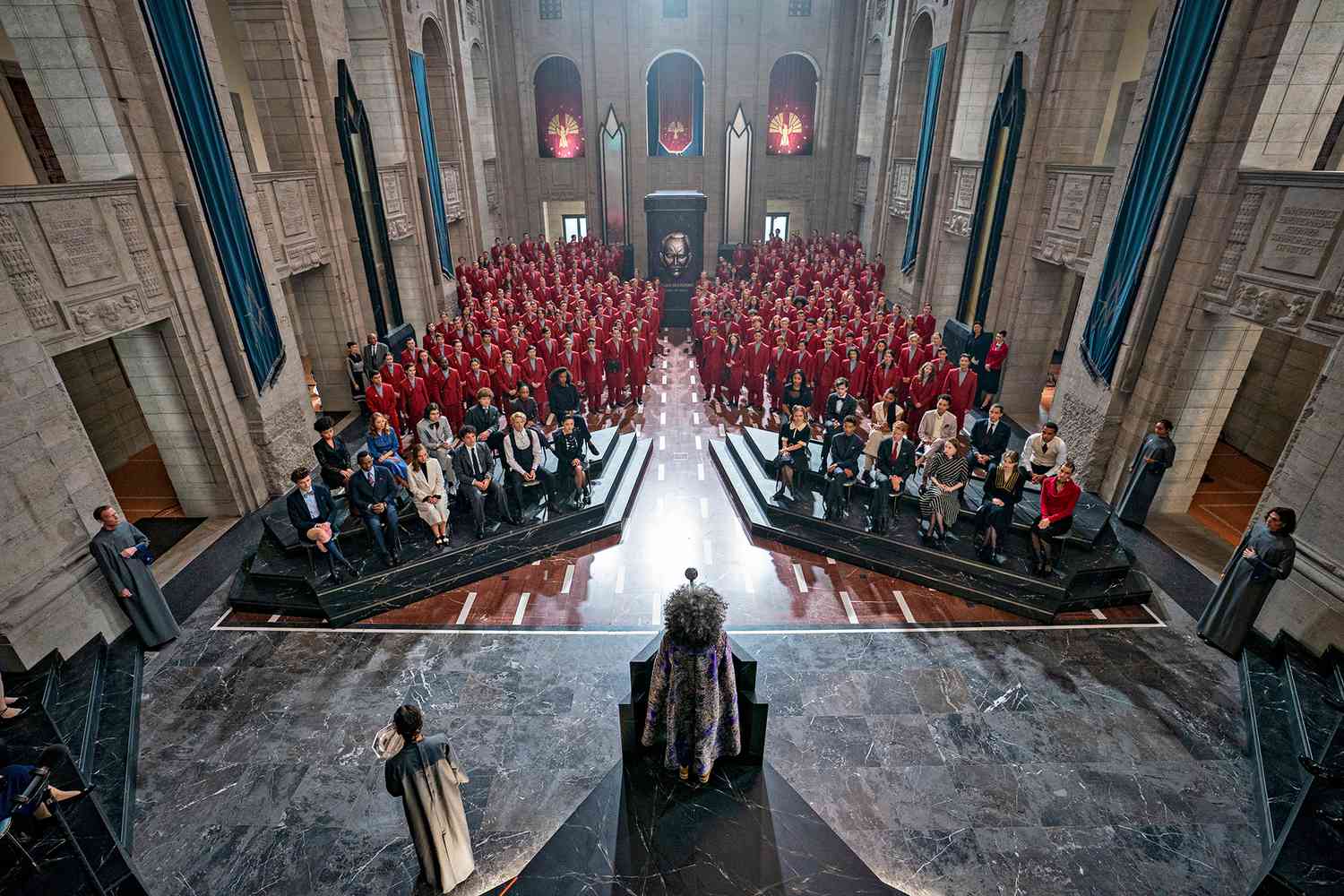
In a strange type of “reverse Easter Egg,” however, Trajan does actually show up elsewhere prior to his formal introduction in Sunrise. Viewers of the Ballad film can sneak a peek of him while the student mentors are watching the reaping ceremony from Heavensbee Hall. We see Dean Highbottom (Peter Dinklage) explaining the Games while he shuffles down the center isle. Behind him is an oversized if forgettable gold-plated bust of someone’s head, likely an important figure to Panem. Curious as ever, I spent some effort craning my neck to look behind Highbottom to see the inscription, which is never fully visible in one shot. But we can see enough to put together the phrase, “Trajan Heavensbee, Father of Panem.” It is in this way that we are subtly introduced to Trajan through a rare Easter egg in a film that points to a later book that had not yet been released (see below).

This raises several questions, including who was responsible for placing Trajan as a subtle backdrop in the Ballad film, and whether they were aware that Collins would feature him in her later, as-yet unannounced Sunrise prequel. I had presumed that the Ballad producers had invented him for some reason, perhaps just to enhance the Heavensbee Hall filming site (in the actual “Bear Hall” of “Old City Hall” in Berlin). Director Francis Lawrence and his producer colleagues are well known for placing all sorts of Easter eggs and callbacks in that film, as in the previous films. There was no mention that I found of Trajan in my numerous re-reads of the Ballad novel. But then Trajan makes his glorious introduction in Sunrise, yet still not mentioned as the “Father of Panem.”
What most likely explains Trajan’s appearance in Ballad prior to the Sunrise novel has to do with an interview by Scholastic’s David Levithan (source coming…). Collins had already finished at least a draft of Sunrise on the Reaping by December, 2023 when she began sharing it with Scholastic. She was clearly already writing it during the production of the Ballad film, which was released only a month prior to Collins sharing her draft for Sunrise. It would make logical sense, then, that Collins likely suggested the addition of Trajan’s plaque to the Ballad film while serving as a consultant on its production. She already knew that Trajan would make his formal appearance in her as-yet unannounced 2nd prequel. This is unsubstantiated, of course, though is the only logical conclusion I can produce at this point.
As for the deeper meaning of Trajan’s name, one should not be so surprised that he fits well into Collins’ naming system for her characters. Those from the Capitol are imbued with historical names of important Classical or Roman figures, or at least those who appear in Shakespeare’s various plays (especially from the likes of “Coriolanus” and “Julius Caesar”). Trajan is no different. His historical counterpart is considered to be the second of the “Five Good Emperors” of Rome, from 98-117 CE. He was one of Rome’s more philanthropic rulers who oversaw extensive public works projects and led Rome to its greatest territorial extent. It would make logical sense (in the spirit of Lenore Dove once again) that Collins tapped this relatively favored Roman ruler for the eventual founder of Panem.
It turns out that the historical Trajan knew the Greco-Roman scholar and historian, Plutarch, quite well. Classical Plutarch had earned many followers and admirers during his lengthy life, becoming quite a celebrity within the Roman Empire. His public duties eventually took him to Rome where he lectured on philosophy and made numerous friends as well. He was further recognized by the emperors Trajan and Hadrian, with Trajan having bestowed the high honour of ornamenta consularia upon him. As “Lucky” Flickerman might say to Collins for her creative character parallels once again, “Take . . a . . bow!”
The Goose and the Common: An Unexpected nod to (New) England in Sunrise on the Reaping
Warning: Spoilers Ahead for Sunrise on the Reaping
As early as page 5 in Sunrise, we learn that Collins seems to maintain some kind of fascination with geese. Haymitch’s “girl,” Lenore Dove, treats about a dozen of them (lots of “dozens” show up in this novel) as pets, leading them around the famed Meadow and thereabouts. They only trust Lenore Dove, as they tend to hiss at Haymitch much like Prim’s cat, Buttercup, who hissed at Katniss — that is, until she fed him. In this case the parallel continues as Haymitch regularly brings some cracked corn from Hattie to appease Lenore Dove’s waddling friends. Of course, this new novel finally explains the bizarre reference to Haymitch raising geese in the Epilogue of Mockingjay. He is remembering his one true love who was stolen from his life much too soon.
Chapter one has barely opened when Collins offers her first song of the novel, which goes unnamed within the narrative. Haymitch arrives at the Meadow to find Lenore Dove “serenading a dozen geese grazing on the grass, her voice as soft and haunting as moonlight” (8). The first verse of the poem-turned-ballad reads:
- They hang the man and flog the woman / Who steals the goose from off the common, / Yet let the greater villain loose / That steals the common from the Goose
With this first verse alone we can see clearly where Collins is headed. As Lenore Dove sings additional verses in between Haymitch’s reflections on family relationships, he tells us that this is “not a song her uncles let her play at the mayor’s house,” or even when the three of them perform around District 12 (9). “Too rebellious,” he explains bluntly, and we can see why. Perhaps the clearest reference with this first verse is its symbolism with the oppressive Capitol which continues to punish the districts for a war ended long ago. The verse implies — quite accurately — that the Capitol maintains the authority to strip all rights and humanity away from its district subjects, while they are the ones who are punished for breaking the Capitol’s draconian rules. What we have here, it turns out, is another protest song, the likes of which we saw with “The Hanging Tree,” featured in both the original series and more recently in Ballad. In one sense, Lenore Dove’s protest song is even more direct than that of Lucy Gray. The last two lines of this one say prophetically, “And geese will still a common lack / Till they go and steal it back.”
It turns out this is not one of Collins’ original poems or songs, but a well-placed throwback to teach us some relevant history once again. She explains in the book’s Acknowledgements that “The Goose and the Common was written by an unknown author in the 17th or 18th century.” This is all she says about it, though this single sentence provides plenty of clues to further chase down its backstory.
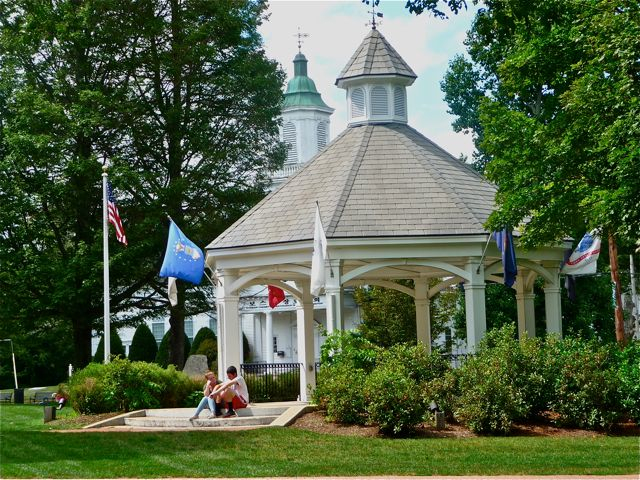
Funny thing, those not from New England (or old England for that matter) may be puzzled over the strange use of the word “common” in both the poem and its title. Is “common” an adjective or a noun? Those with some knowledge of colonial town settlement in New England, from Maine to Connecticut and Rhode Island, will likely pick up this reference right away. Town settlements that followed the lead of the Massachusetts Bay Colony often included a shared public space at or near the center of the village. Known simply as a “common,” this local quirk of regional geography was designed into their otherwise medieval-era town plans as a place on which all farmers could share for the grazing of their cattle or for related uses. The most famous of these, of course, is Boston Common, now one of the city’s cherished public parks. Lenore Dove is nice enough to explain this to our protagonist, once telling him that “the common was land anyone could use.” It is more than fitting that she grazes her geese in the Meadow which, for purposes of this novel, is now re-interpreted as a District 12 public space in the form of an English-style common. And true to the poem, the local Peacekeepers occasionally chase off her geese for no apparent reason other than that they could do so.
By the end of the colonial era, most commons in New England towns were gradually transitioned to public parks, sometimes now referred to bucolically as the “town green” with picturesque gazebos and bandstands and all. Their original agricultural intent was rendered obsolete when New Englanders rebelled en masse — not from an oppressive imperialist nation, but rather from the unforgiving rocky soil that prevented decent farming. Many farm families picked up and moved westward into today’s upper Midwest during the 19th century, not long after that region’s indigenous peoples had been driven off. But I digress…
Despite the excitement some readers like myself enjoyed when finding this New England tidbit in Collins’ novel (I myself am from a colonial-era town in CT), the story behind this opening poem can be traced even further back to England itself. “The Goose and the Common” is largely associated with the English enclosure movement, which involved the intentional closing off of public spaces to convert them into private property. As Oleg Komlik (2018, citing Boyle 2003) writes in the article linked above, “Like most of the criticisms of the enclosure movement, the poem depicts a world of rapacious, state-aided privatization, a conversion into private property of something that had formerly been common property or, perhaps, had been outside of the property system altogether.”
Collins therefore creatively appropriates the poem for her own use as a blatant metaphor for the Capitol’s treatment of the districts, at the same time cleverly tying in this historical protest movement to her novel’s theme of Lenore Dove’s geese. We further learn that even Haymitch is concerned about his girlfriend’s rebellious ways. When mentioning how the Peacekeepers chase her and the geese out of the Meadow for no apparent reason, Lenore Dove tells Haymitch “that’s just a teaspoon of trouble in a river of wrong” (10). He adds, “She worries me, and I’m an Abernathy.” He explains elsewhere that the Abernathys were notorious for their rebellious ways. This foreshadowing sets up Lenore Dove’s character as an outward protester herself against the “river of wrong” that the Capitol imposes on the districts. The rest of this latest prequel continues to feature Haymitch’s own character’s journey from “implicit submission” to “rascally rebel” (my words). He is encouraged in no small part by the courageous Lenore Dove, determined as she is to see that one day the sun will no longer rise on the reaping.

Image Sources: Conspiracy-of-kindness.com (poem graphic above), visitingnewengland.com (feature image of Hopkinton town common, starting place of the Boston Marathon)
A District 12 (and Mockingjay Pin) Family Tree: What We Learn from Sunrise on the Reaping

WARNING: SPOILERS AHEAD (and above) For Sunrise on the Reaping
With the release of Sunrise in March 2025, those of us hoping to fill in some gaps to Katniss’ family tree were treated to incredible new information. At the same time, it is arguably becoming more of a challenge to keep track of our favorite characters in Twelve and how they are all connected. I have seen requests on fan sites for a family tree of the three-plus generations now featured through Collins’ five novels. To that end, I embraced that challenge and created what I believe to be the most accurate possible representation of a District 12 Family Tree, along with the new knowledge we have about the route of the storied mockingjay pin.
While not going into excruciating detail here with all the evidence (or lack of same), I recently added this post about why it seems likely that Maude Ivory is Lenore Dove’s mother, who died in childbirth. Further, this family tree graphic indicates the characters that remain inconclusive with their roles. These include Maude Ivory as Lenore’s probable mother, Haymitch’s friend Blair — who could all too easily be Gale’s future father (or not) — and the mysterious Otho Mellark, the Baker’s son we meet briefly during the reaping in SOTR (see this post for more on the bumbling Otho as a “loose end”).
Further, the route of the mockingjay pin is now filled in quite a bit more, though we still do not know how it eventually travels from Maysilee’s drawer to her niece, Madge, by the time of the original series (see this more recent post about the Donner family connections, including the canary that Asterid inherits from Maysilee!). For now I am presuming that her sister, Merrilee, acquired the pin at some point and gifted it to Madge. But we just don’t know that yet from Sunrise. What we do know is that the pin was originally given to Mr. Donner’s mother (Maysilee’s grandmother), and he handed it down to an unimpressed Maysilee, along with a hummingbird pin to Merrilee (see related post on Maysilee Donner and grandmother). Humorously, Haymitch tells us the story of how Maysilee simply stuck it in a drawer at home, while Merrilee wore hers for probably five minutes before losing it down a well. Lenore Dove, who was irritated with their lack of appreciation, had planned at one point to break into the Donners’ home to steal back Maysilee’s pin. Haymitch and Blair managed to discourage her from doing so.
Perhaps the biggest surprise comes with the continued mystery around Katniss’ father, Burdock Everdeen. How exactly is he related to the Covey? With all the information Collins provides, we still cannot pin down his origins. I and untold others have repeatedly made the case that Maude Ivory is Katniss’ grandmother, as I explain within this post. But that very strong theory has not played out in SOTR, as we learn that Burdock (Katniss’ future father) is some sort of cousin to Lenore Dove (at one point he calls to her, “Hey, cuz”). We are further informed that Haymitch and Burdock had learned many of the Covey songs and music through “private performances” from Lenore Dove. This seems to be how the Covey’s music legacy is handed down to Katniss. Beyond this, there are further clues from Haymitch that Lenore Dove’s father is from the Chance family, and Lenore Dove’s uncles are pretty cagey about it. What this means is that the biggest remaining gap in the District family tree is the familial connection between Burdock Everdeen, Lenore Dove, and the Covey. Right now I can only connect them on this graphic as “cousins.”
Beyond these caveats (perhaps gaps to close within a future prequel?), I hope the following graphic is helpful to sort out the various relationships among our principal District 12 characters.
(PERMISSION FOR SHARING: Feel free to share the graphic (GIF embedded below) with proper credit, as it is meant to be educational for discussion purposes. My name and affiliation are on it already. Ever in your favor!)
(WHILE YOU’RE HERE: You may wish to check out my most recent companion book, Behind the Ballads: A Tribute to the People, Places and Music of Songbirds and Snakes (2024). A future companion guide for the Sunrise prequel and film is also in the works!)
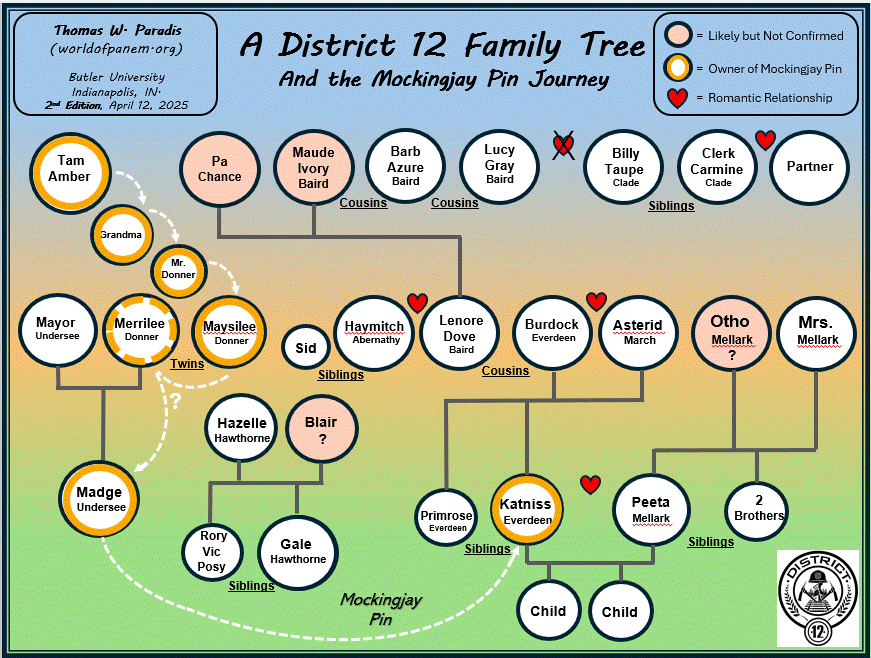
Who is Lenore Dove’s Mother? Unlocking some Important “Grave” Clues in Sunrise
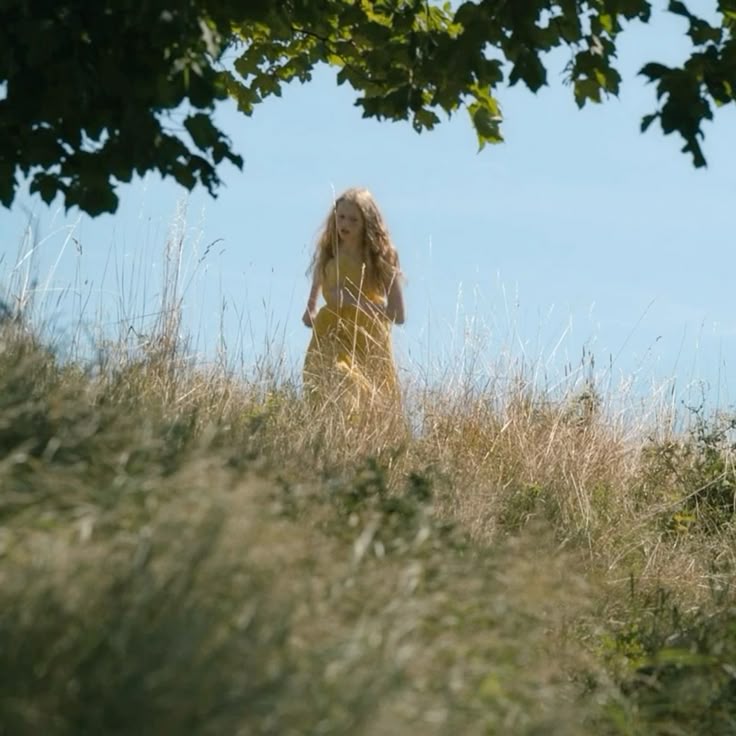
WARNING: SPOILERS AHEAD FOR Sunrise on the Reaping.
For those of us hoping to learn more about the Covey, it is safe to say that we got much more than many of us expected in Collins’ latest Sunrise prequel. As Haymitch’s true love, we learn as early as page 7 that Lenore Dove is Covey, confirming earlier predictions that Collins is using “dove” as a color to indicate the second part of her Covey name. We are even given a dictionary definition of this ambiguous color, as “warm gray with a slight purlish or pinkish tint” (SOTR 7). And cutting to the chase for now, Collins further confirms (more like hits us on the head with a Maysilee slap) that Lenore Dove’s name song is owed to Edgar Allen Poe’s “The Raven.” That’s another story to unpack later. For now, let’s consider what some clues at the beginning and end of the novel may indicate about the Covey family tree (accompanying post), as an answer to Lenore Dove’s lineage may provide further insights into Katniss’ own family.
Some readers already believe — quite logically, as Lenore Dove would have it — that her mother was Lucy Gray. Fans have pointed to clues found in Lenore Dove’s outfit near the beginning of the story to support this idea. Haymitch tells us how “her faded overalls and shirts concealed snips of color, a bright blue handkerchief peeking from her pocket, a raspberry ribbon stitched inside her cuff” (SOTR 7). The particular reference to raspberries seems to be serving as the leading evidence for this notion, which admittedly still may be true.
In the spirit of Collins’ intricate storytelling, however, there is more to consider that points us away from Lucy Gray. First, in Collins’ exclusive 13-page interview (not likely a coincidence) at the end of the Barnes & Noble special edition of Sunrise, she explains that Lenore Dove “romanticizes the Covey’s prewar days as itinerant musicians on the open road. She knows the losses that followed, the murdered parents and orphaned Covey children. And in particular, she’s haunted by the fate of Lucy Gray. She wears bright bits of Lucy Gray’s dress about her person and keeps her forbidden lyrics alive in private performances for Haymitch and Burdock.” In short, this explains the color references to Lucy Gray. Lenore is wearing surviving patches from Lucy Gray’s outfits.
And why would she be “haunted by the fate of Lucy Gray” if her uncles (Tam Amber and Clerk Carmine, as indicated in my District 12 Family Tree post) had likely told her by now that her real mother died in childbirth? (SOTR 8) This tells us (likely) that Lenore Dove is either in the dark about what happened to Lucy Gray, or — more likely — she is keeping it as a Covey secret. Just one instance of several has Haymitch telling us, “I brought our victor up with Lenore Dove a few times, but she never wanted to discuss her.” (45).
Adding another piece to the puzzle, Collins provides what I would interpret as more reliable clues to this mystery. First, Haymitch explains that they (Covey) “worked out a deal with the mayor, whose house boasts the only real piano in District 12.” Lenore Dove is a piano player (or on her own simplified “tune box,” an aging accordion likely handed down from the late Billy Taupe), which further sheds light on why Haymitch saw her fingers moving earlier, “pressing down imaginary keys” (8). This is likely a reference to ivory-colored piano keys and Maude Ivory. The second clue is even more overt, as Haymitch describes her as wearing a “faded green dress, an ivory ribbon tying back her hair” (9). Why ivory, of all colors?
These are classic Collins-style clues which are likely pointing us to Maude Ivory as the mother, who (sadly) died in childbirth. We do not know the father yet, as Lenore’s “pa’s always been something of a mystery” (8). Haymitch does insinuate that her father likely derived from the Chance family, as rumors abound. Incidentally this is a fun callback to the Covey song, “Nothing You Can Take From Me,” with the line, “You can take my pa, but his name’s a mystery.” This may remain the case for quite some time.
Beyond all this, additional clues are found closer to the end of Sunrise, as we make a solemn visit with Haymitch to the Covey’s small forest graveyard. There are three headstones, each carved with snippets of the poems for which the deceased were named. Maude Ivory’s grave is mentioned first, its inscription starting with “Lady…” (This is likely the originating connection to Prim’s goat Lady.) Here Collins confirms that Maude Ivory’s first name is indeed owed to the ballad “Maude Clare,” as several writers had presumed. More to the point, it is easier to miss another clue, found in the description of the gravestones themselves. Maude Ivory’s grave is marked by a “creamy white stone,” indicating her own color (371). Notably, there is no mention of its age or the condition of the marker. While “creamy white” may indicate the color ivory, it could further indicate the relative newness of the grave itself, perhaps only some 16 years ago (upon Lenore Dove’s birth).
But Maude Ivory’s grave is only part of this final clue. The puzzle seems to come together with Haymitch’s description of Lucy Gray’s marker, “On a mossy slab of slate” (371). This seems to indicate that her grave is older and has been subject to natural wear and weathering (although slate itself is a metamorphic rock which is one of the more durable stones out there, perhaps just as Lucy Gray’s ongoing mystery will be). We should further keep in mind that Lucy Gray might not actually be interred there, as the stone may have been simply placed as a memorial (see this insightful article from Screenrant for more on this topic). Taken together, we basically have a choice between two former Covey members who could be the mother of Lenore Dove, keeping in mind that Collins coded Barb Azure as LGBTQ+. (Sure, there are a myriad of ways that Barb Azure could be related, but I don’t like her odds…) While each clue on its own holds little weight, the collection of them together provides a reasonably clear path to Maude Ivory.

Predictions for Sunrise on the Reaping: Why This May be a “Parent” Story We Don’t Expect

With less than a week before the release of Suzanne Collins’ second prequel, I can’t help but provide my own small contribution to the countless predictions and theories that have emerged thus far. Given my re-read of the original series, an interpretation of the chapter 1 excerpt, some earlier Scholastic news, and some basic math, these are my (possibly ill-fated) attempts to decode Collins and see if I end up on the right track with a few things (or not, which will make it all good fun to see how far off base this is). Here we go, for the record. I begin with a more trivial, possibly more obvious prediction, then move onto bigger matters.
- Who is the “most uppity girl in town?” Early media reported that the three District 12 tributes joining Haymitch would consist of “a young friend who’s like a sister to him, a compulsive oddsmaker and the most uppity girl in town.” As many keen fans have done, one can return to the dialogue between Katniss and Peeta in Catching Fire as they watch the highlights of Haymitch’s Games in the 50th Quarter Quell. Katniss tells us that a predecessor to Effie “calls out the name of a girl who’s from the Seam, you can tell by the look of her…” Given our choices, this tribute is not likely the “most uppity,” as she is from one of the most oppressed populations in all of Panem. But how about Maysilee Donner, who is Merchant Class? To recall, we know she is the twin sister to Madge’s mother, who eventually marries Mayor Undersee. Maysilee is therefore Madge’s aunt, to clarify the family tree there. In true Collins fashion, she may have dropped a hint about yet another family connection like those we learned from TBOSAS. In this case, on page 12 of THG (paperback if it matters), Katniss tells us that Madge is “in my year at school. Being the mayor’s daughter, you’d expect her to be a snob, but she’s all right. She just keeps to herself.” It is not unreasonable, then, to have the other female tribute joining Haymitch (i.e. Maysilee) to be considered the “most uppity.” Even if this is only based on perception from their respective D-12 counterparts (for either Madge, Maysilee, or both), this theme runs through both characters here. It will be interesting to learn more about Maysilee’s actual vs. perceived personality in the upcoming book. And circling back to the tribute who is “like a sister” to Haymitch, it’s probably tempting to think this is Maysilee at first, but rather this “sister” figure is more likely the other tribute from the Seam. Haymitch is most likely to know and confide in fellow Seam residents just as Katniss and Gale did. And a final, gut-wrenching prediction here: If Haymitch and the other Seam girl are good friends (like siblings), then Haymitch is likely to experience some Katniss-like devastation when she dies. It would not be surprising to have yet another heart-wrenching death of a younger friend in the arena.
- What’s up with butterflies and ladybugs? Recently a fan posted this promotional image below (apparently from the Sunrise Amazon page) with what seems to be a butterfly and ladybug separated by a solid line. Fans are speculating (quite correctly, I would think) that these have something to do with the temptingly friendly forest friends in the 50th Games that turn out to be all sorts of deadly. However, I discovered this quote upon a re-read of The Hunger Games. On page 78, Katniss and Peeta are trying to cover for Katniss’ recognition of an Avox she once saw trying to escape through the woods. Peeta covers for her by suggesting the Avox looked like Delly Cartwright. Still confused by this comparison, Katniss tells us that “Delly Cartwright is a pasty-faced, lumpy girl with yellowish hair who looks about as much like our server as a beetle does a butterfly. She may also be the friendliest person on the planet…” Upon a quick internet search, it is clear that a ladybug is just one type of beetle (they are called “ladybirds” in Britain). And fans are not clear on which is portrayed here in the image. Is it a coincidence that these specific two insects were chosen here? Katniss uses these very insects in her analogy to indicate a huge difference between Delly and the Avox, just as the solid line here suggests a wide disparity between the butterfly and beetle. If there is indeed a connection here, what a subtle quote to choose from! We’ll see if this leads anywhere.
- Is Sunrise going to feature the backstory to Katniss’ parents? This has been my own unwavering thought since even before Scholastic informed the world that a second prequel was coming. This “middle generation” had not yet been written about by our favorite Panem author, so it made good sense that we still had a lot to learn about Katniss’ parents, how they met, and especially more of the backstory to Katniss’ mysterious father. However, some simple math is leading me down a somewhat altered path with my prediction. Cutting to the chase, Collins might feature Katniss’ mother’s story (and Peeta’s father!) while leaving her father quite out of the picture. If she does virtually ignore Katniss’ father–and I’m going out on a limb here–then I suspect there is a distinct possibility that her father could become a principal character in Collins’ third prequel. On the flip side (of the coin), if Sunrise does somehow feature the backstory of how Katniss’ parents meet, giving more or less equal “air time” to both, then all bets are off about whether another book is coming. But if Katniss’ father goes conveniently “missing” from Sunrise? I think a third book is in the works. Let’s look at why this may be the case:
- Katniss’ mother is at the reaping. How old is Katniss’ mother during the 50th Games, and what is her relationship with Maysilee? Collins (through Katniss) gives us some reliable information on both counts in Catching Fire when Katniss and Peeta are covertly watching Haymitch’s Games. While watching the video, the narrative reads: “Oh, I say. “She was my mother’s friend.” The camera finds her in the crowd, clinging to two other girls. All blond. All definitely merchants’ kids. [P] “I think that’s your mother hugging her,” says Peeta quietly. And he’s right. As Maysilee Donner bravely disengages herself and heads for the stage, I catch a glimpse of my mother at my age, and no one has exaggerated her beauty (CF Ch 14). We thus learn here that Katniss’ future mother is generally Katniss’ age (so let’s go with 17), and that she was good friends with Maysilee. First, that means that Katniss’ mother has to appear prominently during the 50th reaping, as she is right there to console Maysilee, as is Maysilee’s twin. They are all there, standing together. For this reason alone, it would be reasonable to infer that Sunrise will at least feature some backstory of Katniss’ mother, along with more of the history of the mockingjay pin(!), her relationship with Maysilee and her twin, and perhaps even how Maysilee’s sister meets the future Mayor Undersee. (I would not be surprised to see the future mayor showing up in Sunrise, though probably “coded” by Collins to make us all figure it out.)
- Is it too early for Katniss’ father? Let’s look at some math (hooray), to explain why I am revising my earlier prediction that both of Katniss’ parents might be featured in Sunrise. We know that Katniss’ mother is around 17 during the 50th Games. Working backwards, this means she was born around the 33rd Games. And working ahead, Katniss was born around the 58th Games (17 years prior to the 75th Games). This means her Mom was 25 when she had Katniss. That’s about right for this “middle generation” as I call it — the time of Katniss’ parents, in between TBOSAS and THG. But this also means that there are still eight years between the time of the 50th Reaping (mother is 17) and the time she has Katniss (mother is 25). It’s very possible that Katniss’ mother has not even met her future husband yet. For starters, Katniss tells us (THG, p.8) that her “mother’s parents were part of the small merchant class…” They also “ran an apothecary shop in the nicer part of District 12… My father got to know my mother because on his hunts he would sometimes collect medicinal herbs and sell them to her shop to be brewed into remedies.” It makes sense, therefore, that Katniss’ mother has probably(?) not yet run into her future father, who is from the Seam. And we also know that both Katniss’ and Gales’ fathers died in the same mine explosion, and that they were both expert hunters before teaching their own kids how to survive in the woods. Is this potentially amazing backstory likely to show up in Sunrise as well? I am betting not. But who might show up during the 50th Games instead? How about Peeta’s father?
- The Underdog: Peeta’s father as major character? All of the above leads me to believe that the time is too early for Katniss’ father here. But there is a good amount of information about Peeta’s father scattered throughout the original series, especially within The Hunger Games. The big surprise to both Katniss and Peeta alike is that Peeta’s dad showed up to say goodbye to Katniss (and to give her some cookies) just before she is whisked away to the Capitol. This ends up being news to Peeta as well, though while watching Haymitch’s Games in Catching Fire, Peeta says that “My dad mentioned it once,” referring to the apparent fact that Maysilee had a twin sister (Madge’s mother). We also learn later that Peeta’s dad seemed to hold romantic feelings for Katniss’ future mother. And that may be an understatement. During the famous “cave scene” in the first book, Peeta tells Katniss that when they were five years old, “My father pointed you out when we were waiting to line up… He said, ‘See that little girl? I wanted to marry her mother, but she ran off with a coal miner'” (THG 300). Peeta’s father was therefore in some version of “love” with Katniss’ mother, just as Peeta falls in love with Katniss. This backstory probably explains why Peeta’s dad stayed in touch with Katniss and Prim and offered to take care of the “little girl” during Katniss’ last visit with him. He is still watching over the family from the background, while still perhaps regretting that a young man from the Seam had swept Katniss’ mother off her feet with his wonderful singing. In any case, Peeta’s dad has been involved somehow with Katniss’ mother and her orbit of friends since at least the 50th Games. Does it not make sense that Sunrise might feature Peeta’s dad more so than the future Mr. Everdeen?
- A possible catch to all of this: This notion that Sunrise might feature Maysilee’s social orbit including Katniss’ mother has one potentially serious drawback. That is, the story is told in Haymitch’s first-person perspective, just as the original series was told through Katniss. Is he likely to know much about the teenage social networks of the merchant class? Of the most “uppity girl” in town? Not likely, until the tributes suffer through Reaping Day. Anything he learns or knows about Maysilee’s circle will likely need to come from dialogue with Maysilee herself — which is entirely possible. But still, it’s also possible that we learn more of Haymitch’s life and community network within the Seam because, well, he is Seam. And certain individuals within that network of his could indeed include Katniss’ future father. Either way, soon we will know!
Meet the Author
 Tom Paradis

This site inspired by a first-year seminar on the Hunger Games at Butler University.

 The World of Panem