The World of Panem
Interpreting Society, Geography, and Characters of the Hunger Games
What Happened to Lucy Gray?

(NOTE: Spoiler Alert for the Ballad of Songbirds and Snakes)
A considerable amount of discussion is occurring right now about the whereabouts of Lucy Gray Baird near the end of The Ballad of Songbirds and Snakes (BSAS). In typical form for Suzanne Collins, this is one of numerous aspects that she leaves hanging at the end, fueling even further speculation that future books might be coming (or not). While there is reason to believe that Lucy Gray actually dies at the end of the story — and quite logically due to the fact that an impulsive Coriolanus tries to shoot her — I am not yet convinced. There is little or no evidence in the actual narrative that she is even injured, let alone deceased (please bear with me as I play this out below). Admittedly, those who believe she dies have good reasoning to back them up, namely the ballad for which she is named, “Lucy Gray”. If this isn’t a classic case of foreshadowing, I don’t know what is. And just as in “her” ballad, Lucy Gray does indeed disappear within the story. But there is no evidence here of actual death, since the original poem by Wordsworth is modified and only signals disappearance. We don’t know for how long Lucy Gray’s whereabouts will remain unknown.
As a bit of background, the original “Lucy Gray” is a poem written by William Wordsworth in 1799 and is one of his most well-known works. It was also later published in Wordsworth’s Lyrical Ballads. The original poem is based on a true event that was told to Wordsworth by his sister about a little girl in Yorkshire, England who became lost in a snow storm. Her parents traced her footsteps to the middle of a canal lock, where they disappeared. Eventually, this girl’s body was actually found in the canal. In Wordsworth’s version, however, the lost girl simply vanishes into nowhere, likely a spirit which, some say, can still be seen “Upon the lonesome wild”.
The Lucy Gray of Suzanne Collins’ creation clearly parallels the Wordsworth poem as Maude Ivory explains in BSAS. Maude explains that “We mixed it up a little” to change the words to better represent Lucy Gray’s life in the Covey (p. 424 BSAS). Those who believe this Lucy Gray actually perishes at the end can rationally point to both the original and altered poems that suggest Lucy should essentially become a ghost at the conclusion of the story. A supporting argument relates to the confusing exchange in Chapter 30 when Coriolanus is chasing Lucy Gray wildly through the woods and attempts to shoot at her through the trees. He clearly cannot see her, however, and there is no clear indication of whether his bullets hit her (fatally or not). He does hear “a faint cry,” which some interpret as Lucy being hit.
Despite these rational arguments, I’m not convinced. Even if she was struck by a bullet, it could be a non-fatal injury, if she was even hit at all. A flock of birds took off at the same time he heard the cry (p. 583 BSAS). And, she was nowhere to be seen when he reached the spot he thought she would be. Further, it is after this exchange when Lucy somehow amazingly keeps her composure enough to capably sing The Hanging Tree, as a final symbolic gesture to Coriolanus. The mockingjays then fittingly pick up the song with not a little irony.
It is further important to note that Lucy Gray likely knows that forested area like the back of her hand, which Coriolanus does not. She knows where to run and how to get around. A possible clue about her familiarity with the woods is found in Chapter 27, when an unsure Coriolanus asks Lucy Gray how Tam Amber knows the way to the lake. She replies matter-of-factly, “We all know the way. . . It’s our second home”. Suzanne Collins may have included that earlier conversation as a clue for later, indicating that Lucy Gray can easily find her way around the lake and through the forest. And the forest undergrowth is quite thick, which is primarily what impedes Coriolanus’s view — and scrapes him up as well. If it was simply a thinned forest with tree trunks, he would likely have been able to see where she went. Much of the forest in the south-central Appalachians consists of dense undergrowth and a variety of deciduous and evergreen tree species. For someone unfamiliar with such a wide patch of forested land, good luck to them! This is all to say that there is consequently very little, if any, evidence that Coriolanus actually kills her.
Does she disappear as indicated in the poem? Yes—at least until the end of Chapter 30. And this is where all the speculation arises now as to her whereabouts. One possibility is that she simply wandered home to deal with her nemesis, the Mayor, head on while rejoining the Covey. She does admit to Coriolanus earlier that she is not too keen on living in the wild. She says, “It’s not just how hard it will be. It’s too lonely. I might’ve made it for a few days, but then I’d have come home to the Covey” (p. 491, BSAS). Of course, she also admits that the Covey can “get by,” and that Maude Ivory will be old enough to lead the group in a few years. But this reflection on her part came when she was still planning to escape with Coriolanus. Now suddenly without him by her side, it is very possible that she simply went back home. Her one true concern in life was to protect her Covey family, so it is reasonable that her determination in this regard is what finally sends her home (not to mention the foreboding loneliness of the Appalachian mountains).
A New “Theory” of Three Kills
There is one other possible reason why I personally believe Lucy Gray is still alive at the end of BSAS. And despite all of the strong arguments one way or another in the fandom world, I have yet to see this hypothesis (not sure that it’s really a theory yet in the literal sense, but I’ll call it that for now). This argument in support of Lucy’s continued living is based on Suzanne Collins’ continued and strategic use of the number “three”. A lot of things occur in threes throughout the original trilogy (including the chapter numbering and total number of books in the original series). This trend continues apace in BSAS. In fact, there are at least three prominent examples of the use of “threes” that I managed to take note of while reading. The first is the well-known murder of three men by the condemned Arlo Chance, which serves as the fodder for Lucy Gray’s new song, The Hanging Tree. Beyond this, however, Lucy Gray admits to three of her own “kills” during the Tenth Hunger Games, namely Wovey, Reaper, and Treech. She explains each of these in turn in Chapter 24. The first (Wovey) she claims to have been a mistake (she had been “gunning for Coral”). The second was Reaper, which was a “mercy killing”. And Treech’s fate came through her own self-defense with the viper.
The other set of threes has apparently not been considered much in discussions surrounding Lucy Gray’s eventual fate. This involves Coriolanus’s own “kills,” the third of which ends up being Sejanus. Thus, both Coriolanus and Lucy Gray claim three kills each, through the end of Chapter 30. Would Suzanne Collins suddenly defy her habit of using groups of three to allow one more “kill” for Coriolanus? If he actually killed Lucy Gray, this would be his fourth, countering Collins’ own trend. Is this a clue she left us as to the fate of Lucy Gray? We will not know for sure, of course, until (and if) she publishes another book—and only if she decides to continue her character’s story. Now, the one possible glitch in this theory (or whatever it is) is in the Epilogue, when Coriolanus actually does successfully knock off poor Dean Highbottom. However, this occurs technically in the Epilogue, which is not part of the main story. I have to admit the chance, however, that the Epilogue may punch a serious hole in my argument. Still, I can’t see Suzanne Collins suddenly abandoning her trend of “threes,” which to me is a possible code that Lucy Gray is still alive. Until we learn otherwise, however, her footprints will remain as in the Wordsworth poem, suddenly ending in the snow with no Lucy Gray in sight.
Postscript:
One might find it fascinating as I did to learn how closely their final exchange in the woods parallels the actual final verse of the Wordsworth poem. The verse reads as follows:
O’er rough and smooth she trips along,
And never looks behind;
And sings a solitary song
That whistles in the wind.
It appears that Suzanne Collins purposely crafted Lucy Gray’s disappearance in the woods to closely match this final verse. In BSAS, Lucy Gray certainly “trips along” through the woods as Coriolanus chases her and for some time at least, “never looks behind”. Then she sings her “solitary song” (The Hanging Tree) for Coriolanus’s benefit. The song essentially “whistles in the wind” as the mockingjays pick up the tune. Quite the fitting conclusion for Lucy Gray and her own ballad of life!
(Photo: “Winter Road” by Hotel Ocho, Creative Commons)
Keep on the Sunny Side: A Brief History and Very Brief Appearance in “Ballad”
(Revised and Expanded April 8, 2025)
One aspect of the Ballad prequel that astonished many of us is the incredible central role that music plays in the story. Of course, this is directly implied by the book’s title. Some of the numerous songs included in the prequel are original creations for Collins’ story, while others are based closely on actual historical tunes. (See this complete inventory of songs in all Hunger Games books.) One prominent example of the latter is Maude Ivory’s sing-along song, Keep on the Sunny Side. This was an actual song (almost word for word as in the book), written in 1899 by Ada Blenkhorn as a Gospel hymn, apparently inspired by her disabled nephew, who always wanted his wheelchair pushed down “the sunny side” of the street. The song became a popular hit across the country when the famous country group, the Carter Family first recorded the song in 1928. The Carters and Johnny Cash featured the song in various albums in decades thereafter. The tune became a sort-of theme song for the Family singers.
In the book as in the film, a spritely Maude Ivory is featured as lead singer on this one, serving as a snappy, crowd-pleasing sing-along. Collins modified only one verse to render it more secular. Rather than having faith in “our Savior,” we are entrusted to the more inclusive “tomorrow” instead.
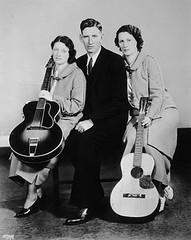
In brief, the Carter family was legendary for their contributions to country and bluegrass genres (including June Carter Cash, Johnny’s wife). According to the book, Homegrown Music: Discovering Bluegrass (2004), “Husband and wife, A.P. and Sara Carter, along with Sara’s cousin, Maybelle Carter, carried music from their southwest Virginia homeplace to a new national audience. They shared the music they grew up with in their families and community, messages and themes that touched hearts and souls everywhere.” Given the rise (and some scholars argue, the birth of) country music in the southern Appalachians around District 12 territory, it makes sense that Collins is tying the history of early 20th-century country music to this region.
Also contributing to the Carters’ budding musical fame was Maybelle’s unique style of guitar playing. Hers was a technique which came to be immortalized as the “Carter scratch.” Basically, this involved her striking one string as the lead note with her thumb while brushing the other strings with her index finger. Since then, guitar players everywhere have sought to imitate her trademark technique.
Despite the challenge of comprehending the song’s words within the Ballad film, the snappy Carter Family staple can be heard in its full glory on the movie soundtrack of songs or on YouTube. Ten-year-old musician Josie Hope Hall provides the delightfully lively singing voice for Maude Ivory in the film and on the soundtrack. Though actress Vaughan Reilly plays Maude Ivory, it is Josie Hope who sings lead on the number. According to their web site, she and her two older sisters comprise the Bennett Hall Band, which performs all around the middle Tennessee region and beyond. Josie Hope is a regular, real-life Maude Ivory, competent as she is on the drums, ukelele, tambourine, and in “killer solo and sibling harmony.” It is to everyone’s benefit that Ballad producers discovered her talents for this upbeat role. (Fun Easter egg in Ballad: One Peacekeeper says to the other, “Who was that girl you were dancing with?” He responds, “I think her name was Josie.” Could this be a shout-out to the actual singer of this number?)
Did You Know? Molly Tuttle, who played the guitar for the Ballad film numbers, wrote, “Fun fact: guitar I recorded with is the same one that you see [Rachel Zegler] play in the movie.” She explains the guitar was inspired by the archtop Gibson model once played by Maybelle Carter of the famed Carter Family.
(Photo: A.P., Sara and Maybelle Carter in their early years. Credit: jean-christophe salad, Creative Commons)
Clementine, Gold Mining and District 12
(NOTE: Spoiler Alert for The Ballad of Songbirds and Snakes).
Probably one of the more recognizable songs we enjoy in The Ballad of Songbirds and Snakes is one that Maude Ivory adores (and one that bugs Coriolanus to no end): “Oh My Darling, Clementine”. I didn’t know much about the song’s background and how it might relate to the book/series, so I naturally researched a few intriguing aspects for those interested. One connection between the song and District 12 makes immediate sense, that of mining. Even Suzanne Collins chose to provide two verses of the song in the actual text (p. 431 in my hard copy), which includes “Excavating for a mine, dwelt a miner, forty-niner”. Curiously, the song thus refers to the California Gold Rush, not coal mining in D-12, which may raise some eyebrows (including mine initially). The “forty-niner” reference gives it away, of course, meaning the Gold Rush of 1849. Those who participated in some way were known generally as “forty-niners”. Beyond this, here is more of the story…
The song is considered an important western “folk ballad,” which provides yet another rationale for Collins’ decision to include it. Generally, a ballad is a song that tells a story, and the ballad tradition heavily influenced the southern Appalachians and its music during the 1700s and 1800s with British immigrants (mainly English and Scots-Irish). But the lyrics of this ballad of Clementine is actually attributed to Percy Montrose around 1884 (though not entirely confirmed), and one author claims that it was an old Spanish ballad that Mexican miners made popular during the Gold Rush. One reputable web site with the song’s lyrics (see below) includes 8 verses of the song (not including the repeated chorus, which Maude Ivory enjoys shouting). So, there are at least two clear connections between the song and Hunger Games, those of “mining” and its “ballad” form. But wait, there’s more!
The typical focus of District 12 in the series is on coal. No problem, as the connections between coal, District 12, and the entire Collins series runs “deep” (pun intended). But what about gold mining and California? Well, I really don’t know if Collins considered this, but here we go: First, before there was coal mining in the “real” D-12 area of the Appalachians, there was gold! America’s first gold rush occurred not in California but within the southern Appalachians (D-12 area), particularly western North Carolina and north Georgia beginning in 1829. The rush came to a crashing end only in 1849 when California became the next great hope of striking it rich. So, there’s that–the gold-rush heritage of the D-12 region. But then, guess where a high percentage of the CA Gold Rush “forty-niners” migrated from in the first place? Yes, southern highlanders from North Carolina and Georgia, often accompanied by slaves, as they had been in the Appalachians as well. A good proportion of the CA forty-niners therefore were Appalachian transplants (either by choice or not).
With all this, I wonder if Collins intended some further symbolic connection between the gold-colored mockingjay pin, the gold bangles (Catching Fire), and of course her hair… In any case, there seems to be an underlying “gold” theme running through the series, and now it shows up again with Clementine. I am not sure yet what Collins had in mind, but it would surprise me if she was not aware of much of this history and connection.
One decent site for the full lyrics of Clementine can be found here.
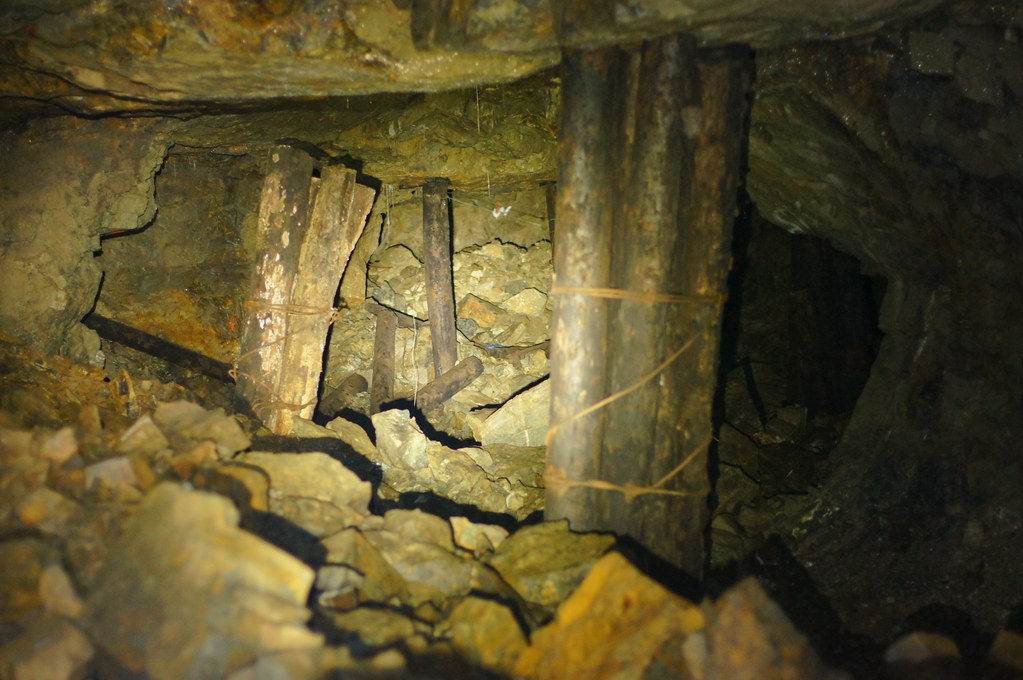
(Photo: Inside an old gold mine. Credit: tiflex2, Creative Commons)
Meet the Author
 Tom Paradis

This site inspired by a first-year seminar on the Hunger Games at Butler University.

 The World of Panem