The World of Panem
Interpreting Society, Geography, and Characters of the Hunger Games
Down the Mutt Berm: Sunrise Parallels with Alice in Wonderland
by Riley Turner, guest author and Anthropology student at Butler University
Suzanne Collins’ second prequel to the Hunger Games trilogy may be the boldest title in the series yet. Haymitch’s story takes readers for a wild ride with many twists and turns, including its vibrant, 70s-inspired Capitol, its enchanting, yet deadly 50th Games arena, its wide cast of characters that boasts both familiar and unfamiliar faces, and its insane world-building. With how dark, gory, and gut wrenching this dystopian novel can get, it therefore may seem farfetched to compare it to Lewis Carroll’s Alice’s Adventures in Wonderland (1865). After all, the latter is a fantastical tale that was originally meant for children, while the former is primarily aimed at young adults and teenagers. However, taking a closer look at Haymitch’s journey brings up many parallels that cannot be overlooked. Whether these were intentional by Suzanne Collins or not, they are begging to be brought to the attention of the fan base. With that being said, let’s dive into the rabbit hole, or mutt berm, of parallels that exist between these two stories.
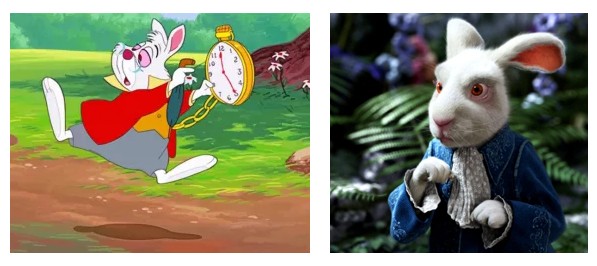
To begin, let’s talk about one of Alice in Wonderland’s most well-known plot points: Alice following the white rabbit and falling down the rabbit hole into Wonderland. This marks the start of Alice’s wacky adventure, and the ensuing events of the book would not have transpired if this didn’t happen. While Haymitch doesn’t have this exact experience in Sunrise, many parts of his journey are surprisingly similar. For one thing, rabbits are also significant to Haymitch, albeit dove-colored ones. Just like Alice encounters the white rabbit multiple times throughout her story, Haymitch comes upon the dove-colored rabbits numerous times. He sees one when he first gets into the arena (SOR 211), when he is thinking about drinking from the stream (SOR 217), when he wakes up in the bushes (SOR 223), when he is stuck in the hedge maze (SOR 266), and when he is in the creepy mutt lab after the Games (SOR 329). And most of his encounters with them are quite influential to his story. Seeing the first one at the beginning of the Games gets him to focus, and seeing one die from drinking the stream water alerts him of the poisonous arena. Likewise, the one in the bushes shows him the food in his pack is safe to eat, and another one helps him escape the hedge maze. Finally, the rabbit in the mutt lab makes him realize just how awful of a situation he is in. These rabbits are essential to Haymitch, just as the white rabbit is to Alice.
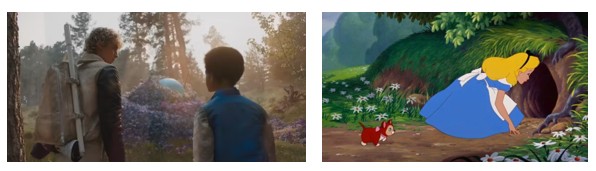
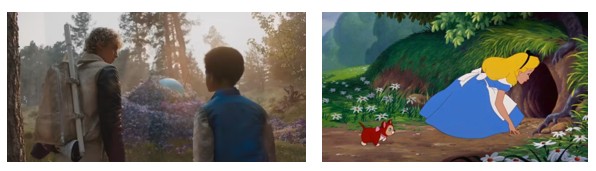
Then, when looking at the rabbit hole that brings Alice into Wonderland, there are two things that are similar in Sunrise. First is the mutt berm, which Haymitch goes down in order to break the arena (SOR 247). Besides also being an unusual hole in the ground, the mutt berm is an important part in the progression of Haymitch’s story, just as the rabbit hole is to Alice’s. Without it, he would not have been able to carry out the carefully-crafted plan to break the arena. The rest of the novel’s events as we know them likely would have been different if Haymitch had not gone down this hole, just like the story of Alice in Wonderland, had Alice not gone down the rabbit hole.
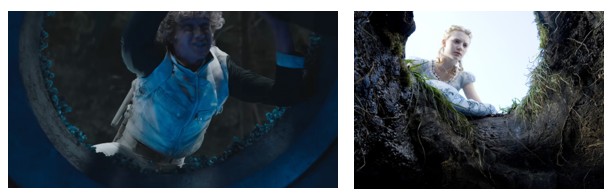
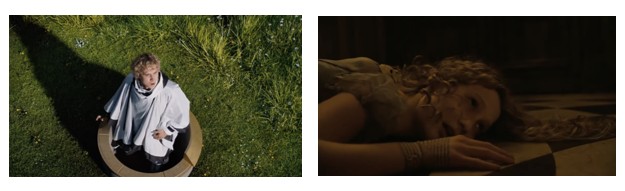
As a side note, this shot of Haymitch opening the mutt berm (below) in the Sunrise teaser trailer looks similar to Alice looking down the rabbit hole in Tim Burton’s live action Alice in Wonderland (2010) movie:
The other Sunrise comparison to the rabbit hole consists of the tribute podium and elevator (SOR 210). It may be bringing Haymitch up into the arena instead of down, but it functions similarly to the rabbit hole in Alice in Wonderland. Both are bringing the protagonist from a familiar world to an unfamiliar one, and returning to the familiar world isn’t an option. Our respective protagonists, Haymitch and Alice, are stuck in strange and mysterious places, and they must use their wits to navigate through them. Haymitch has broken off from the Newcomers alliance at this point as well, making him essentially as alone and friendless in the arena as Alice initially is in Wonderland. Not to mention that in the official Sunrise movie trailer, one of the last shots we see is of Haymitch looking stunned as he rises into the breathtaking arena on his podium, just as Alice is when she falls down the rabbit hole into Wonderland (below).
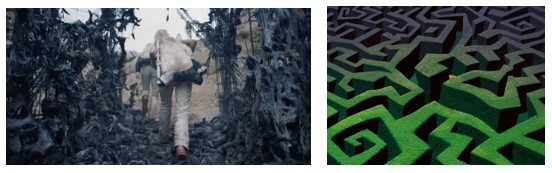
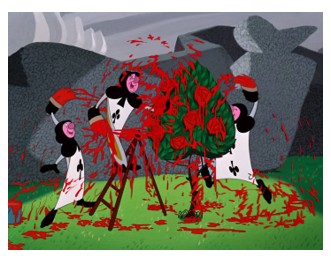
Another setting-related parallel worth discussing is the hedge maze. In Haymitch’s story, there’s one at the very edge of the arena (SOR 264), and in the Disney animated Alice in Wonderland (1951) specifically, the Queen of Hearts’ garden is a labyrinth-like hedge maze. Both are clearly very confusing environments in which the protagonist can easily get lost, but this isn’t the only similarity between them. In Haymitch’s maze, what look like holly berries on the hedge leaves are actually ladybug mutts that will attach themselves to a tribute’s skin, inflate, and explode with their blood (SOR 280). These ladybugs, along with the hedge maze and arena as a whole, were artificially created by the almighty Capitol for the 50th Hunger Games. Somewhat similarly, in the Alice in Wonderland movie, we see three of the queen’s card soldiers painting white roses in her garden red, after accidentally planting white roses instead of red ones. The red roses in the Alice in Wonderland hedge garden are therefore also artificial creations not unlike Haymitch’s environment in Sunrise.
Also worth noting is, within the Alice in Wonderland movie, the Queen of Hearts eventually finds out that those three card soldiers were painting white roses red to cover up their mistake. So, she says, “Off with their heads!” and sends the three of them to be killed for their incompetence. Ironically enough, something similar also happens in Haymitch’s story: three young Gamemakers who, mind you were working for the Capitol, are sent into the arena with armed tributes roaming about in order to fix a mutt berm (coincidentally also covered in red flowers). Whether this was a punishment or just the Capitol viewing its workers as expendable is unknown, but these three also do not make it out of their situation alive. Maysilee and Maritte kill them, with two even dying from head injuries (SOR 297-298). Just like those three card soldiers in the Alice in Wonderland movie, the three Gamemakers in Sunrise die trying to fix something to appease a higher power (the Queen of Hearts and the Capitol, respectfully).
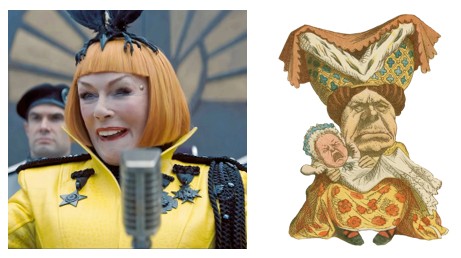
Transitioning now to character parallels, the first noteworthy one is between Drusilla Sickle and a character whose main appearance is in the Alice in Wonderland book: the Duchess. First of all, both characters are described as ugly, older women who are incredibly rude and dismissive of their stories’ respective protagonists. The Duchess is very rude to Alice when she visits her home in Wonderland, while Drusilla treats Haymitch and his fellow tributes as less than human for most of the book. Both characters also shift between their awful attitudes and more tolerable ones. The Duchess is more pleasant when Alice meets her at the Queen of Hearts’ croquet party, while Drusilla is clearly happier when she can sit down and have a drink. She’s also somewhat helpful towards Haymitch when he’s preparing for his interview with Caesar, which surprises him considering her earlier cruelness. Make no mistake though: based on what we see of them in their respective stories, Drusilla seems to be much more of a horrible character than the Duchess. But maybe that’s to be expected. Unlike the Duchess, Drusilla does come from a dystopian world where a death game for children is the norm.
There’s one more small easter egg parallel between these two characters worth mentioning. Remember how Drusilla condescendingly calls Haymitch and his fellow tributes “district piglets?” Well, in Alice in Wonderland, the Duchess has a baby that turns into a piglet in the time that Alice visits her at her home, and she seems to care very little for him. She even mentions beating and speaking severely to him. Does this sound like a certain grumpy escort we know? Why don’t we ask Maysilee?
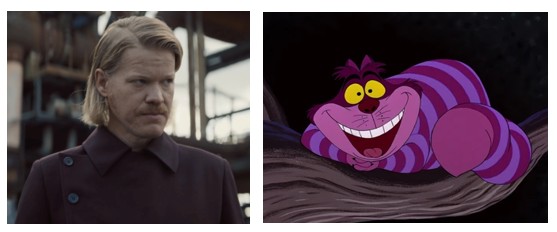
For our next character parallel, we move on to Plutarch and the Cheshire Cat. Not only is Plutarch wearing a violet jumpsuit when he first appears in Sunrise — the same color as the Cheshire Cat’s fur in the Disney film — but both characters are relatively neutral in the eyes of our protagonists. The Cheshire Cat stays out of most of the drama in Wonderland, while Plutarch is involved with both the rebels and the Capitol. This makes their alignment in their respective stories different, but they still leave both Alice and Haymitch questioning: “Whose side is this guy really on?” Both characters are also constantly surprising and confusing their respective protagonists with their actions. The Cheshire Cat fades in and out of existence and gives confusing answers to Alice’s questions, while Plutarch can be waiting hand and foot on President Snow one second and talking to Haymitch about rebellion the next. However, both the Cheshire Cat and Plutarch do prove to be helpful characters. The Cheshire Cat reveals to Alice the ways to reach the Mad Hatter, March Hare, and Queen of Hearts, while Plutarch gives Haymitch clues about the arena’s sun and mutt berms. So, while they might seem strange in the eyes of our protagonists, both characters clearly possess the means to assist them if they so choose.
One more notable aspect of this character parallel calls back to the Duchess and Drusilla. In the Alice in Wonderland book, the Cheshire Cat is technically the Duchess’s cat. He’s her pet. In an ironically similar vein in Sunrise, Plutarch almost acts like Drusilla’s loyal pet when he’s around her. He answers to her at the reaping, acting a lot like a cartoon villain’s little minion, and he showers her with compliments about her appearance and performance on the tribute train. Just like the Cheshire Cat, Plutarch does end up being his own complex character for the rest of Haymitch’s story. However, his actions around Drusilla at the beginning, not to mention his quick thinking and cool demeanor, really make him seem like her own loyal cat.
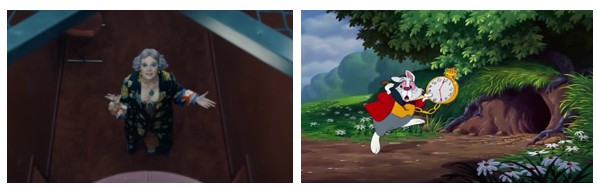
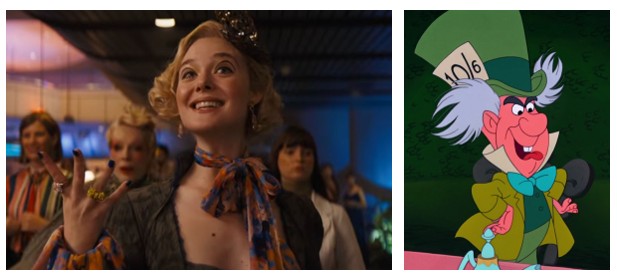
Finally for character parallels, we move on to Effie Trinket. In both the original Hunger Games trilogy as well as Sunrise, she has traits that can be attributed to two different Alice in Wonderland characters: the White Rabbit and the Mad Hatter. To start with her parallels to the White Rabbit, both characters are very concerned with punctuality. It’s very important to both of them that they get to where they are scheduled to be, though the White Rabbit definitely needs to work on actually being on time much more than Effie. Also, similarly to the White Rabbit being the character associated with Alice’s journey from the real world to Wonderland (following him down the rabbit hole), Effie can be seen in a similar vein for both Katniss and Haymitch. In the trilogy, Effie is the first character that Katniss (by extent the readers) meet from the eccentric Capitol (THG 17). Her unusual appearance, personality, and attitude are our first impressions of this strange place beyond District 12, just like how a talking rabbit with a waistcoat and pocketwatch are Alice’s first impression of Wonderland. As for Effie’s character in relation to Haymitch, she is the last person he sees before he rises up on his podium into the arena (SOR 210). Considering what I discussed earlier about how this podium can be seen as a parallel to the rabbit hole, Effie being there for Haymitch is similar to having his very own White Rabbit.
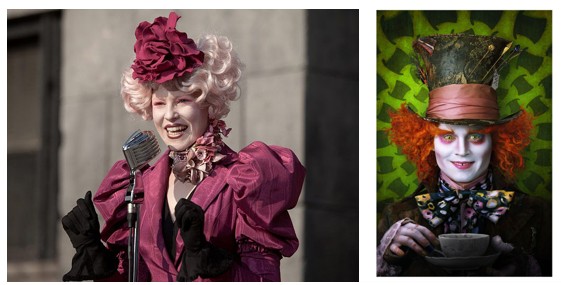
Effie further shares traits with the Mad Hatter. The most notable parallel comes from their physical appearances. Both characters dress very eccentrically, wearing bright colors and exaggerated clothing and accessories. And for these characters, it’s what they’re wearing on their heads that matters most. While the Mad Hatter’s most vital accessory is not surprisingly his hat, Effie takes most pride in her large collection of brightly colored wigs. Also of note is Effie’s “scary white grin” that Katniss describes in the original Hunger Games novel (17-18), which is a fitting description for how the Mad Hatter looks in Tim Burton’s live action Alice in Wonderland movie. Both characters have pale skin and vibrant makeup, and the Mad Hatter’s orange hair even matches the description of Effie’s wig in Catching Fire: pumpkin orange (40). Overall, these two characters are quite similar when it comes to their appearances, and the Mad Hatter certainly would fit right in with the bold fashions of the Capitol!
Besides their appearances, both Effie Trinket and the Mad Hatter are talented when it comes to dressing other characters. Effie saves the day in Sunrise by styling the District 12 tributes in Great Aunt Messalina and Great Uncle Silius’s black clothes. Likewise, in multiple iterations of Alice in Wonderland, the Mad Hatter makes hats and sells them to others. In the Tim Burton movie specifically, the Mad Hatter even makes a small dress for Alice to wear after she shrinks in size. Both Effie and the Mad Hatter are clearly quite crafty and generous when it comes to sharing their skills, but that’s not all they have in common. Personality-wise, both characters can be quite eccentric, which makes sense due to Effie being from the Capitol and the Mad Hatter from Wonderland. However, they have also shown themselves to be kind and welcoming. The Mad Hatter is friendly and helpful towards Alice during her time in Wonderland, while Effie tries to help Katniss, Peeta, and Haymitch feel better about their involvement in the Hunger Games (albeit often to the annoyance of Katniss in particular). Though they may be just as wacky as many other Capitol and Wonderland residents, at least Effie and the Mad Hatter choose to be kind to and help our protagonists in their own ways.
With that, I’ve covered some important parallels between Sunrise on the Reaping and Alice in Wonderland, or at least the ones I was able to recognize. Still, a case can be made for a variety of smaller or less significant parallels as well, though they may not warrant their own section here. Let’s take a brief look at a few to consider:
- Maysilee’s character has a few Alice in Wonderland-esque traits. She’s a blond, well-mannered young girl just like Alice; she also has to survive in the Wonderland-like arena; she has a twin, which could be a loose connection to twins Tweedle-Dee and Tweedle-Dum in the Alice in Wonderland story; and her use of table setups in the arena makes their meals resemble the Mad Hatter’s unbirthday tea party in the woods. While Haymitch is definitely our “Alice” in our comparisons between the two books, there’s no denying that Maysilee shares a few traits characteristic of her and her story as well.
- Wellie’s death, which involves her getting beheaded by Silka (SOR 323), calls back to the Queen of Hearts’ favorite method of execution: “Off with their heads!”
- During Haymitch and Silka’s fight at the end of the 50th Games, Haymitch severely injures her by gouging out her eye with his knife (SOR 325). In Tim Burton’s Alice in Wonderland movie, the Dormouse injures a large beast called the Bandersnatch by gouging out its eye. Neither injury kills the characters; it only serves to make them angrier. Ironically, while the human girl Silka ends up dead with an axe to her head (SOR 326), the Bandersnatch beast stays alive, gets its eye back, and becomes docile.
- The rolls and milk that President Snow gives Haymitch as his only food after the Games (SOR 331) could be seen as a parallel to the Eat Me! cookies (cake in the Tim Burton film) and Drink Me! drink that Alice is confronted with in Wonderland. Both are mysterious, yet enticing to our protagonists: Alice because her items literally say to eat and drink them, and Haymitch because they are the only things available to eat and drink.
- When the Queen of Hearts is playing croquet, she is often depicted using a long-necked, large/long-beaked pink bird as a mallet and a hedgehog as a ball. Both of these animals appear as mutts in the 50th Hunger Games: the long-necked, long-beaked pink birds are what kill Maysilee (SOR 306-307), and similar to a hedgehog, a porcupine mutt that shoots poisonous quills out of its back is battled by Haymitch and Maysilee (SOR 286). Ironically enough, in both stories, the ones in power are using these animals for the same reason: to play their own game. The Queen of Hearts is using them to play croquet and the Capitol is using them as obstacles and entertainment in the Hunger Games.
- The video games American McGee’s Alice (2000) and Alice Madness Returns (2011), which reimagine the story of Alice in Wonderland with darker and more disturbing settings, characters, and themes, involve Alice becoming traumatized after her whole family dies in a house fire. This is also how Haymitch’s family is killed by President Snow, and it’s one of the many reasons for his trauma that lasts through the trilogy (SOR 354).
Perhaps these small comparisons are a stretch; tiny similarities that exist purely by coincidence. After all, we don’t truly know if the story of Alice in Wonderland served as inspiration for any of the aspects of Sunrise on the Reaping, as Collins hasn’t mentioned anything related to this topic of which I am aware. Were the aforementioned parallels, including the larger ones, intentional references to Alice in Wonderland, or are we looking at two unrelated stories about protagonists getting thrust into strange, unknown worlds? Well, considering that Collins did take inspiration from Alice in Wonderland for her earlier Underland Chronicles (see Klein article), it’s far from out of the question. For now though, we can both enjoy and continue to analyze the Sunrise on the Reaping novel, as well as eagerly await the upcoming movie. Haymitch’s story is truly a wild one that fans are curious to learn more about, and only time will tell what the future holds for this thrilling series.
Meet the Author
 Tom Paradis

This site inspired by a first-year seminar on the Hunger Games at Butler University.