The World of Panem
Interpreting Society, Geography, and Characters of the Hunger Games
Unpacking David Hume’s “Implicit Submission”: How He Might Critique Songbirds and Snakes and the Social Contract
Warning: Spoilers ahead for Sunrise on the Reaping
No more implicit submission for you, Haymitch Abernathy.
Plutarch Heavensbee (SOR 197)
It appears that Collins’ fundamental message in her second prequel can be boiled down to two words: implicit submission. This concept first appears in the novel’s opening epigraph of quotes, a practice she began with Songbirds and Snakes. Compared to her more subtle integration of Enlightenment thinkers into her first prequel, however, it seems that this time she flipped the script. Perhaps she tired of too many readers missing her intended lessons. Now leaving nothing to chance, she virtually smacks us over the head with a Maysilee slap, over and over again. Both Haymitch and Plutarch openly discuss “implicit submission” at points throughout the story, directly pulling in David Hume’s now famous two-word phrase. Lest we forget, a reminder:
Nothing appears more surprising to those, who consider human affairs with a philosophical eye, than the easiness with which the many are governed by the few; and the implicit submission, with which men resign their own sentiments and passions to those of their rulers. When we enquire by what means this wonder is effected, we shall find, that, as Force is always on the side of the governed, the governors have nothing to support them but opinion…”
David Hume, 1741, “Essays, Moral and Political”
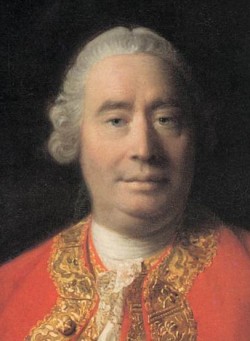
Basically Hume (1711-1776) was asking how it is possible for a few powerful individuals to almost effortlessly manage and control a massive population, with little or no pushback. This is astonishing, he believed, because — as he continues above — the real power is found in those who are being governed. Those in charge are basically living in a hall of mirrors, or a glass house that could come crashing down quickly. That is, if the general population did not implicitly submit to being governed by the few.
Hume points out that the overwhelming numbers of a population could theoretically topple any government rather quickly. Instead, his own observations and historical studies revealed that the public typically accepts their leaders with tacit consent. This is true within autocratic dictatorships and the most liberal democracies alike. For those of us tempted to believe this lack of collective willpower is a recent phenomenon, Hume was already questioning these political power dynamics well before the birth of the United States and its democratic experiment.
So, Collins decided to emphasize in Sunrise that the masses could theoretically rebel—peacefully or otherwise—to overthrow their leaders at any time. The question is, why don’t they? (Or, to better reflect on our own society, why don’t we?) She deftly asks this question by focusing on the experiences of poor Haymitch, who can’t seem to catch a break. He is pressed by numerous others in his life — namely Lenore Dove, Plutarch, Maysilee, and even Willamae, his mother — to stand up for something, to act in defiance against the Capitol in some way, to fight the temptation to implicitly submit. In one prominent case, Plutarch gives his own directive to Haymitch in the following narrative:
“…One last thing. From the Capitol’s perspective, the Games are the best propaganda we have. You tributes, you’re our stars. You carry it out. But only if we control the narrative. Don’t let us.” Plutarch grasps my shoulders and gives me a little shake. “No more implicit submission for you, Haymitch Abernathy. Blow that water tank sky high. The entire country needs you to.” (SOR 197)
Haymitch more often than not descends into fits of guilt because he can’t or won’t stand up for his values. But sometimes he does just that, succumbing to occasional pangs of courage and a burning desire to do the right thing. For much of the story, Haymitch remains conflicted about what he should be doing, asking himself the hard questions that Collins hopes we will ponder as well.
Such deeply philosophical questions are not just a sideshow to Collins, but instead become the central focus of her story. In her exclusive interview for the Barnes & Noble edition of Sunrise, she immediately responds to Scholastic’s David Levithan about her primary goal: “If all people do is read the full Hume quote and discuss it, this book has been a win for me. This quote invites so many questions. Like, ‘Do you think Hume is right? As human beings, do we ultimately end up being governed by a few people? Not just in, say, a totalitarian state, but in a democracy?” Collins continues to ask why we have resigned ourselves to being ruled by a small number of leaders, along with the role of propaganda:
Why are we implicitly submitting to this? Especially since force is on our side, as the governed. Hume answers that for us. We’re allowing ourselves to be controlled by “opinion.” And that’s where propaganda comes in. All right, then, “What propaganda do we all consume on a daily basis that maintains this status quo? Is it harder to maintain in an autocracy or a democracy where we pride ourselves on our intellectual or political freedom? How much propaganda does it take to make you think that implicit submission is what you want? Is it inevitable? Is there a way to protect ourselves against it? What would that entail?”
Suzanne Collins, Interview with David levithan (B&N)
For Haymitch’s part, Collins introduces her lead character to the influences of propaganda in dramatic fashion. He is astonished and horrified about how Snow and the Capitol are controlling the narrative of the 50th Games and his role within it. He learns that he holds no individual power to authentically tell his own story. Indeed, this is how President Snow and his supporters have manipulated public opinion about the Games, through the blatant falsehoods of a controlled narrative.
Ampert’s Answer to Implicit Submission
Then there’s little Ampert Latier, who demonstrates admirably that the true power of a population lies with the many over the few. Or to say it more in Hume’s terms, “Force is always on the side of the governed.” Ampert’s ambitious goal is to assemble a growing alliance of “Newcomers”—as the courageous youngsters decide to call themselves after Haymitch’s suggestion. At Haymitch’s prodding, he explains his reasoning while taking impressive leadership of the group: “It’s like this,” he begins, “A disproportionate amount of the time, the Careers win. But they’re only one quarter of the tributes. We’ve got three times their numbers. So the idea is, we get the rest of us together and, for a change, we hunt them down instead of letting them hunt us” (113). Haymitch then silently realizes that the districts actually outnumber the Capitol by “far more than three to one.” Ampert continues, “We don’t have to buy into their mind game, that somehow they will always defeat us… Everyone acts like the odds aren’t in our favor, but I’m sure we can beat those odds.” Essentially Ampert is refusing to implicitly submit to the propaganda and expectations of the Capitol. He is making Hume’s point that the power actually lies with the governed, as they far outnumber those in charge.
This message becomes a running thread throughout the 50th Games, as Haymitch and friends keep occasional tallies of remaining Newcomers and Careers. Ampert’s efforts represent the first step to collaboration among the districts that will eventually occur more formally during Katniss’ time. A similar alliance forms during the 75th Games, with a good number of them leading the way into actual rebellion.
Collins emphasizes the role of Ampert and the Newcomers later in her extensive interview with David Levithan (B&N edition). She explains, “Ampert’s laying the groundwork for the rebellion later with the district alliance in the third Quarter Quell. It’s a work in progress. Even in the trilogy, we’re well into the war before the rebels finally get all the districts on board. But Ampert’s message wins out. ‘We don’t have to put up with living under the Capitol’s rule. We have greater numbers, more power, more strength. We can change our lives.'” Ampert’s Newcomers can thus be interpreted as Hume reincarnate. His leadership ultimately unifies many of the tributes to defy a common enemy and — in turn — to resist the temptation to implicitly submit to authority.
And, of course, Ampert’s focus on power in numbers provides a running purpose for Wyatt Callow’s character arc. He becomes indispensable with calculating the odds of success or failure at a moment’s notice. It is in these ways that Ampert and Wyatt demonstrate how we can all take Hume’s central idea to heart. Ideally, submitting blindly to a few powerful leaders is not necessary, as the population truly holds the power. At first, even Haymitch remains unconvinced, as he suspects that his “ally days began and ended with Louella.” (SOR 85) But Ampert persists in his diplomatic quest, eventually bringing the total Newcomer count to twice that of the Careers. Wyatt can live with those odds, at least for now.
Hume’s Rebuttal to Social Contract Theory — and to Songbirds and Snakes
What is not so obvious in Collins’ latest prequel is how Hume disputed the more popular social contract theory favored by numerous peers. Hume’s thinking about implicit submission was actually out of the mainstream and remains so to this day. He was one of the most critical toward the idea that people will willingly give up some basic human freedoms in exchange for the security and laws provided by a central government. The notion of a social contract between the governing and the governed was promoted widely by fellow philosophers of the time, especially by Thomas Hobbes, John Locke, and Jean-Jacques Rousseau. The concept eventually became the cornerstone of contemporary democracies—not the least being that of the United States. It is especially John Locke’s more optimistic view of human nature and his own social contract theory that served as the model for the US Constitution.
Readers of Songbirds and Snakes might recognize Locke, Rousseau, and Hobbes from that prequel’s own epigraph of quotes. Collins essentially created avatar-like characters to embody their differing philosophies on human nature and preferences for various governing structures. Her avatars should be quite familiar from the first prequel, namely Coriolanus Snow (speaking for Hobbes), Lucy Gray Baird (speaking for Rousseau), and Sejanus Plinth (speaking for John Locke). In brief, Collins devotes much of their dialogue to compare differing philosophies on human nature. To the chagrin of many, it is Snow—with his dark, Hobbesian worldview—who “lands on top,” at least for now. (See this post for more interpretation of Ballad’s three philosophers.)
As emphasized in Songbirds & Snakes, the “big three” philosophers and their avatars demonstrated vast contrasts between their own personal views of human nature and effective government. But Hobbes, Locke, and Rousseau held one fundamental belief in common. They presumed that humans were overall rational beings and could make collective decisions that made logical sense. That is, people are rational enough to consciously buy into a social contract with a governing institution to secure their own peace and safety.
Hume was not having any of that, however. He argued in his Treatise of Human Nature (1739) that “Reason is, and ought only to be, the slave of the passions.” That is, humans were little different from Greek gods: both irrational and incapable of establishing consensus governments through the collective voice of reason (Gongqing, et. al, 2025). He viewed the social contract as “historical fiction,” a mental fabrication that inaccurately attributed the formation of governments to collective consent. Rather, he noted in the historical record that political institutions originate and evolve out of various sudden or long-term processes. These could include anything from outright invasion and conquering to gradual usurping of power over time. There is no “social contract,” but more so an uncontrolled evolution of events and decisions that mold a governing body.
At least for purposes here, the notion of Hume’s “implicit submission” becomes all the more fascinating when we realize that his observation is based on his rejection of the social contract theory. Humans are not rationally surrendering some rights to a new government to protect them through rational laws, he believed, but are rather simply submitting to a central authority without their collective consent. The form of the governing institution itself (from democracy to autocracy) is irrelevant. In Suzanne Collins’ fictional world of Panem, therefore, her first prequel rested on the notion of the social contract and the vast array of forms it can take. In contrast, Sunrise on the Reaping moves into an entirely different direction. Now she provides a voice to Hume’s rebuttal, encouraging readers to ask why the many so willingly submit to the few. It was Hume’s central question and—thanks to Collins—is ours now as well.
Sources:
The Basics of Philosophy: David Hume
Stanford Encyclopedia of Philosophy: David Hume
The Socratic Method: David Hume
Gongqing, Li, et. al., 2025. “Hume’s doubts about politics: A critique and reimagining of Social Contract Theory.” Journal of Politics and Law, Vol. 18, No. 2.
2 Comments on “Unpacking David Hume’s “Implicit Submission”: How He Might Critique Songbirds and Snakes and the Social Contract”
Leave a comment
Meet the Author
 Tom Paradis

This site inspired by a first-year seminar on the Hunger Games at Butler University.

 The World of Panem
Pingback: Pa Abernathy’s Big Metaphor: Painting Posters and Reclaiming the Narrative – The World of Panem
Pingback: Decoding the Sunrise Title: David Hume’s Other Lesson – The World of Panem